Level:
Correct: 0
Incorrect: 0
Marks: 0/0
Exam Practice
Course:
Topics:
OCR GCSE Maths (Higher calculator) Smart practice A mixed round aimed at your weak spots
Unit 1
Number Operations and Integers
Unit 2
Fractions, Decimals and Percentages
Unit 3
Indices and Surds
Unit 4
Approximation and Estimation
Unit 5
Ratio, Proportion and Rates of Change
Unit 6
Algebra
Unit 7
Graphs of Equations and Functions
Unit 8
Basic Geometry
Unit 9
Congruence and Similarity
Unit 10
Mensuration
Unit 11
Probability
Unit 12
Statistics
Avg
score:
–
Topics
done:
0/121

Circle theorem: angles in the same segment

Practise 13 exam-style questions on Circle theorem: angles in the same segment for OCR GCSE Maths (Higher calculator). Write your answer as you would in the exam and get it marked in seconds against the mark scheme, point by point, with the Study Helper on hand if you get stuck.

  • 13 questions
  • 1–5 marks each
  • Instant marking
  • No sign-up needed
13 questions, marked as you go

Sample questions with model answers

Here are 4 of the questions in this topic, each with a model answer, an explanation of why it earns the marks and the mark scheme an examiner would use.

Question 1

3 marks

The diagram shows a circle.
A, B, C and D are points on the circumference.

AB = 6.1 cm, BC = 4.9 cm and angle ABC = 90°.

Show that angle BDC = 38.8°, correct to 1 decimal place.
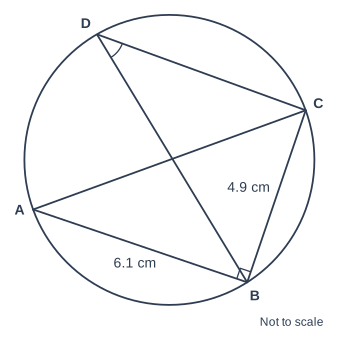
Geometry diagram, marked "Not to scale". A circle; A, B, C and D lie on it, in that order going anticlockwise. Triangle ABC. Line segments DB and DC are drawn. Angle ABC is marked as a right angle (90°). Side AB is labelled 6.1 cm. Side BC is labelled 4.9 cm. Angle BDC is marked with a single arc.

Model answer

In the right-angled triangle ABC, BC is opposite angle BAC and AB is adjacent to it.
\(\tan BAC = \dfrac{4.9}{6.1} = 0.8032...\)
Angle BAC = 38.774...°
Angle BDC and angle BAC both stand on the arc BC, and angles in the same segment are equal, so
angle BDC = 38.774...° = 38.8° (1 d.p.)

Explanation

You cannot find angle BDC directly, but angle BAC is in the same segment (both stand on the arc BC), so the two angles are equal. Triangle ABC is right-angled at B, so tangent gives angle BAC. In a 'show that' question, show the value to more decimal places than the one you are given.

Mark scheme
  1. 1 mark

    M1 for \(\tan BAC = \dfrac{4.9}{6.1}\) oe

    Accept any equivalent method, e.g. AC = \(\sqrt{6.1^2 + 4.9^2}\) (= 7.82...) then \(\sin BAC = \dfrac{4.9}{AC}\). All values in this mark are exact values from the question.

  2. 1 mark

    A1 for angle BAC = 38.77...

    Accept 38.77 to 38.78, or better. A value with more than 1 decimal place must be seen, because 38.8 is given.

  3. 1 mark

    B1 for angle BDC = angle BAC because angles in the same segment are equal

    Accept 'angles subtended by the same arc (BC) are equal' or 'angles at the circumference standing on the same arc are equal'. Do not accept 'angles in the same section' or 'bow tie angles'. Answer only scores 0.
Question 2

3 marks

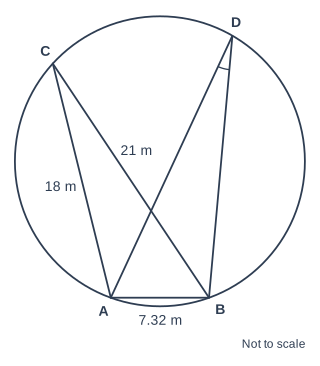
The diagram shows the goalposts, A and B, of a football goal, viewed from above.
The goalposts are 7.32 m apart.
A player stands at C, 18 m from A and 21 m from B.

A second player stands at D, on the circle through A, B and C, on the same side of AB as C.

Work out the size of angle ADB.
Give your answer correct to 1 decimal place and give a reason for your answer.

Geometry diagram, marked "Not to scale". A circle; A, B, D and C lie on it, in that order going anticlockwise. Triangle ABC. Line segments DA and DB are drawn. Side AB is labelled 7.32 m. Side AC is labelled 18 m. Side BC is labelled 21 m. Angle ADB is marked with a single arc.

Model answer

Cosine rule in triangle ABC:
\(\cos ACB = \dfrac{18^2 + 21^2 - 7.32^2}{2 \times 18 \times 21} = \dfrac{711.4176}{756} = 0.94103...\)
Angle ACB = 19.774...°
Angles ACB and ADB are both subtended by the chord AB, with C and D in the same segment.
Angles in the same segment are equal, so angle ADB = 19.8° (1 d.p.)

Explanation

The angle between a player's lines of sight to the two goalposts is the angle at the circumference subtended by AB. Every player on the same arc of the circle through A, B and C sees the goal at the same angle, because angles in the same segment are equal. So find angle ACB with the cosine rule.

Mark scheme
  1. 1 mark

    M1 for \(\cos ACB = \dfrac{18^2 + 21^2 - 7.32^2}{2 \times 18 \times 21}\) oe

    The lengths are exact values from the question. May be implied by \(\cos ACB = 0.941\) (accept 0.941 to 0.9411).

  2. 1 mark

    A1 for angle ACB = 19.8

    Accept 19.77 to 19.8. The full value is 19.774... More accurate answers are accepted.

  3. 1 mark

    B1 for angle ADB = their angle ACB because angles in the same segment are equal

    FT their angle ACB. Accept 'angles subtended by the same chord / arc AB are equal'. A correct answer of 19.8 for angle ADB with no reason scores M1 A1 B0.

Question 3

4 marks

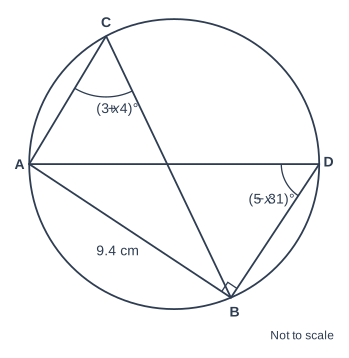
The diagram shows a circle.
A, B, C and D are points on the circumference.

Angle ACB = \((3x + 4)^\circ\) and angle ADB = \((5x - 31)^\circ\).
Angle ABD = 90° and AB = 9.4 cm.

Calculate the length of AD.
Give your answer correct to 3 significant figures.

Geometry diagram, marked "Not to scale". A circle; A, B, D and C lie on it, in that order going anticlockwise. Triangle ABD. Line segments CA and CB are drawn. Angle ACB is marked (3x + 4)°. Angle ADB is marked (5x − 31)°. Angle ABD is marked as a right angle (90°). Side AB is labelled 9.4 cm.

Model answer

Angle ACB and angle ADB both stand on the arc AB, so they are equal (angles in the same segment are equal).
\(3x + 4 = 5x - 31\)
\(35 = 2x\)
\(x = 17.5\)
Angle ADB = \(5 \times 17.5 - 31 = 56.5^\circ\)
In the right-angled triangle ABD, AB is opposite angle ADB and AD is the hypotenuse.
\(\sin 56.5^\circ = \dfrac{9.4}{AD}\)
AD = \(\dfrac{9.4}{\sin 56.5^\circ} = 11.272...\)
AD = 11.3 cm (3 s.f.)

Explanation

Set the two angles in the same segment equal to find x, then work out angle ADB itself. Triangle ABD has a right angle at B, so AD is the hypotenuse and AB is opposite the 56.5° angle: use sine. Check that 3x + 4 gives 56.5° as well.

Mark scheme
  1. 1 mark

    M1 for \(3x + 4 = 5x - 31\) oe

    Angles in the same segment are equal. An equation adding the angles to 180 scores M0; correct answer with no working scores full marks

  2. 1 mark

    A1 for \(x = 17.5\) or angle ADB = 56.5°

    17.5 and 56.5 are exact values.

  3. 1 mark

    M1 for \(AD = \dfrac{9.4}{\sin 56.5}\) oe

    FT their angle ADB. AB is opposite angle ADB and AD is the hypotenuse. Accept any equivalent method.

  4. 1 mark

    A1 for 11.3

    Accept 11.27 to 11.3 (cm). The full value is 11.272... More accurate answers are accepted. 6.22 (from 9.4 ÷ tan 56.5, which is BD) scores M1 A1 M0 A0. A correct answer with no working scores 4 marks.

Question 4

4 marks

The diagram shows a circle.
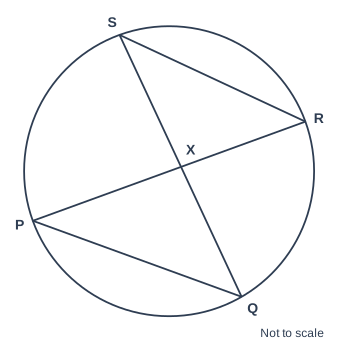
P, Q, R and S are points on the circumference.
The chords PR and QS cross at X.

Prove that \(PX \times XR = QX \times XS\).

Geometry diagram, marked "Not to scale". A circle; P, Q, R and S lie on it, in that order going anticlockwise. Line segments PR, QS, PQ and SR are drawn. X lies on PR and QS.

Model answer

Angle QPX = angle QPR and angle RSX = angle RSQ both stand on the arc QR, so angle QPX = angle RSX (angles in the same segment are equal).
Angle PXQ = angle SXR (vertically opposite angles are equal).
So triangles PQX and SRX are similar, with P corresponding to S, Q to R and X to X.
Corresponding sides are in the same ratio:
\(\dfrac{PX}{SX} = \dfrac{QX}{RX}\)
Multiplying both sides by \(SX \times RX\):
\(PX \times XR = QX \times XS\)

Explanation

This is the intersecting chords theorem. Angles in the same segment give one pair of equal angles, and vertically opposite angles give another, so the triangles PQX and SRX are similar. The hard part is matching the corresponding sides: PX in one triangle goes with SX in the other, because P and S are the vertices with equal angles.

Mark scheme
  1. 1 mark

    B1 for angle QPR = angle QSR (angle QPX = angle RSX) because angles in the same segment are equal

    Both angles stand on the arc QR. The reason is needed. Accept angle PQS = angle PRS (both on arc PS) instead.

  2. 1 mark

    B1 for a second pair of equal angles with a reason, e.g. angle PXQ = angle SXR because vertically opposite angles are equal, or angle PQS = angle PRS because angles in the same segment are equal

    The reason is needed.

  3. 1 mark

    M1 for stating that triangles PQX and SRX are similar, and writing a correct ratio of corresponding sides, e.g. \(\dfrac{PX}{SX} = \dfrac{QX}{RX}\)

    The correspondence must be correct: P with S, Q with R, X with X. A ratio from the wrong correspondence (e.g. \(\dfrac{PX}{RX} = \dfrac{QX}{SX}\)) scores M0.

  4. 1 mark

    A1 for rearranging to \(PX \times XR = QX \times XS\) to complete the proof

    All previous marks needed. A proof using measured or invented lengths scores 0. Answer only scores 0.

Ready to try the rest? Every answer you write is marked against the mark scheme, so you can see exactly where the marks are.

Study Helper Hints first, answers after you try

Stuck on this one? Ask for a hint and I’ll point you in the right direction, without giving the answer away. Once you’ve checked your answer, I’ll show you how the marks are awarded.