Practise 14 exam-style questions on Properties of triangles for OCR GCSE Maths (Higher calculator). Write your answer as you would in the exam and get it marked in seconds against the mark scheme, point by point, with the Study Helper on hand if you get stuck.
14 questions
1–4 marks each
Instant marking
No sign-up needed
14 questions, marked as you go
Sample questions with model answers
Here are 4 of the questions in this topic, each with a model answer, an explanation of why it earns the marks and the mark scheme an examiner would use.
Question 1
2 marks
An equilateral triangle has sides of length 9 cm.
Calculate the perpendicular height of the triangle. Give your answer correct to 3 significant figures.
Model answer
Each angle of an equilateral triangle is 60°, and the height from a vertex meets the opposite side at its midpoint at right angles. Height = \(9 \times \sin 60^\circ = 7.7942...\) (or \(\sqrt{9^2 - 4.5^2} = \sqrt{60.75} = 7.7942...\)) Height = 7.79 cm
Explanation
The perpendicular height of an equilateral triangle cuts it into two right-angled triangles with hypotenuse 9 cm, base 4.5 cm and angle 60°. Either trigonometry or Pythagoras then gives the height.
Mark scheme
1 mark
M1 for \(9 \sin 60\) or \(\sqrt{9^2 - 4.5^2}\) oe
Exact values from the question. Uses angle 60° or the height bisecting the base. \(9 \cos 60 = 4.5\) scores M0; correct answer with no working scores full marks
1 mark
A1 for 7.79
Accept 7.79 to 7.795 (calculator value 7.7942...) or \(\dfrac{9\sqrt{3}}{2}\); more accurate answers are accepted.
Question 2
3 marks
An isosceles triangle has a base of 12 cm and a perpendicular height of 7.5 cm.
Calculate the perimeter of the triangle. Give your answer correct to 3 significant figures.
Model answer
The height of an isosceles triangle meets the base at its midpoint, at right angles, so each half of the base is 6 cm. Equal side = \(\sqrt{6^2 + 7.5^2} = \sqrt{92.25} = 9.6046...\) cm Perimeter = \(12 + 2 \times 9.6046... = 31.209...\) Perimeter = 31.2 cm
Explanation
The line of symmetry of an isosceles triangle is its perpendicular height, and it bisects the base. Each half is a right-angled triangle with sides 6 cm and 7.5 cm, so Pythagoras gives the equal sides. Add all three sides for the perimeter.
Mark scheme
1 mark
M1 for \(6^2 + 7.5^2\) oe
Exact values. The height bisects the base. Implied by 92.25. Using 12 instead of 6 (\(\sqrt{200.25} = 14.15\)) scores M0; correct answer with no working scores full marks
1 mark
M1 for \(12 + 2 \times \sqrt{\text{their } 92.25}\)
Accept 9.6 or 9.60 to 9.605 for the equal side (9.6046...), or better.
1 mark
A1 for 31.2
Accept 31.2 to 31.21 (calculator value 31.209...); more accurate answers are accepted. 21.6 (only one equal side added) scores M1 M0 A0.
Question 3
3 marks
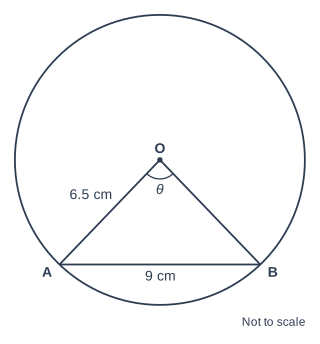
The diagram shows a circle with centre O and radius 6.5 cm. A and B are points on the circle, and the chord AB has length 9 cm.
Calculate the size of angle AOB, marked θ. Give your answer correct to 1 decimal place.
Model answer
OA = OB = 6.5 cm (radii), so triangle OAB is isosceles. The perpendicular from O to AB bisects AB, so each half is 4.5 cm. \(\sin\left(\dfrac{\theta}{2}\right) = \dfrac{4.5}{6.5}\), so \(\dfrac{\theta}{2} = 43.813...^\circ\) \(\theta = 87.626...^\circ\) θ = 87.6°
Explanation
Two radii and a chord always make an isosceles triangle, which is the key fact in many circle proofs. Its line of symmetry cuts the chord in half at right angles, so right-angled trigonometry finds half of the angle. Remember to double it.
Mark scheme
1 mark
B1 for: OA = OB = 6.5 (radii), so triangle OAB is isosceles
Exact values. May be implied by splitting the triangle into two right-angled triangles with hypotenuse 6.5 and opposite side 4.5, or by the cosine rule with two sides of 6.5; correct answer with no working scores full marks
1 mark
M1 for \(\sin\left(\dfrac{\theta}{2}\right) = \dfrac{4.5}{6.5}\) oe
Accept 87.6 to 87.63 (calculator value 87.626...); more accurate answers are accepted. 43.8 (half the angle) scores B1 M1 A0.
Question 4
4 marks
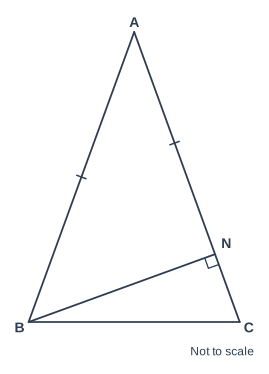
The diagram shows triangle ABC with AB = AC. N is the point on AC such that BN is perpendicular to AC.
Prove that angle NBC is half of angle BAC.
Model answer
Let angle BAC = a. AB = AC, so angle ABC = angle ACB (base angles of an isosceles triangle are equal). Angles in triangle ABC add up to 180°, so angle ACB = \(\dfrac{180^\circ - a}{2} = 90^\circ - \dfrac{a}{2}\). In triangle BNC, angle BNC = 90° and angle NCB = angle ACB = \(90^\circ - \dfrac{a}{2}\). Angle NBC = \(180^\circ - 90^\circ - \left(90^\circ - \dfrac{a}{2}\right) = \dfrac{a}{2}\) (angles in a triangle add up to 180°). So angle NBC is half of angle BAC.
Explanation
Write every angle in terms of a single letter. The isosceles triangle gives the base angle 90° − a/2, and the right-angled triangle BNC then gives angle NBC = a/2. Each step needs a geometric reason.
Mark scheme
1 mark
B1 for angle ABC = angle ACB, because base angles of an isosceles triangle are equal (AB = AC)
Reason needed. Any letter may be used for the angles, e.g. angle BAC = a. Naming an angle with a letter on its own scores 0.
1 mark
B1 for angle ACB = \(\dfrac{180 - a}{2}\) or \(90 - \dfrac{a}{2}\), where a = angle BAC, because angles in a triangle add up to 180°
Reason needed. Any letter for angle BAC.
1 mark
M1 for angle NBC = \(180 - 90 - \left(90 - \dfrac{a}{2}\right)\) (angles in triangle BNC add up to 180°)
FT their angle ACB. Alternative: angle ABN = 90 − a (angles in triangle ABN add up to 180°) and angle NBC = angle ABC − angle ABN.
1 mark
A1 for angle NBC = \(\dfrac{a}{2}\), which is half of angle BAC
Completes the proof. Numerical examples only score 0.
Ready to try the rest? Every answer you write is marked against the mark scheme, so you can see exactly where the marks are.
Ctrl + Enter to check
Study HelperHints first, answers after you try
Stuck on this one? Ask for a hint and I’ll point you in the right direction, without giving the answer away. Once you’ve checked your answer, I’ll show you how the marks are awarded.