
Level:
Correct: 0
Incorrect: 0
Marks: 0/0
Exam Practice
Course:
Topics:
OCR GCSE Maths (Higher calculator) Smart practice A mixed round aimed at your weak spots
Unit 1
Number Operations and Integers
Unit 2
Fractions, Decimals and Percentages
Unit 3
Indices and Surds
Unit 4
Approximation and Estimation
Unit 5
Ratio, Proportion and Rates of Change
Unit 6
Algebra
Unit 7
Graphs of Equations and Functions
Unit 8
Basic Geometry
Unit 9
Congruence and Similarity
Unit 10
Mensuration
Unit 11
Probability
Unit 12
Statistics
Avg
score:
–
Topics
done:
0/121

Inequalities and regions on graphs

Practise 14 exam-style questions on Inequalities and regions on graphs for OCR GCSE Maths (Higher calculator). Write your answer as you would in the exam and get it marked in seconds against the mark scheme, point by point, with the Study Helper on hand if you get stuck.

  • 14 questions
  • 2–5 marks each
  • Instant marking
  • No sign-up needed
14 questions, marked as you go

Sample questions with model answers

Here are 4 of the questions in this topic, each with a model answer, an explanation of why it earns the marks and the mark scheme an examiner would use.

Question 1

2 marks

The region R is defined by the inequalities

\(y \geqslant 1\)   \(x + y \leqslant 6\)   \(y < 2x\)

R is shown on the grid.
The points P(2, 2), Q(1, 2), S(4, 2) and T(3, 4) are also marked.

Which of the points P, Q, S and T are in the region R?
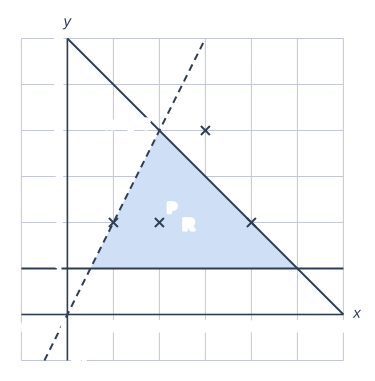
A coordinate grid with x from −1 to 6 and y from −1 to 6; each grid square is 1 unit across, and the axes cross at the origin O. Three boundary lines are drawn across the grid: y = 1 (solid), x + y = 6 (solid) and y = 2x (dashed). The region labelled R satisfying y ≥ 1, x + y ≤ 6 and y < 2x is shaded. Point P is marked with a cross at (2, 2). Point Q is marked with a cross at (1, 2). Point S is marked with a cross at (4, 2). Point T is marked with a cross at (3, 4).

Model answer

P(2, 2): \(2 \geqslant 1\), \(4 \leqslant 6\), \(2 < 4\). All true, so P is in R.
Q(1, 2): \(2 < 2\) is false (Q is on the dashed line), so Q is not in R.
S(4, 2): \(2 \geqslant 1\), \(6 \leqslant 6\), \(2 < 8\). All true (S is on the solid line), so S is in R.
T(3, 4): \(3 + 4 = 7\), which is not \(\leqslant 6\), so T is not in R.
P and S are in R.

Explanation

A point is in R only if it satisfies every inequality. Points on a solid boundary line are included, and points on a dashed line are not. Substituting the coordinates is more reliable than judging from the diagram.

Mark scheme
  1. 2 marks

    B2 for P and S only

    B1 for P and S with one other point, or for P only, or for S only. Q(1, 2) is on the dashed line y = 2x, so it is not in R (2 is not less than 2). T(3, 4) gives x + y = 7, which is more than 6. S(4, 2) is on the solid line x + y = 6, so it is included.
Question 2

3 marks

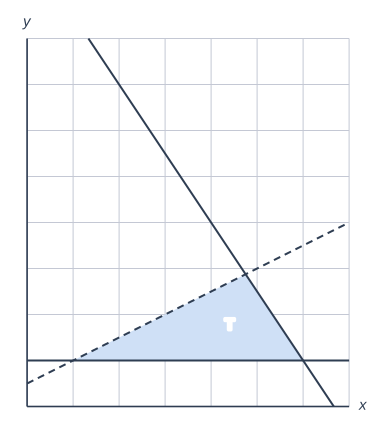
Triangle T is shaded on the grid.
The boundary lines of T are not labelled.

Write down three inequalities that are satisfied by all the points in T and by no other points.

A coordinate grid with x from 0 to 7 and y from 0 to 8; each grid square is 1 unit across, and the axes cross at the origin O. Three straight boundary lines are drawn across the grid (one dashed, two solid); their positions can be read from the grid. The region labelled T enclosed by them is shaded.

Model answer

Bottom side: the solid line \(y = 1\); T is above it: \(y \geqslant 1\)
Right side: the solid line through \((4, 4)\) and \((6, 1)\) has gradient \(\dfrac{1 - 4}{6 - 4} = -1.5\), and \(1 = -1.5 \times 6 + c\) gives \(c = 10\), so it is \(y = 10 - 1.5x\); T is below it: \(y \leqslant 10 - 1.5x\)
Left side: the dashed line through \((1, 1)\) and \((3, 2)\) has gradient 0.5, and \(1 = 0.5 \times 1 + c\) gives \(c = 0.5\), so it is \(y = 0.5x + 0.5\); T is below it: \(y < 0.5x + 0.5\)

Explanation

Find the equation of each boundary line from two points on it: the gradient, then the y-intercept by substituting a point. Then decide which side of each line the triangle is on by testing a point inside T, such as (4, 2). The dashed line gives a strict inequality.

Mark scheme
  1. 1 mark

    B1 for \(y \geqslant 1\)

    Solid line; correct answer with no working scores full marks

  2. 1 mark

    B1 for \(y \leqslant 10 - 1.5x\) oe

    Solid line through (2, 7), (4, 4) and (6, 1). e.g. \(3x + 2y \leqslant 20\) or \(y \leqslant -\dfrac{3}{2}x + 10\).

  3. 1 mark

    B1 for \(y < 0.5x + 0.5\) oe

    Dashed line through (1, 1), (3, 2) and (5, 3). e.g. \(2y < x + 1\). If 0 scored, SC1 for all three correct boundary lines with wrong or missing inequality signs.

Question 3

3 marks

The region R is defined by the inequalities

\(y > 2x - 1\)   \(y < 4.5 - 0.5x\)   \(x \geqslant 0\)

Find the coordinates of the point where the lines \(y = 2x - 1\) and \(y = 4.5 - 0.5x\) meet.

Hence explain why there are no points in R with x-coordinate 3.

Model answer

\(2x - 1 = 4.5 - 0.5x\)
\(2.5x = 5.5\)
\(x = 2.2\), \(y = 2 \times 2.2 - 1 = 3.4\)
The lines meet at \((2.2, 3.4)\).
R is above \(y = 2x - 1\) and below \(y = 4.5 - 0.5x\). To the right of \(x = 2.2\) the line \(y = 2x - 1\) is above the other line, so no point can be above the first and below the second.
For example, at \(x = 3\): \(y > 5\) and \(y < 3\), which is impossible. So no points in R have x-coordinate 3.

Explanation

The region between the two sloping lines closes up where they meet, at x = 2.2. Beyond that, the conditions y > 2x − 1 and y < 4.5 − 0.5x contradict each other. Substituting x = 3 shows this directly.

Mark scheme
  1. 1 mark

    M1 for \(2x - 1 = 4.5 - 0.5x\) oe

    Exact values.

  2. 1 mark

    A1 for \((2.2, 3.4)\)

    Exact values.

  3. 1 mark

    B1 for a correct explanation, e.g. R only exists to the left of x = 2.2, where the lines meet / when x = 3, y would need to be more than 5 and less than 3, which is impossible

    Accept a correct explanation using substitution of x = 3 even if the meeting point is wrong.

Question 4

5 marks

The region R is the triangle defined by the inequalities

\(y \geqslant 1\)   \(y \leqslant 2x - 1\)   \(3x + 2y \leqslant 15\)

Work out the perimeter of R.
Give your answer correct to 3 significant figures.

Model answer

Vertices:
\(y = 1\) and \(y = 2x - 1\): \(x = 1\), giving \((1, 1)\)
\(y = 1\) and \(3x + 2y = 15\): \(3x = 13\), giving \((4.333..., 1)\)
\(y = 2x - 1\) and \(3x + 2y = 15\): \(3x + 4x - 2 = 15\), \(x = \dfrac{17}{7} = 2.428...\), \(y = 3.857...\)
Side lengths:
horizontal side \(= 4.333... - 1 = 3.333...\)
\(\sqrt{(2.428... - 1)^2 + (3.857... - 1)^2} = \sqrt{10.204...} = 3.1943...\)
\(\sqrt{(4.333... - 2.428...)^2 + (3.857... - 1)^2} = \sqrt{11.791...} = 3.4338...\)
Perimeter \(= 3.333... + 3.1943... + 3.4338... = 9.9616...\)
Perimeter = 9.96 (3 s.f.)

Explanation

The vertices of R are where the boundary lines meet, so solve each pair of equations simultaneously. The horizontal side is a subtraction, and each sloping side needs Pythagoras on the differences of the coordinates. Keep the fractions or full calculator values until the end.

Mark scheme
  1. 1 mark

    M1 for solving a pair of boundary equations to find a vertex

    e.g. \(3x + 2(2x - 1) = 15\); correct answer with no working scores full marks

  2. 1 mark

    A1 for all three vertices: \((1, 1)\), \((\dfrac{13}{3}, 1)\) and \((\dfrac{17}{7}, \dfrac{27}{7})\)

    Accept (4.33, 1) and (2.43, 3.86) or more accurate (4.333..., 2.4285..., 3.8571...).

  3. 1 mark

    M1 for Pythagoras for one sloping side, e.g. \(\sqrt{1.428...^2 + 2.857...^2}\)

    FT their vertices. Accept 3.19 or 3.194 (3.1943...) or 3.43 or 3.434 (3.4338...).

  4. 1 mark

    M1 for adding three side lengths, including \(\dfrac{10}{3}\) (3.33...) for the horizontal side

    FT their vertices. Accept 3.33 or better for the horizontal side.

  5. 1 mark

    A1 for 9.96

    Value 9.9616... Accept 9.96 to 9.962. Premature rounding of the vertices to 1 d.p. ((4.3, 1), (2.4, 3.9)) gives 9.99 (9.987...): M1 A0 M1 M1 A0.

Ready to try the rest? Every answer you write is marked against the mark scheme, so you can see exactly where the marks are.

Study Helper Hints first, answers after you try

Stuck on this one? Ask for a hint and I’ll point you in the right direction, without giving the answer away. Once you’ve checked your answer, I’ll show you how the marks are awarded.