Level:
Correct: 0
Incorrect: 0
Marks: 0/0
Exam Practice
Course:
Topics:
OCR GCSE Maths (Higher calculator) Smart practice A mixed round aimed at your weak spots
Unit 1
Number Operations and Integers
Unit 2
Fractions, Decimals and Percentages
Unit 3
Indices and Surds
Unit 4
Approximation and Estimation
Unit 5
Ratio, Proportion and Rates of Change
Unit 6
Algebra
Unit 7
Graphs of Equations and Functions
Unit 8
Basic Geometry
Unit 9
Congruence and Similarity
Unit 10
Mensuration
Unit 11
Probability
Unit 12
Statistics
Avg
score:
–
Topics
done:
0/121

Circle theorem: angle at the centre

Practise 13 exam-style questions on Circle theorem: angle at the centre for OCR GCSE Maths (Higher calculator). Write your answer as you would in the exam and get it marked in seconds against the mark scheme, point by point, with the Study Helper on hand if you get stuck.

  • 13 questions
  • 1–5 marks each
  • Instant marking
  • No sign-up needed
13 questions, marked as you go

Sample questions with model answers

Here are 4 of the questions in this topic, each with a model answer, an explanation of why it earns the marks and the mark scheme an examiner would use.

Question 1

3 marks

The diagram shows a circle, centre O.
A, B and C are points on the circumference.
The radius of the circle is 8.5 cm.

Angle ACB = 31°.

Calculate the length of the minor arc AB.
Give your answer correct to 3 significant figures.
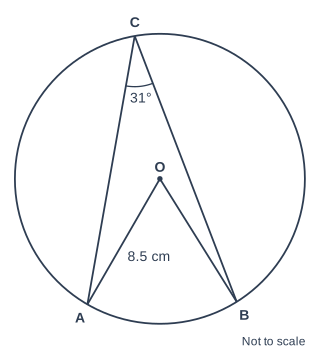
Geometry diagram, marked "Not to scale". A circle with centre O; A, B and C lie on it, in that order going anticlockwise. Line segments OA, OB, CA and CB are drawn. Angle ACB is marked 31°. OA is labelled 8.5 cm.

Model answer

Angle AOB and angle ACB both stand on the minor arc AB.
The angle at the centre is twice the angle at the circumference, so angle AOB = \(2 \times 31 = 62^\circ\).
Arc AB = \(\dfrac{62}{360} \times 2 \times \pi \times 8.5\)
\(= 9.197...\)
\(= 9.20\) cm (3 s.f.)

Explanation

The arc length uses the angle at the centre, not the angle at C, so double 31° first to get 62°. Then the arc is the fraction 62/360 of the full circumference 2πr. Using 31° in the arc length gives half the correct answer.

Mark scheme
  1. 1 mark

    B1 for angle AOB = 62° soi

    The angle at the centre is twice the angle at the circumference. May be implied by 62 used in an arc length calculation; correct answer with no working scores full marks

  2. 1 mark

    M1 for \(\dfrac{62}{360} \times 2 \times \pi \times 8.5\) oe

    FT their angle AOB. Accept \(\dfrac{62}{360} \times \pi \times 17\). Using 31° as the angle at the centre (\(\dfrac{31}{360} \times 2 \times \pi \times 8.5 = 4.598...\)) scores B0 M1 A0.

  3. 1 mark

    A1 for 9.20

    Accept 9.19 to 9.2. The full calculator value is 9.197..., and more accurate answers are accepted. A correct answer with no working scores 3 marks.
Question 2

3 marks

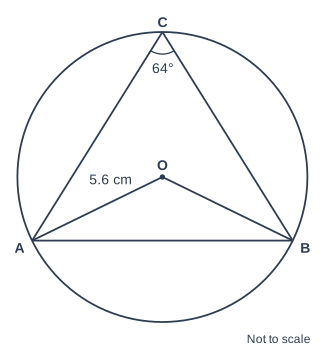
The diagram shows a circle, centre O, with radius 5.6 cm.
A, B and C are points on the circumference.

Angle ACB = 64°.

Sam works out the length of the chord AB.
Here is his working.

Angle AOB = \(64 \div 2 = 32^\circ\)
\(AB^2 = 5.6^2 + 5.6^2 - 2 \times 5.6 \times 5.6 \times \cos 32^\circ\)
AB = 3.09 cm

Explain the mistake Sam has made.
Work out the correct length of AB, giving your answer correct to 3 significant figures.

Geometry diagram, marked "Not to scale". A circle with centre O; A, B and C lie on it, in that order going anticlockwise. Line segments OA, OB, AB, CA and CB are drawn. Angle ACB is marked 64°. OA is labelled 5.6 cm.

Model answer

Sam has halved angle ACB. The angle at the centre is twice the angle at the circumference, so angle AOB should be \(2 \times 64 = 128^\circ\), not 32°.
\(AB^2 = 5.6^2 + 5.6^2 - 2 \times 5.6 \times 5.6 \times \cos 128^\circ\)
\(AB^2 = 101.33...\)
AB = 10.066...
AB = 10.1 cm (3 s.f.)

Explanation

Angle AOB and angle ACB stand on the same arc AB, and the angle at the centre is the larger one: it is twice the angle at the circumference. Sam's method with the cosine rule is right, but with the wrong angle. A quick check: angle ACB is 64°, so the chord must be quite long compared with the radius, not 3.09 cm.

Mark scheme
  1. 1 mark

    B1 for explaining that Sam has halved the angle when he should have doubled it: the angle at the centre is twice the angle at the circumference, so angle AOB = 128° oe

    Accept e.g. 'angle AOB should be \(2 \times 64\) = 128°' or 'the angle at the centre is double the angle at the circumference, not half'. Do not accept 'he used the wrong angle' with no further detail, or 'he should have used the sine rule'.

  2. 1 mark

    M1 for \(5.6^2 + 5.6^2 - 2 \times 5.6 \times 5.6 \times \cos 128\) oe or \(2 \times 5.6 \times \sin 64\) oe

    May be implied by \(AB^2 = 101.3...\). A correct method using right-angled trigonometry in triangle OAM, where M is the midpoint of AB, is also M1.

  3. 1 mark

    A1 for 10.1

    Accept 10.06 to 10.1 (cm). The full calculator value is 10.066..., and more accurate answers are accepted.

Question 3

4 marks

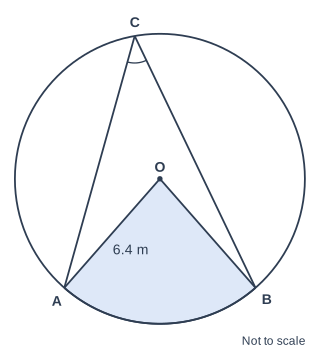
The diagram shows a circular garden with centre O and radius 6.4 m.
A, B and C are points on the edge of the garden.
The shaded sector AOB is a flower bed with an area of 29.5 m².

Calculate the size of angle ACB.
Give your answer correct to 1 decimal place.

Geometry diagram, marked "Not to scale". A circle with centre O; A, B and C lie on it, in that order going anticlockwise. A shaded sector with centre O, bounded by the radii OA and OB and the minor arc from A to B. Line segments CA and CB are drawn. OA is labelled 6.4 m. Angle ACB is marked with a single arc.

Model answer

Let angle AOB = \(\theta\).
Area of sector AOB = \(\dfrac{\theta}{360} \times \pi \times 6.4^2 = 29.5\)
\(\theta = \dfrac{29.5 \times 360}{\pi \times 6.4^2} = 82.530...^\circ\)
The angle at the centre is twice the angle at the circumference, so
angle ACB = \(82.530... \div 2 = 41.265...\)
Angle ACB = 41.3° (1 d.p.)

Explanation

Work backwards from the sector area to find the angle at the centre: the sector is the fraction θ/360 of the whole circle's area πr². Angle ACB stands on the same arc AB, so it is half of angle AOB. Keep the unrounded angle in your calculator until the end.

Mark scheme
  1. 1 mark

    M1 for \(\dfrac{\theta}{360} \times \pi \times 6.4^2 = 29.5\) oe, where \(\theta\) is angle AOB

    Accept any equivalent method, e.g. M1 for \(\dfrac{29.5}{\pi \times 6.4^2}\) (= 0.229...) or \(\pi \times 6.4^2 = 128.6...\) used with 29.5; correct answer with no working scores full marks

  2. 1 mark

    A1 for angle AOB = 82.5°

    Accept 82.5 to 82.6. The full value is 82.530...

  3. 1 mark

    M1 for their angle AOB \(\div 2\)

    The angle at the centre is twice the angle at the circumference. Their angle AOB must come from an attempt using the sector area.

  4. 1 mark

    A1 for 41.3

    Accept 41.2 to 41.3. The full value is 41.265... Using 82.5 gives 41.25, which is accepted. More accurate answers are accepted. Using the circumference instead of the area (\(\dfrac{29.5}{2 \times \pi \times 6.4} \times 360 = 132.0...\), then 66.0) scores M0 A0 M1 A0. A correct answer with no working scores 4 marks.

Question 4

5 marks

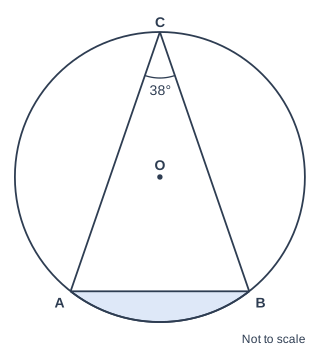
The diagram shows a circle, centre O, with radius 9.5 cm.
A, B and C are points on the circumference.
The shaded region is a segment, bounded by the chord AB and the minor arc AB.

Angle ACB = 38°.

Calculate the perimeter of the shaded segment.
Give your answer correct to 3 significant figures.

Geometry diagram, marked "Not to scale". A circle with centre O; A, B and C lie on it, in that order going anticlockwise. A minor arc from A to B with centre O (the region between the arc and AB is shaded). Line segments AB, CA and CB are drawn. Angle ACB is marked 38°.

Model answer

The angle at the centre is twice the angle at the circumference, so angle AOB = \(2 \times 38 = 76^\circ\).
Arc AB = \(\dfrac{76}{360} \times 2 \times \pi \times 9.5 = 12.601...\) cm
Chord AB = \(2 \times 9.5 \times \sin 38^\circ = 11.697...\) cm
Perimeter of the segment = 12.601... + 11.697... = 24.298...
Perimeter = 24.3 cm (3 s.f.)

Explanation

The segment's perimeter is the minor arc AB plus the straight chord AB; the radii are not part of it. Both the arc and the chord need angle AOB, which is twice angle ACB. Find the chord with the cosine rule or by splitting the isosceles triangle AOB into two right-angled triangles.

Mark scheme
  1. 1 mark

    B1 for angle AOB = 76° soi

    The angle at the centre is twice the angle at the circumference; correct answer with no working scores full marks

  2. 1 mark

    M1 for arc AB = \(\dfrac{76}{360} \times 2 \times \pi \times 9.5\) oe

    FT their angle AOB. Accept any equivalent method. May be implied by 12.6 (12.60...).

  3. 1 mark

    M1 for chord AB = \(2 \times 9.5 \times \sin 38\) oe or \(\sqrt{9.5^2 + 9.5^2 - 2 \times 9.5 \times 9.5 \times \cos 76}\) oe

    FT their angle AOB. May be implied by 11.7 (11.69...).

  4. 1 mark

    M1 for their arc + their chord

    Both must be attempts at the arc length and the chord length. Adding two radii (giving the perimeter of the sector, 31.6) or adding the radii as well scores M0 for this mark.

  5. 1 mark

    A1 for 24.3

    Accept 24.29 to 24.3 (cm). The full value is 24.298... More accurate answers are accepted. Using 38° as angle AOB (arc 6.30, chord 6.19, total 12.5) scores B0 M1 M1 M1 A0. A correct answer with no working scores 5 marks.

Ready to try the rest? Every answer you write is marked against the mark scheme, so you can see exactly where the marks are.

Study Helper Hints first, answers after you try

Stuck on this one? Ask for a hint and I’ll point you in the right direction, without giving the answer away. Once you’ve checked your answer, I’ll show you how the marks are awarded.