Question 1
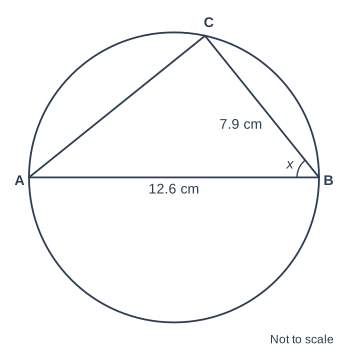
3 marksThe diagram shows a circle.
A, B and C are points on the circumference.
AB is a diameter of the circle.
AB = 12.6 cm and BC = 7.9 cm.
Angle ABC = \(x\).
Calculate the value of \(x\).
Give your answer correct to 1 decimal place.
Model answer
AB is a diameter, so angle ACB = 90° (angle in a semicircle).
AB is the hypotenuse and BC is adjacent to angle ABC.
\(\cos x = \dfrac{7.9}{12.6} = 0.6269...\)
\(x = \cos^{-1}(0.6269...) = 51.172...\)
\(x = 51.2^\circ\) (1 d.p.)
Explanation
Because AB is a diameter, the angle at C is 90°, so the diameter is the hypotenuse of triangle ABC. BC is next to angle ABC, so the ratio is cosine. Always identify the hypotenuse first: it is the side opposite the right angle.
Mark scheme
-
1 mark
B1 for angle ACB = 90° soi
The angle in a semicircle is 90°. Implied by a correct trigonometric ratio with AB as the hypotenuse; correct answer with no working scores full marks
-
1 mark
M1 for \(\cos x = \dfrac{7.9}{12.6}\) oe
Accept any equivalent method, e.g. AC = \(\sqrt{12.6^2 - 7.9^2}\) (= 9.81...) and then \(\tan x = \dfrac{AC}{7.9}\). Using \(\tan x = \dfrac{7.9}{12.6}\) (giving 32.1) scores B0 M0 A0.
-
1 mark
A1 for 51.2
Accept 51.16 to 51.2. The full value is 51.172... More accurate answers are accepted. 38.8 (angle CAB) as the final answer scores B1 M1 A0 if it comes from a correct method for angle CAB (e.g. \(\sin CAB = \dfrac{7.9}{12.6}\)), otherwise B1 M0 A0. A correct answer with no working scores 3 marks.