
Level:
Correct: 0
Incorrect: 0
Marks: 0/0
Exam Practice
Course:
Topics:
OCR GCSE Maths (Higher calculator) Smart practice A mixed round aimed at your weak spots
Unit 1
Number Operations and Integers
Unit 2
Fractions, Decimals and Percentages
Unit 3
Indices and Surds
Unit 4
Approximation and Estimation
Unit 5
Ratio, Proportion and Rates of Change
Unit 6
Algebra
Unit 7
Graphs of Equations and Functions
Unit 8
Basic Geometry
Unit 9
Congruence and Similarity
Unit 10
Mensuration
Unit 11
Probability
Unit 12
Statistics
Avg
score:
–
Topics
done:
0/121

Loci

Practise 13 exam-style questions on Loci for OCR GCSE Maths (Higher calculator). Write your answer as you would in the exam and get it marked in seconds against the mark scheme, point by point, with the Study Helper on hand if you get stuck.

  • 13 questions
  • 2–6 marks each
  • Instant marking
  • No sign-up needed
13 questions, marked as you go

Sample questions with model answers

Here are 4 of the questions in this topic, each with a model answer, an explanation of why it earns the marks and the mark scheme an examiner would use.

Question 1

2 marks

A goat is tied to a post at the point P by a rope of length 5.5 m.
P is on a long straight fence, and the goat can only be on one side of the fence.

Calculate the area of grass that the goat can reach.
Give your answer correct to 3 significant figures.

Model answer

The goat can reach every point up to 5.5 m from P on one side of the fence.
This region is a semicircle, centre P, radius 5.5 m.
Area = \(\dfrac{1}{2} \times \pi \times 5.5^2 = 47.5165...\)
Area = 47.5 m²

Explanation

The locus of points within 5.5 m of P is a circle of radius 5.5 m, but the fence through its centre cuts it in half. So the goat reaches a semicircle. A common error is to use the whole circle.

Mark scheme
  1. 1 mark

    M1 for \(\dfrac{1}{2} \times \pi \times 5.5^2\) oe

    Exact values from the question. The region is a semicircle of radius 5.5 m, centre P. 95.0 (whole circle) or 23.8 (quarter circle) scores M0 A0; correct answer with no working scores full marks

  2. 1 mark

    A1 for 47.5

    Accept 47.5 to 47.52 (calculator value 47.5165...); more accurate answers are accepted. Accept 15.125π only if then evaluated; 15.125π alone scores M1 A0.
Question 2

3 marks

Ravi controls a drone from the point C on level ground.
The drone can be controlled only when it is less than 250 m from C.

The drone hovers 120 m vertically above the point P on the ground.
P is 205 m from C.

Can Ravi control the drone?
Show how you decide.

Model answer

The drone, P and C form a right-angled triangle with the right angle at P.
Distance from C to the drone = \(\sqrt{120^2 + 205^2} = \sqrt{56\,425} = 237.539...\) m
237.5 m < 250 m, so the drone is within range.
Yes, Ravi can control the drone.

Explanation

The points less than 250 m from C form the inside of a sphere (in three dimensions) of radius 250 m. The straight-line distance from C to the drone is the hypotenuse of a right-angled triangle with sides 205 m and 120 m. It is about 238 m, so the drone is inside the region.

Mark scheme
  1. 1 mark

    M1 for \(120^2 + 205^2\) oe

    Implied by 56 425. Pythagoras with the distance from C to the drone as the hypotenuse.

  2. 1 mark

    A1 for 237.5...

    Accept 237 to 238 (calculator value 237.539...), or 56 425 compared with \(250^2 = 62\,500\).

  3. 1 mark

    A1 for Yes, because 237.5 < 250 oe

    A correct comparison is needed, e.g. 56 425 < 62 500. Accept 'yes, it is about 238 m away, which is less than 250 m'. 'Yes' with no working scores 0. Using 120 + 205 = 325 and answering 'No' scores 0.

Question 3

3 marks

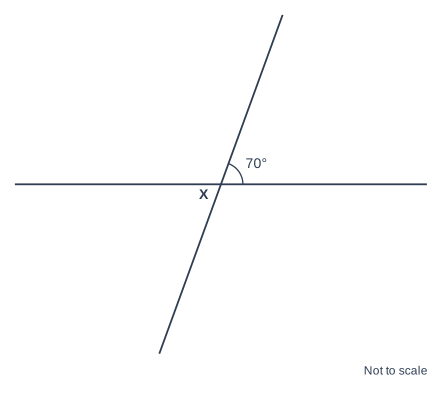
The diagram shows two straight roads that cross at X.
One of the angles between the roads is 70°.

Describe fully the locus of points that are the same distance from both roads.

Geometry diagram, marked "Not to scale". A horizontal straight line is drawn through X. A sloping straight line is drawn through X. The angle at X between the line going to the right from X and the line going upwards from X is marked 70°.

Model answer

The points the same distance from two crossing lines lie on the bisectors of the angles between them.
The roads make angles of 70° and 180° − 70° = 110°.
The locus is two straight lines through X:
one bisects the 70° angles, making 35° with each road;
the other bisects the 110° angles, making 55° with each road.
The two lines are perpendicular (35° + 55° = 90°).

Explanation

The locus of points equidistant from two lines is the bisector of the angle between them. Two crossing lines make two pairs of angles (70° and 110°), so there are two bisectors, and together they form a pair of perpendicular lines through X. Giving only the bisector of the 70° angle is the common incomplete answer.

Mark scheme
  1. 1 mark

    B1 for the bisector of the 70° angle / a straight line through X making 35° with each road

    Accept 'the line that cuts the 70° angle in half'.

  2. 1 mark

    B1 for the bisector of the 110° angle / a straight line through X making 55° with each road

    Accept 'the line that cuts the other angle (180° − 70°) in half'.

  3. 1 mark

    B1 for: the locus is both lines, which are complete straight lines through X at right angles to each other

    Accept 'two perpendicular lines through X'. This mark needs two lines through X that extend on both sides of X; a single line or a ray from X scores B0 here.

Question 4

5 marks

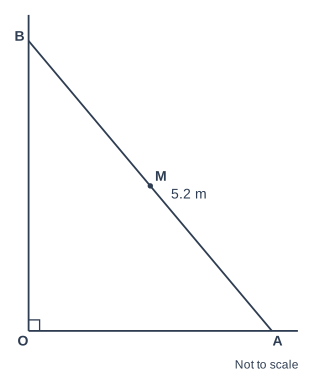
The diagram shows a ladder AB of length 5.2 m leaning against a vertical wall.
A is on horizontal ground and O is where the wall meets the ground.
M is the midpoint of the ladder.

The ladder slides, with A moving along the ground and B moving down the wall.
At the start, the ladder makes an angle of 70° with the ground.
At the end, it makes an angle of 30° with the ground.

Calculate the length of the path travelled by M.
Give your answer correct to 3 significant figures.

Geometry diagram, marked "Not to scale". A straight line is drawn from O through B, extending beyond B. A straight line is drawn from O through A, extending beyond A. Line segment AB is drawn. M lies on AB. Angle AOB is marked as a right angle (90°). AB is labelled 5.2 m.

Model answer

Triangle AOB has a right angle at O, so O lies on the circle with diameter AB (angle in a semicircle).
The centre of that circle is M, so OM = MA = MB = 5.2 ÷ 2 = 2.6 m in every position.
So M moves along an arc of a circle with centre O and radius 2.6 m.
MO = MA, so triangle OMA is isosceles and angle MOA = angle MAO = the angle of the ladder with the ground.
So OM turns from 70° to 30° with the ground, through 40°.
Path length = \(\dfrac{40}{360} \times 2 \times \pi \times 2.6 = 1.8151...\)
M travels 1.82 m.

Explanation

The key fact is that the midpoint of the hypotenuse of a right-angled triangle is the same distance from all three vertices, so M is always 2.6 m from O and its locus is an arc of a circle. The isosceles triangle OMA shows that OM turns through the same angle as the ladder, 40°. A common error is to find the straight-line distance between the two positions of M instead of the arc length.

Mark scheme
  1. 1 mark

    B1 for OM = 2.6 m in every position, with a reason

    2.6 is exact. E.g. M is the midpoint of the hypotenuse of the right-angled triangle AOB, so M is the centre of the circle through O, A and B (angle in a semicircle); or OAXB is a rectangle and its diagonals are equal and bisect each other; or M = \((2.6\cos\theta, 2.6\sin\theta)\); correct answer with no working scores full marks

  2. 1 mark

    B1 for the locus of M is an arc of a circle with centre O and radius 2.6 m

    Exact radius 2.6. May be implied by the arc length method.

  3. 1 mark

    M1 for the angle turned through by OM = 70 − 30 = 40

    OM makes the same angle with the ground as the ladder, because MO = MA (triangle OMA is isosceles). May be implied by \(\dfrac{40}{360}\).

  4. 1 mark

    M1 for \(\dfrac{40}{360} \times 2 \times \pi \times 2.6\) oe

    Exact values. FT their radius and angle. Using radius 5.2 (3.63) scores B0 B0 M1 M1 A0 if 40 is used.

  5. 1 mark

    A1 for 1.82

    Accept 1.815 to 1.82 (calculator value 1.8151...); more accurate answers are accepted. 1.78 (the straight-line distance between the start and end positions of M) scores at most B1 B1 M1 M0 A0.

Ready to try the rest? Every answer you write is marked against the mark scheme, so you can see exactly where the marks are.

Study Helper Hints first, answers after you try

Stuck on this one? Ask for a hint and I’ll point you in the right direction, without giving the answer away. Once you’ve checked your answer, I’ll show you how the marks are awarded.