Practise 16 exam-style questions on Cosine rule for OCR GCSE Maths (Higher calculator). Write your answer as you would in the exam and get it marked in seconds against the mark scheme, point by point, with the Study Helper on hand if you get stuck.
16 questions
2–6 marks each
Instant marking
No sign-up needed
16 questions, marked as you go
Sample questions with model answers
Here are 4 of the questions in this topic, each with a model answer, an explanation of why it earns the marks and the mark scheme an examiner would use.
Question 1
3 marks
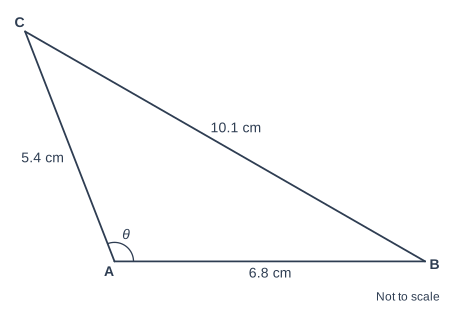
The diagram shows triangle ABC. AB = 6.8 cm, AC = 5.4 cm and BC = 10.1 cm.
Calculate the size of angle \(\theta\). Give your answer correct to 1 decimal place.
Model answer
θ is opposite the side BC = 10.1 cm. \(\cos\theta = \dfrac{6.8^2 + 5.4^2 - 10.1^2}{2 \times 6.8 \times 5.4} = \dfrac{46.24 + 29.16 - 102.01}{73.44} = \dfrac{-26.61}{73.44} = -0.36233...\) \(\theta = \cos^{-1}(-0.36233...) = 111.24...^\circ\) \(\theta = 111.2^\circ\) (to 1 d.p.)
Explanation
With three sides known, rearrange the cosine rule for the angle: the side opposite θ is subtracted on the top of the fraction. A negative value of cos θ means θ is obtuse, which matches θ being opposite the longest side. The inverse cosine function gives obtuse angles directly, unlike inverse sine.
Exact values from the question; or \(10.1^2 = 6.8^2 + 5.4^2 - 2 \times 6.8 \times 5.4 \cos\theta\); correct answer with no working scores full marks
1 mark
M1 for \(\cos\theta = \dfrac{-26.61}{73.44}\) or −0.3623... oe
Accept −0.362 or better (−0.36233...).
1 mark
A1 for 111.2
Accept 111.2 to 111.25 (111.243...); more accurate answers are accepted. 68.8 (from +0.3623, a sign error) scores M1 M0 A0. Premature rounding: cos θ = −0.36 gives 111.1, which scores M1 M1 A0.
Question 2
3 marks
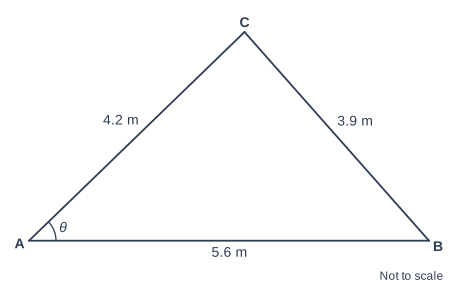
The diagram shows a triangular sail ABC. AB = 5.6 m, AC = 4.2 m and BC = 3.9 m.
Calculate the size of angle \(\theta\), the angle between the two longest sides of the sail. Give your answer correct to 1 decimal place.
Model answer
The two longest sides are AB = 5.6 m and AC = 4.2 m, so θ is angle BAC, opposite BC = 3.9 m. \(\cos\theta = \dfrac{5.6^2 + 4.2^2 - 3.9^2}{2 \times 5.6 \times 4.2} = \dfrac{31.36 + 17.64 - 15.21}{47.04} = \dfrac{33.79}{47.04} = 0.71832...\) \(\theta = 44.083...^\circ\) \(\theta = 44.1^\circ\) (to 1 d.p.)
Explanation
The angle between the two longest sides is opposite the shortest side, so 3.9² is the term subtracted on the top. The angle opposite the shortest side is always the smallest angle, so an answer of about 44° makes sense.
Exact values from the question; correct answer with no working scores full marks
1 mark
M1 for \(\cos\theta = \dfrac{33.79}{47.04}\) or 0.7183... oe
Accept 0.718 or better (0.71832...).
1 mark
A1 for 44.1
Accept 44.08 to 44.1 (44.083...); more accurate answers are accepted. Premature rounding: cos θ = 0.72 gives 43.9, which scores M1 M1 A0. 87.4 or 48.5 (other angles of the triangle) score M0 A0 unless the correct cosine rule for θ is seen.
Question 3
4 marks
In triangle ABC, AC = 9 cm and BC = 11 cm. Angle ACB is acute. The area of triangle ABC is 40 cm².
Calculate the length of AB. Give your answer correct to 3 significant figures.
Model answer
Angle ACB is between the sides AC and BC. \(\dfrac{1}{2} \times 9 \times 11 \times \sin C = 40\) \(\sin C = \dfrac{80}{99} = 0.80808...\) \(C = 53.908...^\circ\) (acute) AB is opposite angle C: \(AB^2 = 9^2 + 11^2 - 2 \times 9 \times 11 \times \cos 53.908...^\circ\) \(= 202 - 198 \times 0.58907... = 85.363...\) \(AB = 9.2392...\) AB = 9.24 cm (to 3 s.f.)
Explanation
The area formula ½ab sin C gives angle C, the angle between the two known sides. Then the cosine rule gives the third side AB. The information that C is acute matters: the obtuse angle 126.1° has the same sine and would give a different triangle with AB = 17.9 cm.
Mark scheme
1 mark
M1 for \(\dfrac{1}{2} \times 9 \times 11 \times \sin C = 40\) oe
\(\sin C = \dfrac{80}{99}\) (0.8080...); correct answer with no working scores full marks
1 mark
A1 for angle ACB = 53.9 or 53.91
Accept 53.9 to 53.91 (53.908...°).
1 mark
M1 for \(AB^2 = 9^2 + 11^2 - 2 \times 9 \times 11 \times \cos\) (their C)
Accept their C rounded to 1 d.p. or better; \(AB^2 = 85.36...\) (accept 85.3 to 85.4).
1 mark
A1 for 9.24
Accept 9.239 to 9.24 (9.2392...); more accurate answers are accepted. Premature rounding: C = 54° gives 9.25, which scores M1 A0 M1 A0. Using the obtuse angle 126.1° gives 17.9, which scores M1 A0 M1 A0 (angle ACB is acute).
Question 4
5 marks
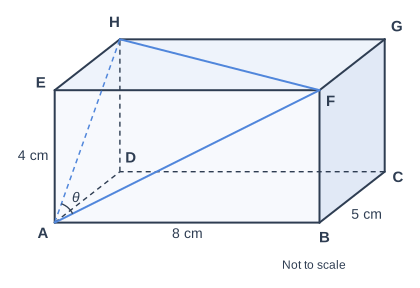
The diagram shows a cuboid ABCDEFGH. AB = 8 cm, BC = 5 cm and AE = 4 cm.
Calculate the size of angle HAF. Give your answer correct to 1 decimal place.
Each side of triangle AFH lies across a different face of the cuboid, so Pythagoras on each face gives the three sides. Triangle AFH is not right-angled, so use the cosine rule for the angle at A, with FH (opposite A) as the side subtracted. Using the squared lengths keeps the working exact.
Mark scheme
1 mark
M1 for a correct method for one of AF, AH or FH (or its square)
\(AF^2 = 8^2 + 4^2 = 80\), \(AH^2 = 5^2 + 4^2 = 41\), \(FH^2 = 8^2 + 5^2 = 89\). Exact values; correct answer with no working scores full marks
1 mark
A1 for all three: \(AF^2 = 80\), \(AH^2 = 41\) and \(FH^2 = 89\) oe
Or AF = 8.94, AH = 6.40, FH = 9.43 (accept 8.944 to 8.95, 6.403 to 6.41, 9.433 to 9.44).
1 mark
M1 for \(\cos(HAF) = \dfrac{AF^2 + AH^2 - FH^2}{2 \times AF \times AH}\) with their values
FH must be the side opposite angle HAF.
1 mark
M1 for \(\cos(HAF) = \dfrac{32}{2\sqrt{80}\sqrt{41}}\) or 0.2793... oe
Accept 0.279 or better (0.27937...).
1 mark
A1 for 73.8
Accept 73.77 to 73.8 (73.777...); more accurate answers are accepted. Sides rounded to 3 s.f. give 73.8 (accepted). Using the space diagonal AG (\(\sqrt{105}\) = 10.2...) in place of FH scores M1 A0 M1 M0 A0.
Ready to try the rest? Every answer you write is marked against the mark scheme, so you can see exactly where the marks are.
Ctrl + Enter to check
Study HelperHints first, answers after you try
Stuck on this one? Ask for a hint and I’ll point you in the right direction, without giving the answer away. Once you’ve checked your answer, I’ll show you how the marks are awarded.