
Level:
Correct: 0
Incorrect: 0
Marks: 0/0
Exam Practice
Course:
Topics:
OCR GCSE Maths (Higher calculator) Smart practice A mixed round aimed at your weak spots
Unit 1
Number Operations and Integers
Unit 2
Fractions, Decimals and Percentages
Unit 3
Indices and Surds
Unit 4
Approximation and Estimation
Unit 5
Ratio, Proportion and Rates of Change
Unit 6
Algebra
Unit 7
Graphs of Equations and Functions
Unit 8
Basic Geometry
Unit 9
Congruence and Similarity
Unit 10
Mensuration
Unit 11
Probability
Unit 12
Statistics
Avg
score:
–
Topics
done:
0/121

Direct proportion

Practise 16 exam-style questions on Direct proportion for OCR GCSE Maths (Higher calculator). Write your answer as you would in the exam and get it marked in seconds against the mark scheme, point by point, with the Study Helper on hand if you get stuck.

  • 16 questions
  • 1–4 marks each
  • Instant marking
  • No sign-up needed
16 questions, marked as you go

Sample questions with model answers

Here are 4 of the questions in this topic, each with a model answer, an explanation of why it earns the marks and the mark scheme an examiner would use.

Question 1

3 marks

The graph shows the extension, \(e\) cm, of a spring when a mass of \(m\) grams hangs from it.

\(e\) is directly proportional to \(m\).
Assume this is still true for masses greater than those shown on the graph.

Work out the extension of the spring when a mass of 1.2 kg hangs from it.
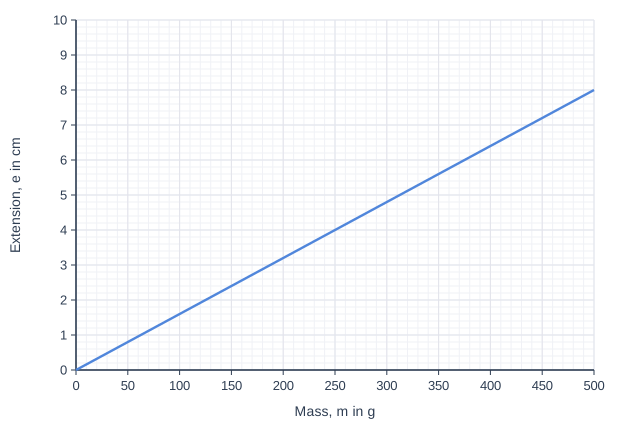
Line graph of extension, e in cm (y-axis, 0 to 10) against mass, m in g (x-axis, 0 to 500). The line joins the points (0, 0), (500, 8).

Model answer

From the graph, a mass of 500 g gives an extension of 8 cm.
1.2 kg = 1200 g
\(e = 8 \times \dfrac{1200}{500} = 8 \times 2.4 = 19.2\) cm

Explanation

Because \(e\) is directly proportional to \(m\), multiplying the mass by 2.4 multiplies the extension by 2.4. Read an accurate pair of values from the graph (at a point where the line crosses grid lines), and remember to change 1.2 kg to 1200 g. The formula is \(e = 0.016m\).

Mark scheme
  1. 1 mark

    M1 for a correct pair of values read from the graph

    E.g. (500, 8), (250, 4), (125, 2) or (375, 6). These are exact readings; correct answer with no working scores full marks

  2. 1 mark

    M1 for their \(8 \div 500 \times 1200\) oe

    E.g. \(k = 0.016\) and \(e = 0.016 \times 1200\), or \(8 \times \dfrac{1200}{500}\). FT their pair of values.

  3. 1 mark

    A1 for 19.2

    Accept 19.2 cm (exact). \(8 \times 1.2 \div 500\) (not converting kg to g) scores M1 M0 A0. A correct answer with no working scores 3 marks.

Question 2

3 marks

\(y\) is directly proportional to the cube root of \(x\).
When \(x = 64\), \(y = 11.2\).

Find the value of \(x\) when \(y = 15.4\).

Model answer

\(y = k\sqrt[3]{x}\)
\(11.2 = k \times \sqrt[3]{64} = 4k\), so \(k = 2.8\)
\(15.4 = 2.8\sqrt[3]{x}\)
\(\sqrt[3]{x} = 15.4 \div 2.8 = 5.5\)
\(x = 5.5^3 = 166.375\)

Explanation

Write the proportion as \(y = k\sqrt[3]{x}\) and find \(k\) from the given pair: the cube root of 64 is 4. After substituting \(y = 15.4\), undo the cube root by cubing. Mixing up the cube root with the square root is a common error.

Mark scheme
  1. 1 mark

    M1 for \(11.2 = k\sqrt[3]{64}\) oe

    \(\sqrt[3]{64} = 4\). Exact values from the question; correct answer with no working scores full marks

  2. 1 mark

    M1 for \(k = 2.8\) and \(\sqrt[3]{x} = 15.4 \div 2.8\) or 5.5

    Or \(\dfrac{\sqrt[3]{x}}{4} = \dfrac{15.4}{11.2}\). FT their \(k\). 5.5 is exact.

  3. 1 mark

    A1 for 166.375

    Exact answer; accept 166.4 or 166 if 166.375 or \(5.5^3\) is seen. 5.5 (not cubed) scores M1 M1 A0. \(y = k\sqrt{x}\) used (giving \(x = 121\)) scores M0 M0 A0.

Question 3

3 marks

The power, \(P\) kilowatts, produced by a wind turbine is directly proportional to the cube of the wind speed, \(v\) m/s.

When \(v = 6\), \(P = 540\).

Work out the wind speed when the turbine produces 1000 kilowatts.
Give your answer correct to 3 significant figures.

Model answer

\(P = kv^3\)
\(540 = k \times 6^3 = 216k\), so \(k = 2.5\)
\(1000 = 2.5v^3\)
\(v^3 = 400\)
\(v = \sqrt[3]{400} = 7.3680...\)
\(v = 7.37\) m/s (3 s.f.)

Explanation

Write \(P = kv^3\), find \(k\) from \(v = 6\), \(P = 540\), then solve for \(v\) by taking the cube root. Because power depends on the cube of the speed, nearly doubling the power needs only about a 23% increase in wind speed. A common error is to take a square root instead of a cube root.

Mark scheme
  1. 1 mark

    M1 for \(540 = k \times 6^3\) oe

    \(k = 2.5\) (exact); correct answer with no working scores full marks

  2. 1 mark

    M1 for \(v^3 = 1000 \div\) their 2.5 or 400 oe

    Or \(v^3 = 216 \times \dfrac{1000}{540}\). 400 is exact. FT their \(k\).

  3. 1 mark

    A1 for 7.37

    Accept 7.368 to 7.37 (7.3680...); more accurate answers are accepted. 20 (\(\sqrt{400}\)) scores M1 M1 A0. 11.1 (\(6 \times \dfrac{1000}{540}\), treating \(P\) as proportional to \(v\)) scores 0. If 0 scored, SC1 for their answer to more than 3 figures correctly rounded to 3 s.f.

Question 4

4 marks

The rate of flow of water through a pipe, \(R\) litres per second, is directly proportional to the fourth power of the radius of the pipe, \(r\) cm.

A pipe of radius 1.5 cm has a rate of flow of 0.81 litres per second.

A new pipe must have a rate of flow of 3.24 litres per second.

Work out the radius of the new pipe.
Give your answer correct to 3 significant figures.

Model answer

\(R = kr^4\)
\(0.81 = k \times 1.5^4 = 5.0625k\), so \(k = 0.16\)
\(3.24 = 0.16r^4\)
\(r^4 = 20.25\)
\(r = \sqrt[4]{20.25} = 2.1213...\)
\(r = 2.12\) cm (3 s.f.)

Explanation

Write \(R = kr^4\) and find \(k\) from the first pipe. To undo the fourth power, take the fourth root (or square root twice). The rate of flow is 4 times as big, but the radius only needs to be \(\sqrt[4]{4} = 1.414...\) times as big.

Mark scheme
  1. 1 mark

    M1 for \(R = kr^4\) and \(0.81 = k \times 1.5^4\) oe

    \(1.5^4 = 5.0625\) (exact); correct answer with no working scores full marks

  2. 1 mark

    M1 for \(k = 0.16\)

    Exact. Or the scale factor method: \(R\) is multiplied by \(3.24 \div 0.81 = 4\) (exact).

  3. 1 mark

    M1 for \(r^4 = 3.24 \div 0.16\) or 20.25, or \(r = 1.5 \times \sqrt[4]{4}\)

    20.25 is exact. FT their \(k\).

  4. 1 mark

    A1 for 2.12

    Accept 2.12 to 2.1214 (2.1213..., which is \(1.5\sqrt{2}\)); more accurate answers are accepted. 4.5 (\(\sqrt{20.25}\), a square root instead of a fourth root) scores M1 M1 M1 A0. 6 (\(1.5 \times 4\), treating \(R\) as proportional to \(r\)) scores 0.

Ready to try the rest? Every answer you write is marked against the mark scheme, so you can see exactly where the marks are.

Study Helper Hints first, answers after you try

Stuck on this one? Ask for a hint and I’ll point you in the right direction, without giving the answer away. Once you’ve checked your answer, I’ll show you how the marks are awarded.