
Level:
Correct: 0
Incorrect: 0
Marks: 0/0
Exam Practice
Course:
Topics:
OCR GCSE Maths (Higher calculator) Smart practice A mixed round aimed at your weak spots
Unit 1
Number Operations and Integers
Unit 2
Fractions, Decimals and Percentages
Unit 3
Indices and Surds
Unit 4
Approximation and Estimation
Unit 5
Ratio, Proportion and Rates of Change
Unit 6
Algebra
Unit 7
Graphs of Equations and Functions
Unit 8
Basic Geometry
Unit 9
Congruence and Similarity
Unit 10
Mensuration
Unit 11
Probability
Unit 12
Statistics
Avg
score:
–
Topics
done:
0/121

Calculating with positive and negative numbers

Practise 14 exam-style questions on Calculating with positive and negative numbers for OCR GCSE Maths (Higher calculator). Write your answer as you would in the exam and get it marked in seconds against the mark scheme, point by point, with the Study Helper on hand if you get stuck.

  • 14 questions
  • 2–4 marks each
  • Instant marking
  • No sign-up needed
14 questions, marked as you go

Sample questions with model answers

Here are 4 of the questions in this topic, each with a model answer, an explanation of why it earns the marks and the mark scheme an examiner would use.

Question 1

2 marks

The table shows the lowest temperature recorded in six cities on one day in February.

Work out the difference between the highest and the lowest of these temperatures.
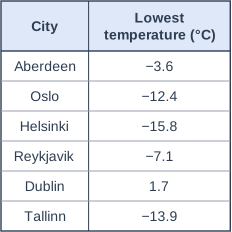
Table with columns "City", "Lowest temperature (°C)". City: Aberdeen; Lowest temperature (°C): −3.6 | City: Oslo; Lowest temperature (°C): −12.4 | City: Helsinki; Lowest temperature (°C): −15.8 | City: Reykjavik; Lowest temperature (°C): −7.1 | City: Dublin; Lowest temperature (°C): 1.7 | City: Tallinn; Lowest temperature (°C): −13.9.

Model answer

Highest temperature: Dublin, 1.7 °C
Lowest temperature: Helsinki, \(-15.8\) °C
Difference \(= 1.7 - (-15.8) = 1.7 + 15.8 = 17.5\) °C

Explanation

The lowest temperature is the most negative one, \(-15.8\) °C, and the highest is the only positive one, 1.7 °C. The difference is the higher minus the lower, and subtracting a negative number is the same as adding: \(1.7 + 15.8 = 17.5\). A common mistake is to work out \(15.8 - 1.7\), which ignores that the two temperatures are on opposite sides of zero.

Mark scheme
  1. 1 mark

    M1 for \(1.7 - (-15.8)\) oe

    Choosing Dublin (1.7) and Helsinki (\(-15.8\)) and attempting to find the difference, e.g. \(1.7 + 15.8\), or counting up from \(-15.8\) to 0 and then to 1.7; correct answer with no working scores full marks

  2. 1 mark

    A1 for 17.5

    Accept 17.5 °C or \(-17.5\) (condone the sign for a difference). \(15.8 - 1.7 = 14.1\) scores M0 A0. Using \(-3.6\) as the highest (\(-3.6 - (-15.8) = 12.2\)) scores M0 A0. Correct answer with no working scores 2 marks.

Question 2

3 marks

\(p = -2.5\) and \(q = -6.4\).

Work out the value of \(\dfrac{4p - 3q}{p}\).

Model answer

\(4p = 4 \times (-2.5) = -10\)
\(3q = 3 \times (-6.4) = -19.2\)
\(4p - 3q = -10 - (-19.2) = -10 + 19.2 = 9.2\)
\(\dfrac{9.2}{-2.5} = -3.68\)

Explanation

Substitute carefully, putting each negative value in brackets. A positive times a negative is negative, so \(4p = -10\) and \(3q = -19.2\); subtracting \(-19.2\) is the same as adding 19.2, giving 9.2. Finally a positive divided by a negative is negative. Using brackets on the calculator, e.g. (4 × (−2.5) − 3 × (−6.4)) ÷ (−2.5), avoids sign errors.

Mark scheme
  1. 1 mark

    M1 for \(4 \times (-2.5) - 3 \times (-6.4)\) or \(-10 - (-19.2)\)

    Implied by 9.2 seen. Also implied by \(-10\) and \(-19.2\) both seen; correct answer with no working scores full marks

  2. 1 mark

    M1 for their \(9.2 \div (-2.5)\)

    Their numerator must come from an attempt at \(4p - 3q\) with the values substituted. Also M1 for \(\dfrac{4p}{p} - \dfrac{3q}{p} = 4 - \dfrac{3 \times (-6.4)}{-2.5}\) oe, i.e. \(4 - 7.68\).

  3. 1 mark

    A1 for \(-3.68\)

    Accept \(-\dfrac{92}{25}\). 3.68 scores M1 M1 A0. Common wrong answer: \(-10 - 19.2 = -29.2\), then \(-29.2 \div (-2.5) = 11.68\), scores M0 M1 A0. Correct answer with no working scores 3 marks.

Question 3

3 marks

In golf, a player's score for a round can be given relative to par.
On one golf course, par for each round is 71.
So a score of \(-3\) means 3 strokes fewer than 71, which is 68 strokes.

Aisha plays four rounds on this course.
Her scores relative to par for the first three rounds are \(-3\), \(+2\) and \(-5\).
Her total number of strokes for the four rounds is 279.

Work out Aisha's score relative to par for the fourth round.

Model answer

Par for four rounds \(= 4 \times 71 = 284\)
Aisha's total relative to par \(= 279 - 284 = -5\)
First three rounds: \(-3 + 2 + (-5) = -6\)
Fourth round \(= -5 - (-6) = -5 + 6 = +1\)
Aisha's score for the fourth round was \(+1\) (one over par).

Explanation

Compare Aisha's total strokes with par for all four rounds to get her overall score relative to par, \(-5\). Her first three rounds already total \(-6\), so the fourth round must be \(-5 - (-6) = +1\). Another way: she took 68, 73 and 66 strokes in the first three rounds, so 72 in the fourth, which is 1 over par.

Mark scheme
  1. 1 mark

    M1 for \(4 \times 71\) or 284, or for \(-3 + 2 - 5\) or \(-6\)

    Or M1 for the strokes in the first three rounds: 68, 73 and 66, or 207 seen; correct answer with no working scores full marks

  2. 1 mark

    M1 for \(279 - 284\) or \(-5\) (total relative to par), or for \(279 - 207\) or 72 (strokes in round 4)

    Implied by a correct method for the final step, e.g. \(-5 - (-6)\).

  3. 1 mark

    A1 for \(+1\)

    Accept 1, \(+1\) or 'one over par'. 72 on its own (the number of strokes) scores M1 M1 A0. Common wrong answer: \(-1\) (from \(-6 - (-5)\)) scores M1 M1 A0. Correct answer with no working scores 3 marks.

Question 4

4 marks

A scientist records the temperature of a liquid as it cools.

At 9:30 am the temperature was 6.8 °C.
At 1:15 pm the temperature was \(-8.2\) °C.

The temperature fell at a constant rate and continued to fall at this rate after 1:15 pm.

Work out the temperature of the liquid at 3 pm.

Model answer

Fall from 9:30 am to 1:15 pm: \(6.8 - (-8.2) = 15\) °C
Time taken: 3 hours 45 minutes \(= 3.75\) hours
Rate: \(15 \div 3.75 = 4\) °C per hour
From 1:15 pm to 3 pm is 1 hour 45 minutes \(= 1.75\) hours
Further fall: \(1.75 \times 4 = 7\) °C
Temperature at 3 pm: \(-8.2 - 7 = -15.2\) °C

Explanation

The fall is the difference between the two temperatures, \(6.8 - (-8.2) = 15\) °C, over 3.75 hours, so the liquid cools by 4 °C each hour. In the next 1.75 hours it falls another 7 °C, taking it further below zero. Be careful to write 3 hours 45 minutes as 3.75 hours, not 3.45.

Mark scheme
  1. 1 mark

    M1 for \(6.8 - (-8.2)\) or 15

    The fall in temperature from 9:30 am to 1:15 pm; correct answer with no working scores full marks

  2. 1 mark

    M1 for their \(15 \div 3.75\) or 4 (°C per hour)

    Or for \(15 \div 225\) = 0.0666... °C per minute, or 1 °C every 15 minutes. Using 3.15 or 3 h 45 min written as 3.45 for the time scores M0 for this point.

  3. 1 mark

    M1 for \(-8.2 - 1.75 \times\) their 4 oe

    Or for \(6.8 - 5.5 \times\) their 4 oe (from 9:30 am to 3 pm). Implied by 7 (the further fall) used correctly.

  4. 1 mark

    A1 for \(-15.2\)

    Accept \(-15.2\) °C. Common wrong answers: \(-1.2\) (from \(-8.2 + 7\)) scores M1 M1 M0 A0. Correct answer with no working scores 4 marks.

Ready to try the rest? Every answer you write is marked against the mark scheme, so you can see exactly where the marks are.

Study Helper Hints first, answers after you try

Stuck on this one? Ask for a hint and I’ll point you in the right direction, without giving the answer away. Once you’ve checked your answer, I’ll show you how the marks are awarded.