Practise 12 exam-style questions on Translations for OCR GCSE Maths (Higher calculator). Write your answer as you would in the exam and get it marked in seconds against the mark scheme, point by point, with the Study Helper on hand if you get stuck.
12 questions
1–4 marks each
Instant marking
No sign-up needed
12 questions, marked as you go
Sample questions with model answers
Here are 4 of the questions in this topic, each with a model answer, an explanation of why it earns the marks and the mark scheme an examiner would use.
Question 1
1 mark
The point \((-3.5, 2.25)\) is moved by the translation \(\begin{pmatrix} 6 \\ -4.5 \end{pmatrix}\).
Where does the point end up? Give its coordinates.
Model answer
Add the top number to the x-coordinate: \(-3.5 + 6 = 2.5\) Add the bottom number to the y-coordinate: \(2.25 + (-4.5) = -2.25\) \((2.5, -2.25)\)
Explanation
A translation adds the column vector to the coordinates: top number to x, bottom number to y. Take care with the negative numbers; a calculator helps with the decimals. Subtracting the vector would give the point that is mapped onto \((-3.5, 2.25)\), not its image.
Mark scheme
1 mark
B1 for \((2.5, -2.25)\)
Accept x = 2.5, y = -2.25. \((-9.5, 6.75)\) (vector subtracted) scores 0.
Question 2
2 marks
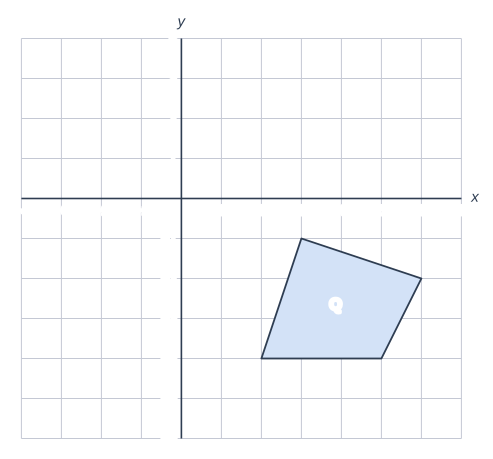
Shape P is translated by the vector \(\begin{pmatrix} 4 \\ -3 \end{pmatrix}\) to give shape Q.
Shape Q is drawn on the grid. Shape P is not shown.
Write down the coordinates of the four vertices of shape P.
Model answer
P is translated onto Q, so to get back from Q to P use the opposite vector \(\begin{pmatrix} -4 \\ 3 \end{pmatrix}\): 4 left and 3 up. \((2, -4) \rightarrow (-2, -1)\) \((5, -4) \rightarrow (1, -1)\) \((6, -2) \rightarrow (2, 1)\) \((3, -1) \rightarrow (-1, 2)\)
Explanation
The translation goes from P to Q, so to undo it you move each vertex of Q by the reverse vector, with both signs changed. A good check is to translate one of your answers by the original vector and see that it lands on a vertex of Q. Adding the given vector to Q's vertices moves Q further away instead of back to P.
Mark scheme
2 marks
B2 for \((-2, -1)\), \((1, -1)\), \((2, 1)\) and \((-1, 2)\)
In any order. B1 for two or three of these correct, or for all four of \((6, -7)\), \((9, -7)\), \((10, -5)\), \((7, -4)\) (the vector added to Q instead of subtracted).
Question 3
3 marks
The translation \(\begin{pmatrix} a \\ -3 \end{pmatrix}\) maps the point \((2, 5)\) onto a point on the line \(y = 2.5x - 6\).
Find the value of a.
Model answer
The image of \((2, 5)\) is \((2 + a, 5 - 3) = (2 + a, 2)\) It lies on \(y = 2.5x - 6\): \(2 = 2.5(2 + a) - 6\) \(8 = 2.5(2 + a)\) \(2 + a = 3.2\) \(a = 1.2\)
Explanation
Write the image in terms of a by adding the vector, then use the fact that its coordinates satisfy the equation of the line. The y-coordinate of the image is known, so the line gives the x-coordinate, 3.2, and a is how far the point moved across to get there. Remember the question asks for a, not the x-coordinate.
Mark scheme
1 mark
M1 for the image written as \((2 + a, 2)\)
Or for y-coordinate of the image = 2 seen; correct answer with no working scores full marks
1 mark
M1 for \(2 = 2.5(2 + a) - 6\) oe
Or for finding the x-coordinate of the point on the line with y = 2: \(2 = 2.5x - 6\), x = 3.2. FT their image.
1 mark
A1 for \(a = 1.2\)
Accept \(\dfrac{6}{5}\) oe. 3.2 (the x-coordinate of the image) as the final answer scores M1 M1 A0.
Question 4
4 marks
A shape is translated a distance of 9.6 units in a direction that makes an angle of 35° with the positive x-direction, upwards and to the right.
Write this translation as a column vector. Give each number correct to 1 decimal place.
Model answer
The translation is the hypotenuse of a right-angled triangle with hypotenuse 9.6 and angle 35° at the start. Across: \(9.6 \cos 35^\circ = 7.863...\) Up: \(9.6 \sin 35^\circ = 5.506...\) \(\begin{pmatrix} 7.9 \\ 5.5 \end{pmatrix}\)
Explanation
Split the movement into a horizontal part and a vertical part with right-angled triangle trigonometry. The side next to the 35° angle is the movement across (cos), and the side opposite is the movement up (sin). Both are positive because the movement is up and to the right; check that \(7.86^2 + 5.51^2\) is about \(9.6^2\).
Mark scheme
1 mark
M1 for \(9.6 \cos 35^\circ\) oe
9.6 is an exact value from the question. Or \(9.6 \sin 55^\circ\); correct answer with no working scores full marks
1 mark
A1 for top number 7.9
Accept 7.86 to 7.9 (7.8638...) in the top position.
1 mark
M1 for \(9.6 \sin 35^\circ\) oe
Or \(9.6 \cos 55^\circ\), or \(\sqrt{9.6^2 - \text{their } 7.86^2}\); accept 7.86 to 7.864 for their 7.86.
1 mark
A1 for bottom number 5.5
Accept 5.5 to 5.51 (5.5063...) in the bottom position. \(\begin{pmatrix} 5.5 \\ 7.9 \end{pmatrix}\) (sin and cos swapped) scores M1 A0 M1 A0.
Ready to try the rest? Every answer you write is marked against the mark scheme, so you can see exactly where the marks are.
Ctrl + Enter to check
Study HelperHints first, answers after you try
Stuck on this one? Ask for a hint and I’ll point you in the right direction, without giving the answer away. Once you’ve checked your answer, I’ll show you how the marks are awarded.