The big idea
Most metals are found in the Earth's crust as compounds, so they have to be extracted. Metals that are too reactive to be extracted with carbon are extracted by electrolysis of their molten compounds. Electrolysis uses huge amounts of energy, so it is only used when cheaper methods will not work. Aluminium is the most important example.
When is electrolysis needed?
Carbon can reduce (remove the oxygen from) the oxides of metals that are less reactive than carbon (see also: Extraction of metals and reduction).
| More reactive than carbon: electrolysis | Less reactive than carbon: reduction with carbon |
|---|
| potassium, sodium, lithium, calcium, magnesium, aluminium | zinc, iron, copper |
Electrolysis is used if:
- the metal is too reactive to be extracted by reduction with carbon, because carbon cannot remove the oxygen from its compounds; or
- the metal reacts with carbon, so heating its ore with carbon would give an unwanted compound instead of the pure metal.
The compound must be molten, not dissolved in water: in a solution of a reactive metal's compound, hydrogen would form at the cathode instead of the metal.
The energy cost. Large amounts of energy are used:
- to melt the compound and keep it molten, because ionic compounds have high melting points;
- to produce the electric current.
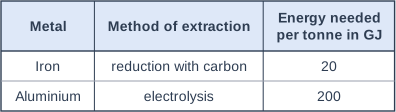
This makes electrolysis expensive, so aluminium costs more to produce than iron, which is extracted using carbon. Aluminium plants are often built where electricity is cheap, and recycling aluminium saves most of the energy, because the metal only has to be melted, with no electrolysis.
Extracting aluminium
Aluminium is manufactured by the electrolysis of aluminium oxide, Al₂O₃, which is purified from the ore bauxite.
| Part of the cell | What it is made of | Why |
|---|
| Electrolyte | Aluminium oxide dissolved in molten cryolite | The mixture melts at about 950 °C instead of over 2000 °C, so much less energy is needed |
| Positive electrode (anode) | Blocks of carbon (graphite) | Carbon conducts electricity and is cheap |
| Negative electrode (cathode) | The carbon lining of the steel tank | Collects the aluminium |
Why a mixture? Pure aluminium oxide melts at over 2000 °C. Dissolving it in molten cryolite gives a mixture with a much lower melting point, so less energy is needed to melt the electrolyte and keep it molten, which reduces costs.
At the electrodes:
- Negative electrode: aluminium ions, Al³⁺, gain electrons and form aluminium. The cell is hotter than the melting point of aluminium (660 °C), so the aluminium forms as a liquid. It sinks to the bottom of the cell and is tapped off.
- Positive electrode: oxide ions, O²⁻, lose electrons and form oxygen.
Overall: aluminium oxide → aluminium + oxygen. The aluminium oxide loses its oxygen, so it is reduced.
Why the positive electrode must be replaced
The oxygen made at the positive electrode reacts with the hot carbon to form carbon dioxide:
C(s) + O₂(g) → CO₂(g)
So the positive electrode gradually burns away and must be replaced regularly. The negative electrode does not wear away, because aluminium, not oxygen, forms there.
Higher tier only
Half equations.
- Negative electrode (cathode): Al³⁺ + 3e⁻ → Al. The aluminium ions gain electrons, so they are reduced.
- Positive electrode (anode): 2O²⁻ → O₂ + 4e⁻ (or 2O²⁻ − 4e⁻ → O₂). The oxide ions lose electrons, so they are oxidised.
Extracting magnesium
Magnesium is extracted by electrolysing molten magnesium chloride, MgCl₂, with graphite positive electrodes. Explain why electrolysis is used, and suggest why these positive electrodes last much longer than the ones in an aluminium cell.
- Magnesium is more reactive than carbon, so it cannot be extracted by reduction with carbon: electrolysis is needed.
- Magnesium ions, Mg²⁺, are attracted to the negative electrode, where magnesium forms. Chloride ions, Cl⁻, are attracted to the positive electrode, where chlorine forms.
- In the aluminium cell, oxygen forms at the carbon positive electrode and reacts with it, so the electrode burns away. Here the product at the positive electrode is chlorine, which does not burn the graphite away, so the electrode lasts much longer. The chlorine is a useful by-product that can be sold.
Remember
- Metals more reactive than carbon are extracted by electrolysis of their molten compounds.
- Energy is needed to melt the compound and to produce the current.
- Aluminium: aluminium oxide dissolved in molten cryolite, with carbon electrodes.
- Cryolite lowers the melting point, which saves energy.
- The carbon positive electrode reacts with oxygen to form carbon dioxide, so it is replaced regularly.
Common mistakes
- Saying cryolite is a catalyst, or that it lowers the boiling point. It lowers the melting point of the electrolyte.
- Saying the positive electrode "melts", "dissolves" or "corrodes". It reacts with the oxygen produced and burns away as carbon dioxide.
- Saying both electrodes must be replaced. Only the positive electrode reacts with oxygen.
- Saying electrolysis is used for unreactive metals. It is used for metals more reactive than carbon.
- Giving only one energy cost. Energy is needed to produce the current as well as to melt the compound.
Exam tip
For a 6-mark "describe and explain" answer on aluminium, work through the cell in order (the electrolyte, the negative electrode, the positive electrode) and give a reason after each fact, using "because" or "so".