Practise 9 exam-style questions on Diamond for AQA GCSE Combined Science (Chemistry Paper 1). Write your answer as you would in the exam and get it marked in seconds against the mark scheme, point by point, with the Study Helper on hand if you get stuck.
9 questions
1–6 marks each
Instant marking
No sign-up needed
9 questions, marked as you go
Sample questions with model answers
Here are 4 of the questions in this topic, each with a model answer, an explanation of why it earns the marks and the mark scheme an examiner would use.
Question 1
2 marks
Explain why diamond is very hard.
Model answer
In diamond each carbon atom is joined to four other carbon atoms by strong covalent bonds. These form a rigid giant covalent structure in three dimensions, so a very large number of strong bonds would have to be broken to scratch or break it.
Explanation
Hardness comes from the network of strong covalent bonds extending in all directions. There are no layers that can slide and no weak forces between molecules, because there are no molecules.
Mark scheme
1 mark
each carbon atom is joined to four other carbon atoms by (strong) covalent bonds
allow all atoms joined by strong covalent bonds
1 mark
in a giant (covalent) structure / rigid three-dimensional network
allow lots of strong bonds must be broken to scratch or break it
Question 2
2 marks
Diamond is used for the tips of drills that cut through rock. The tips get very hot during drilling.
Suggest two properties of diamond that make it suitable for the tips of these drills.
Model answer
Diamond is very hard, so it can cut through rock without wearing away, and it has a very high melting point, so it does not melt when the tip becomes very hot.
Explanation
Both properties come from the giant covalent structure: every carbon atom is held by four strong covalent bonds, which are very difficult to break.
Mark scheme
1 mark
very hard
allow does not wear away easily
1 mark
very high melting point / does not melt when it gets hot
Question 3
3 marks
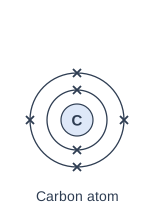
The diagram shows the electronic structure of a carbon atom.
Use the diagram to explain why each carbon atom forms four covalent bonds in diamond and why diamond has no delocalised electrons.
Model answer
The diagram shows that a carbon atom has four electrons in its outer shell (2,4). In diamond each of these electrons is shared with a neighbouring carbon atom, so each carbon atom forms four covalent bonds. All four outer electrons are used in bonds, so there are no electrons left over to become delocalised.
Explanation
The number of covalent bonds an atom forms depends on how many electrons it needs to share to complete its outer shell. Carbon has four outer electrons and in diamond all four are shared.
Mark scheme
1 mark
a carbon atom has four electrons in its outer shell
1 mark
each outer electron is shared with a different carbon atom, forming four covalent bonds / four shared pairs
1 mark
so all of the outer electrons are used in bonding and none are free to move / delocalised
Question 4
4 marks
In both diamond and methane, CH₄, each carbon atom forms four covalent bonds. Diamond has a very high melting point. Methane is a gas at room temperature.
Explain this difference.
Model answer
Methane is made of small molecules, each with one carbon atom bonded to four hydrogen atoms. The forces between the molecules are weak, so little energy is needed to overcome them, and the covalent bonds do not break; methane therefore boils at a very low temperature. In diamond each carbon atom is bonded to four other carbon atoms, forming a giant covalent structure with no separate molecules. To melt diamond, many strong covalent bonds must be broken, which needs a lot of energy, so its melting point is very high.
Explanation
The bonding within the molecule is similar, but the structures are different. In methane the four bonds join one carbon to hydrogen atoms in a small molecule; in diamond they join each carbon to other carbons in a giant network.
Mark scheme
1 mark
methane consists of small molecules
max 4
1 mark
there are weak intermolecular forces between methane molecules, which need little energy to overcome
1 mark
when methane changes state the covalent bonds are not broken
1 mark
diamond has a giant covalent structure / each carbon atom is bonded to four other carbon atoms throughout the structure
1 mark
to melt diamond, (many) strong covalent bonds must be broken, which needs a lot of energy
Ready to try the rest? Every answer you write is marked against the mark scheme, so you can see exactly where the marks are.
Ctrl + Enter to check
Study HelperHints first, answers after you try
Stuck on this one? Ask for a hint and I’ll point you in the right direction, without giving the answer away. Once you’ve checked your answer, I’ll show you how the marks are awarded.