Level:
Correct: 0
Incorrect: 0
Marks: 0/0
Exam Practice
Course:
Topics:
AQA GCSE Combined Science (Chemistry Paper 1) Smart practice A mixed round aimed at your weak spots
Unit 1
Atomic structure and the periodic table
Unit 2
Bonding, structure, and the properties of matter
Unit 3
Quantitative chemistry
Unit 4
Chemical changes
Unit 5
Energy changes
Avg
score:
–
Topics
done:
0/55

Metal oxides

Practise 10 exam-style questions on Metal oxides for AQA GCSE Combined Science (Chemistry Paper 1). Write your answer as you would in the exam and get it marked in seconds against the mark scheme, point by point, with the Study Helper on hand if you get stuck.

  • 10 questions
  • 1–4 marks each
  • Instant marking
  • No sign-up needed
10 questions, marked as you go

Sample questions with model answers

Here are 4 of the questions in this topic, each with a model answer, an explanation of why it earns the marks and the mark scheme an examiner would use.

Question 1

1 mark

Give the meaning of the term oxidation in terms of oxygen.

Model answer

Oxidation is the gain of oxygen by a substance.

Explanation

When a metal reacts with oxygen it gains oxygen and forms an oxide, so it is oxidised. The opposite process, the loss of oxygen, is reduction.

Mark scheme
  1. 1 mark

    gain of oxygen

    allow a substance gains / adds / combines with oxygen; do not accept loss of oxygen

Question 2

2 marks

A student heats a piece of shiny copper foil strongly in air. The surface of the foil turns black.

Name the black substance formed and explain why this reaction is an oxidation.

Model answer

The black substance is copper oxide. The reaction is an oxidation because the copper gains oxygen from the air.

Explanation

Copper reacts with oxygen in the air when heated: copper + oxygen → copper oxide. Any reaction in which a substance gains oxygen is an oxidation, so all reactions of metals with oxygen are oxidation reactions.

Mark scheme
  1. 1 mark

    copper oxide

    allow copper(II) oxide / CuO

  2. 1 mark

    (because) copper gains oxygen

    allow copper combines / reacts with oxygen (from the air) to form an oxide; do not accept copper loses oxygen

Question 3

3 marks

A student heated 1.20 g of magnesium ribbon in a crucible until it had all reacted with oxygen from the air. The mass of magnesium oxide formed was 2.00 g.

Explain why the mass of solid increased. Calculate the mass of oxygen that reacted with the magnesium.

Model answer

When magnesium is heated it reacts with (gains) oxygen from the air to form magnesium oxide. The oxygen was not included in the starting mass, but it becomes part of the solid product, so the mass of solid increases.
Mass of oxygen = 2.00 − 1.20 = 0.80 g

Explanation

Mass is conserved in the reaction: the mass of magnesium oxide equals the mass of magnesium plus the mass of oxygen that reacted. The mass of solid seems to increase only because the oxygen came from the air and was not weighed at the start.

Mark scheme
  1. 1 mark

    magnesium has combined with / gained oxygen (from the air)

    allow magnesium is oxidised by oxygen from the air

  2. 1 mark

    the oxygen atoms are now part of the solid (magnesium oxide), so the solid has the mass of the magnesium plus the mass of the oxygen

    allow oxygen is a gas from the air that was not weighed at the start

  3. 1 mark

    mass of oxygen = 2.00 − 1.20 = 0.80 (g)

    allow 0.8 (g)

Question 4

4 marks

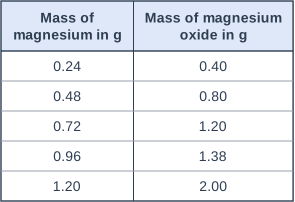
A class investigated the mass of magnesium oxide formed when different masses of magnesium were heated in a crucible with a lid. The table shows their results.

Identify the anomalous result and explain how you identified it. Suggest two reasons why the mass of magnesium oxide in this result was lower than expected.

Table with columns "Mass of magnesium in g", "Mass of magnesium oxide in g". Mass of magnesium in g: 0.24; Mass of magnesium oxide in g: 0.40 | Mass of magnesium in g: 0.48; Mass of magnesium oxide in g: 0.80 | Mass of magnesium in g: 0.72; Mass of magnesium oxide in g: 1.20 | Mass of magnesium in g: 0.96; Mass of magnesium oxide in g: 1.38 | Mass of magnesium in g: 1.20; Mass of magnesium oxide in g: 2.00.

Model answer

The anomalous result is 0.96 g of magnesium giving 1.38 g of magnesium oxide. In the other results the mass of oxide is 5/3 of the mass of magnesium, so 0.96 g should give 1.60 g.
Reason 1: not all of the magnesium had reacted with oxygen, for example because it was not heated for long enough.
Reason 2: some magnesium oxide smoke escaped from the crucible when the lid was lifted.

Explanation

The other four results all fit the same pattern (0.24 g → 0.40 g, 0.48 g → 0.80 g, and so on), so the result that does not fit is anomalous. A low mass of product means either less oxygen was gained than expected (incomplete oxidation) or some product was lost.

Mark scheme
  1. 1 mark

    the result for 0.96 g of magnesium / 1.38 g of magnesium oxide

  2. 1 mark

    the expected mass is 1.60 g / the other results show the mass of oxide is 5/3 of the mass of magnesium (or 1.67 times)

    allow any valid use of the pattern in the other results to justify the choice

  3. 1 mark

    not all the magnesium had reacted / was oxidised

    max 2 for the reasons; allow not heated for long enough / not heated strongly enough

  4. 1 mark

    some magnesium oxide (smoke) escaped when the lid was lifted

    allow some solid was lost / spilled from the crucible

  5. 1 mark

    the lid was not lifted often enough, so not enough oxygen got in

Ready to try the rest? Every answer you write is marked against the mark scheme, so you can see exactly where the marks are.

Revision notes

Metal oxides

The big idea

Most metals react with oxygen to form metal oxides. The metal gains oxygen, so the reaction is an oxidation. The opposite change, when a substance loses oxygen, is a reduction. You will use these two definitions again when you explain how metals are extracted from their compounds.

Metals reacting with oxygen

metal + oxygen → metal oxide

The more reactive the metal, the more readily and vigorously it reacts with oxygen:

  • Sodium and lithium react with oxygen in the air at room temperature, so a freshly cut surface quickly goes dull.
  • Magnesium burns with a bright white flame, leaving a white powder of magnesium oxide.
  • Copper does not burn, but when heated strongly its surface turns black as copper(II) oxide forms.
  • Gold does not react, even when heated strongly.

In symbol equations, oxygen is always O₂. Work out the oxide's formula from its ions, then balance. Copper(II) ions are Cu²⁺ and oxide ions are O²⁻, so copper(II) oxide is CuO, and one O₂ molecule makes two CuO:

2Cu(s) + O₂(g) → 2CuO(s)

Oxidation and reduction in terms of oxygen

ProcessDefinitionExample
Oxidationgain of oxygena metal reacting with oxygen to form its oxide
Reductionloss of oxygena metal oxide being turned back into the metal

Oxidation and reduction always happen together: if one substance loses oxygen, another must gain it. A reaction in which both happen is a redox reaction.

Which substance is oxidised?

A burning strip of magnesium is lowered into a gas jar of carbon dioxide. It keeps burning, leaving white magnesium oxide and black specks of carbon:

2Mg + CO₂ → 2MgO + C

Identify the substance oxidised and the substance reduced.

  • Magnesium becomes magnesium oxide. It gains oxygen, so magnesium is oxidised.
  • Carbon dioxide becomes carbon. It loses oxygen, so carbon dioxide is reduced.

Name the reactant each time. "Carbon is reduced" would be wrong: carbon is the product.

Why the mass goes up

When a metal is heated in air, the oxide weighs more than the metal did, because oxygen atoms from the air have joined on. The increase in mass is the mass of oxygen that combined. When magnesium is heated in a crucible, the lid is lifted now and then to let oxygen in, but kept on most of the time so the magnesium oxide smoke does not escape. Heating and reweighing until the mass stops changing (heating to constant mass) shows that all the metal has reacted.

Common mistakes

  • Writing O instead of O₂ for oxygen in a symbol equation.
  • Naming the product as the substance reduced. In NiO + H₂ → Ni + H₂O it is nickel(II) oxide that is reduced, not nickel.
  • Answering "combustion" or "burning" when asked for the type of reaction. The answer is oxidation.
  • Thinking a metal loses mass when it burns. It gains oxygen, so the product is heavier.

Exam tip

"Identify the substance oxidised and the substance reduced" questions usually give one mark for each name and one for each reason. Write both in full: "X is oxidised because it gains oxygen; Y is reduced because it loses oxygen."

Study Helper Hints first, answers after you try

Stuck on this one? Ask for a hint and I’ll point you in the right direction, without giving the answer away. Once you’ve checked your answer, I’ll show you how the marks are awarded.