Level:
Correct: 0
Incorrect: 0
Marks: 0/0
Exam Practice
Course:
Topics:
AQA GCSE Combined Science (Chemistry Paper 1) Smart practice A mixed round aimed at your weak spots
Unit 1
Atomic structure and the periodic table
Unit 2
Bonding, structure, and the properties of matter
Unit 3
Quantitative chemistry
Unit 4
Chemical changes
Unit 5
Energy changes
Avg
score:
–
Topics
done:
0/55

Mixtures

Practise 12 exam-style questions on Mixtures for AQA GCSE Combined Science (Chemistry Paper 1). Write your answer as you would in the exam and get it marked in seconds against the mark scheme, point by point, with the Study Helper on hand if you get stuck.

  • 12 questions
  • 1–6 marks each
  • Instant marking
  • No sign-up needed
12 questions, marked as you go

Sample questions with model answers

Here are 4 of the questions in this topic, each with a model answer, an explanation of why it earns the marks and the mark scheme an examiner would use.

Question 1

2 marks

Air is a mixture of gases, mainly nitrogen and oxygen. Pure oxygen relights a glowing splint. Many substances burn in air because of the oxygen it contains.

Explain, in terms of mixtures, why the oxygen in air has the same chemical properties as pure oxygen.

Model answer

In air the oxygen is only mixed with the nitrogen and other gases; it is not chemically combined with them. The chemical properties of each substance in a mixture are unchanged, so the oxygen in air still reacts in the same way as pure oxygen.

Explanation

Because no chemical reaction happens when substances are mixed, each substance keeps its own chemical properties. Substances burn less fiercely in air than in pure oxygen only because the oxygen is more spread out among other molecules, not because it has changed.

Mark scheme
  1. 1 mark

    the oxygen is not chemically combined with the nitrogen / other gases in air

    allow oxygen molecules are just mixed with the other gases

  2. 1 mark

    the chemical properties of each substance in a mixture are unchanged

    allow the oxygen is still oxygen / the same substance, so it reacts in the same way

Question 2

2 marks

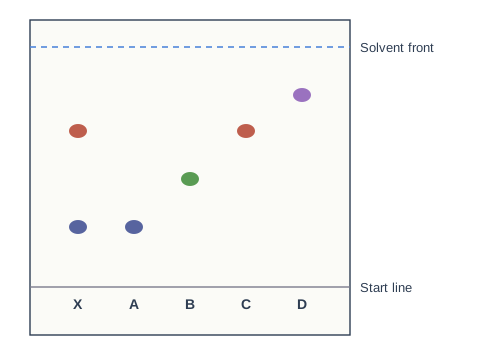
A student used paper chromatography to analyse a food colouring, X, and four dyes, A, B, C and D. The chromatogram shows the results.

Which dyes does food colouring X contain?
How does the chromatogram show that X is a mixture?

Paper chromatogram. The solvent front is 8 cm above the start line. X: 2 spots at 2 cm, 5.2 cm; A: one spot at 2 cm; B: one spot at 3.6 cm; C: one spot at 5.2 cm; D: one spot at 6.4 cm.

Model answer

X contains dyes A and C, because its two spots are at the same heights as the spots for A and C. X is a mixture because it separated into two different spots.

Explanation

Each dye travels a characteristic distance up the paper in a given solvent, so a spot in the mixture at the same height as a known dye is likely to be that dye. A single substance gives only one spot; a mixture separates into one spot for each dissolved substance.

Mark scheme
  1. 1 mark

    A and C

    both needed; do not accept if B or D is also given

  2. 1 mark

    X separates into two (different) spots

    allow X contains more than one substance / dye

Question 3

3 marks

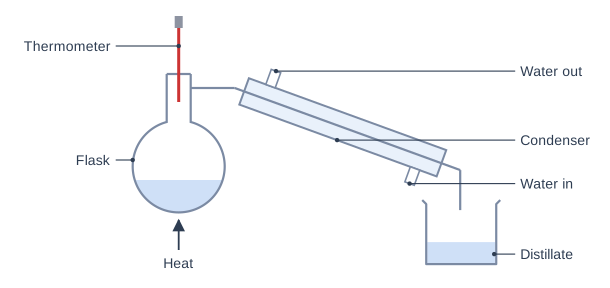
The diagram shows apparatus for the simple distillation of seawater.

Explain how this apparatus produces pure water from seawater.

Diagram of simple distillation apparatus. Labelled parts: Thermometer, Flask, Water out, Condenser, Water in, Distillate.

Model answer

When the seawater is heated, the water boils and turns into water vapour, but the salt does not evaporate because its boiling point is much higher. The water vapour passes into the condenser, which is cooled by cold water flowing through its outer jacket. The vapour condenses back into liquid water, which drips into the beaker as pure water (the distillate). The salt stays in the flask.

Explanation

Simple distillation separates a liquid from a solution because the solvent evaporates at a much lower temperature than the dissolved solid. It relies on two changes of state - evaporation then condensation - and no new substances are made, so it is a physical process.

Mark scheme
  1. 1 mark

    the seawater is heated so the water boils / evaporates but the salt does not

    max 3; allow salt has a much higher boiling point

  2. 1 mark

    the water vapour passes into the condenser where it is cooled (by cold water)

  3. 1 mark

    the vapour condenses into liquid (pure) water, collected as the distillate

  4. 1 mark

    the salt is left behind in the flask

Question 4

4 marks

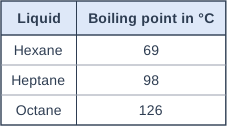
A mixture contains three liquids: hexane, heptane and octane. The table shows their boiling points.

Describe how fractional distillation separates the three liquids.
Your answer should include which liquid is collected first.

Table with columns "Liquid", "Boiling point in °C". Liquid: Hexane; Boiling point in °C: 69 | Liquid: Heptane; Boiling point in °C: 98 | Liquid: Octane; Boiling point in °C: 126.

Model answer

The mixture is heated in a flask with a fractionating column on top. The liquids evaporate and the vapours rise up the column, which is hottest at the bottom and coolest at the top. Vapours of liquids with higher boiling points condense in the column and run back down. Hexane has the lowest boiling point (69 °C), so its vapour reaches the top first; it passes into the condenser and is collected while the thermometer reads 69 °C. When the temperature rises to 98 °C, heptane is collected in a new container, and then octane at 126 °C.

Explanation

Fractional distillation separates liquids with different boiling points. The temperature gradient in the column means a liquid only gets to the top once the temperature there reaches its boiling point, so the liquids come off one at a time, lowest boiling point first.

Mark scheme
  1. 1 mark

    the mixture is heated so the liquids evaporate and the vapours rise up the fractionating column

    max 4

  2. 1 mark

    the column is hotter at the bottom and cooler at the top / there is a temperature gradient

  3. 1 mark

    each liquid reaches the top and condenses / is collected when the temperature reaches its boiling point; the thermometer shows which liquid is being collected

    allow collect each fraction at a different temperature

  4. 1 mark

    hexane is collected first because it has the lowest boiling point

    reason needed

  5. 1 mark

    then heptane (at about 98 °C) and then octane (at about 126 °C)

Ready to try the rest? Every answer you write is marked against the mark scheme, so you can see exactly where the marks are.

Revision notes

Mixtures

The big idea

A mixture consists of two or more elements or compounds that are not chemically combined. Because nothing has bonded, the chemical properties of each substance are unchanged, and the mixture can be separated by physical processes. Choosing the right technique depends on how the substances in the mixture differ.

Mixtures and compounds

MixtureCompound
Particlessubstances side by side, not bondedatoms of different elements chemically bonded
Compositionthe proportions can varyfixed proportions
Propertieseach substance keeps its own propertiesnew properties, different from its elements
Separatingby physical processesonly by chemical reactions

Air, sea water, crude oil and ink are all mixtures. Sea water is not a compound: the amount of salt in it varies, and evaporating the water leaves the salt behind unchanged.

The separation techniques below are physical processes: they do not involve chemical reactions and no new substances are made. The substances you collect were in the mixture all along.

The separation techniques

TechniqueUse it to separateIt works because
Filtrationan insoluble solid from a liquidsolid particles cannot pass through the filter paper
Crystallisationa dissolved solid from its solutionremoving some solvent and cooling leaves more solid than the solution can hold
Simple distillationa solvent from a solutionthe solvent boils at a much lower temperature than the dissolved solid
Fractional distillationliquids that mix but have different boiling pointseach liquid boils and condenses at a different temperature
Paper chromatographythe dyes in an ink or a food colouringthe substances have different solubilities in the solvent, so they travel different distances

Filtration and crystallisation

  • Filtration: the solid left on the filter paper is the residue; the liquid that passes through is the filtrate. Dissolved substances pass through with the water, so the filtrate from salty water is still salt solution.
  • Crystallisation: heat the solution in an evaporating basin to evaporate some of the water, until crystals start to form at the edge. Leave it to cool so crystals form, then filter them off and pat them dry between filter papers. Do not heat to dryness: the crystals are small, the solid may spit out, and some solids decompose. Blue copper sulfate crystals lose their water and turn into a white powder.

Distillation

Diagram of simple distillation apparatus. Labelled parts: Thermometer, Flask, Water out, Condenser, Water in, Distillate.
Simple distillation: the vapour is cooled in the condenser, and the pure liquid (the distillate) is collected.
  • Simple distillation: the solution is heated and the solvent evaporates. The vapour is cooled in the condenser and condenses back into a pure liquid, which is collected. The dissolved solid stays in the flask. The thermometer shows the boiling point of the liquid being collected (100 °C for water). Cold water enters the condenser at the bottom so that it stays full. Add anti-bumping granules so the liquid boils smoothly, and never heat the flask until it is dry.
  • Fractional distillation: a fractionating column sits above the flask. It is hotter at the bottom and cooler at the top. The liquid with the lowest boiling point reaches the top first and is collected, while the others condense in the column and run back. The thermometer stays steady at the boiling point of the liquid distilling; when it rises, change the collecting vessel. This is how crude oil and liquid air are separated.

Chromatography

Draw the start line in pencil, because pencil does not dissolve and move with the solvent. Put spots of the sample on the line and stand the paper in a solvent, with the solvent level below the start line so the spots do not wash off into it. As the solvent rises, each substance moves a different distance. In the same solvent, the same substance always travels the same distance, so matching spots identify substances (see also: Chromatography). A spot that stays on the start line is insoluble in that solvent: try a different one.

Planning a separation

A camper has muddy sea water: water containing soil particles and dissolved salt. Explain why filtering it does not give drinking water, and describe how to get pure water from it.

  1. Filter it. The soil is insoluble, so it stays on the filter paper as the residue.
  2. The salt is dissolved, so it passes through the paper with the water. The filtrate is still salt solution.
  3. Use simple distillation on the filtrate. The water evaporates, but the salt does not, because its boiling point is far higher. The water vapour condenses in the condenser and is collected as pure water, while the salt stays in the flask.

Common mistakes

  • Defining a mixture as "two or more elements joined together". That is a compound: in a mixture the substances are not chemically combined.
  • Saying the filtrate is pure water. Dissolved substances pass through filter paper.
  • Heating a solution until all the water has gone to make crystals. Evaporate only some of it, then leave it to cool.
  • Using fractional distillation for salt water, or simple distillation for two liquids with close boiling points.
  • Saying crystallisation is a chemical reaction because a solid appears. No new substance is made: the solid was dissolved in the solution all along.

Exam tip

For "suggest a method" questions, name the technique and link it to the property it uses: "filtration, because the sand is insoluble". For a mixture of three substances, give the steps in order, removing any insoluble solid first.

Study Helper Hints first, answers after you try

Stuck on this one? Ask for a hint and I’ll point you in the right direction, without giving the answer away. Once you’ve checked your answer, I’ll show you how the marks are awarded.