Level:
Correct: 0
Incorrect: 0
Marks: 0/0
Exam Practice
Course:
Topics:
AQA GCSE Combined Science (Chemistry Paper 1) Smart practice A mixed round aimed at your weak spots
Unit 1
Atomic structure and the periodic table
Unit 2
Bonding, structure, and the properties of matter
Unit 3
Quantitative chemistry
Unit 4
Chemical changes
Unit 5
Energy changes
Avg
score:
–
Topics
done:
0/55

Relative atomic mass

Practise 9 exam-style questions on Relative atomic mass for AQA GCSE Combined Science (Chemistry Paper 1). Write your answer as you would in the exam and get it marked in seconds against the mark scheme, point by point, with the Study Helper on hand if you get stuck.

  • 9 questions
  • 1–4 marks each
  • Instant marking
  • No sign-up needed
9 questions, marked as you go

Sample questions with model answers

Here are 4 of the questions in this topic, each with a model answer, an explanation of why it earns the marks and the mark scheme an examiner would use.

Question 1

2 marks

What is meant by the relative atomic mass of an element?

Model answer

The relative atomic mass is an average value of the mass of the atoms of an element that takes account of the abundance of each of its isotopes.

Explanation

Most elements are a mixture of isotopes with different mass numbers. The relative atomic mass is a weighted average, so a common isotope affects it much more than a rare one.

Mark scheme
  1. 1 mark

    an average / mean mass of the atoms of the element

    allow average of the mass numbers of the isotopes

  2. 1 mark

    that takes account of the abundance of each isotope

    allow weighted by the percentage of each isotope

Question 2

2 marks

The relative atomic mass of chlorine is 35.5. Every chlorine atom has a whole-number mass number.

Explain why the relative atomic mass of chlorine is not a whole number.

Model answer

Chlorine is a mixture of isotopes with different mass numbers, chlorine-35 and chlorine-37. The relative atomic mass is an average of their masses that takes account of how abundant each isotope is, so it does not have to be a whole number.

Explanation

No single chlorine atom has a mass of 35.5. The value comes from averaging many atoms: three-quarters chlorine-35 and one-quarter chlorine-37.

Mark scheme
  1. 1 mark

    chlorine has isotopes / atoms with different mass numbers (35 and 37)

    allow atoms with different numbers of neutrons

  2. 1 mark

    the relative atomic mass is an average that takes account of the abundance of each isotope

    allow mean / weighted average

Question 3

3 marks

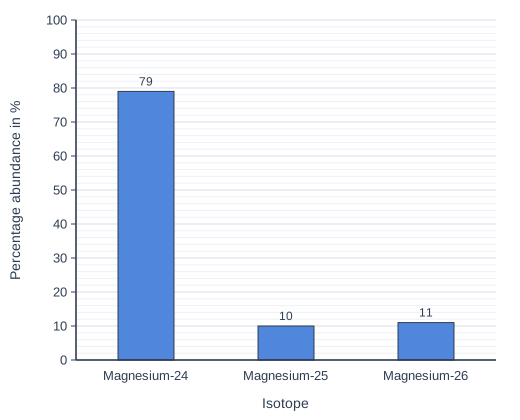
The bar chart shows the percentage abundance of the three isotopes of magnesium.

Calculate the relative atomic mass of magnesium.
Give your answer to 1 decimal place.

Bar chart of percentage abundance in % for each isotope: Magnesium-24 79, Magnesium-25 10, Magnesium-26 11.

Model answer

Ar = (24 × 79 + 25 × 10 + 26 × 11) ÷ 100
= (1896 + 250 + 286) ÷ 100
= 2432 ÷ 100
= 24.32
= 24.3 (1 d.p.)

Explanation

The same method works for any number of isotopes: multiply each mass number by its abundance, add all the products and divide by the total abundance (100%). Check that the percentages add up to 100 before you start.

Mark scheme
  1. 1 mark

    (24 × 79) + (25 × 10) + (26 × 11)

    an answer of 24.3 scores 3 marks

  2. 1 mark

    2432 ÷ 100 = 24.32

    allow ecf from one incorrect product

  3. 1 mark

    24.3

    answer to 1 decimal place; allow ecf

Question 4

3 marks

Gallium has two isotopes:
gallium-69, percentage abundance 60.1%
gallium-71, percentage abundance 39.9%

Calculate the relative atomic mass of gallium.
Give your answer to 3 significant figures.

Model answer

Ar = (69 × 60.1 + 71 × 39.9) ÷ 100
= (4146.9 + 2832.9) ÷ 100
= 6979.8 ÷ 100
= 69.798
= 69.8 (3 s.f.)

Explanation

The method is the same for any element, even one you have not met. Rounding 69.798 to 3 significant figures gives 69.8, which sits between 69 and 71 but closer to 69 because gallium-69 is more abundant.

Mark scheme
  1. 1 mark

    (69 × 60.1) + (71 × 39.9)

    an answer of 69.8 scores 3 marks

  2. 1 mark

    6979.8 ÷ 100 = 69.798

    allow ecf from one incorrect product

  3. 1 mark

    69.8

    answer to 3 significant figures; allow ecf

Ready to try the rest? Every answer you write is marked against the mark scheme, so you can see exactly where the marks are.

Revision notes

Relative atomic mass

The big idea

Most elements are a mixture of isotopes: atoms with the same number of protons but different numbers of neutrons, so different masses. The relative atomic mass (Ar) of an element is an average value that takes account of the abundance of each isotope. That is why many Ar values in the periodic table, such as 35.5 for chlorine, are not whole numbers, even though every single atom has a whole-number mass number.

Calculating relative atomic mass

The percentage abundance of an isotope is the percentage of the element's atoms that are that isotope. The abundances of all the isotopes add up to 100%.

Multiply each isotope's mass number by its abundance, add the results, and divide by the total abundance, which is 100 when the abundances are percentages:

\[A_r = \dfrac{(\text{mass}_1 \times \text{abundance}_1) + (\text{mass}_2 \times \text{abundance}_2) + \dots}{\text{total abundance}}\]

This is a weighted mean: the more common an isotope is, the more it counts. So the answer always lies between the smallest and largest mass numbers, and nearest to the most abundant isotope. Use this as a quick check on every answer.

Abundances given as a ratio

Antimony has two isotopes. Antimony-121 and antimony-123 atoms are found in the ratio 4 : 3. Calculate the relative atomic mass of antimony to 1 decimal place.

The total abundance is \(4 + 3 = 7\) parts, so divide by 7, not by 100.

\(A_r = \dfrac{(121 \times 4) + (123 \times 3)}{7} = \dfrac{484 + 369}{7} = \dfrac{853}{7} = 121.857\ldots\)

To 1 decimal place: 121.9

Check: 121.9 lies between 121 and 123, and nearer 121, the more common isotope. The periodic table gives 122.

Common mistakes

  • Taking a simple mean of the mass numbers, such as \((121 + 123) \div 2\). That only works if the isotopes are equally abundant.
  • Saying the relative atomic mass is the mass of one atom. No antimony atom has a mass of 121.9: each has a mass number of 121 or 123, and Ar is an average.
  • Leaving out a rare isotope, or dividing by the number of isotopes instead of the total abundance.
  • Not giving the answer to the number of decimal places asked for.

Exam tip

Write out the whole calculation before you work it out, such as \((121 \times 4) + (123 \times 3)\), because the method mark is awarded even if you slip later. Then give the answer to the decimal places the question asks for.

Study Helper Hints first, answers after you try

Stuck on this one? Ask for a hint and I’ll point you in the right direction, without giving the answer away. Once you’ve checked your answer, I’ll show you how the marks are awarded.