Level:
Correct: 0
Incorrect: 0
Marks: 0/0
Exam Practice
Course:
Topics:
AQA GCSE Combined Science (Chemistry Paper 1) Smart practice A mixed round aimed at your weak spots
Unit 1
Atomic structure and the periodic table
Unit 2
Bonding, structure, and the properties of matter
Unit 3
Quantitative chemistry
Unit 4
Chemical changes
Unit 5
Energy changes
Avg
score:
–
Topics
done:
0/55

Properties of metals and alloys

Practise 11 exam-style questions on Properties of metals and alloys for AQA GCSE Combined Science (Chemistry Paper 1). Write your answer as you would in the exam and get it marked in seconds against the mark scheme, point by point, with the Study Helper on hand if you get stuck.

  • 11 questions
  • 1–6 marks each
  • Instant marking
  • No sign-up needed
11 questions, marked as you go

Sample questions with model answers

Here are 4 of the questions in this topic, each with a model answer, an explanation of why it earns the marks and the mark scheme an examiner would use.

Question 1

2 marks

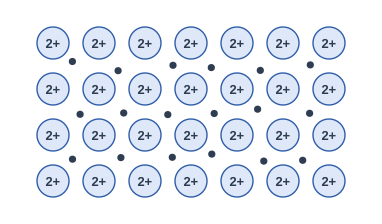
The diagram shows the arrangement of particles in a pure metal.

Explain why pure metals can be bent and shaped.

Metallic structure: a regular grid of positive metal ions (circles marked "2+") with small dots (electrons) scattered between them.

Model answer

In a pure metal all the atoms are the same size and are arranged in regular layers. When a force is applied, the layers can slide over each other, so the metal can be bent and shaped.

Explanation

Because all the atoms in a pure metal are identical, the layers are regular and slide easily. This is also why pure metals are often too soft for many uses.

Mark scheme
  1. 1 mark

    the atoms / ions are arranged in layers

    allow rows; allow regular arrangement of atoms of the same size

  2. 1 mark

    the layers can slide over each other (when a force is applied)

Question 2

2 marks

Alloys have metallic bonding.

Name the particles in an alloy that are attracted to each other in metallic bonding, and explain why alloys usually have high melting points.

Model answer

In metallic bonding there is a strong electrostatic attraction between the positive metal ions and the delocalised electrons. This bonding is strong and acts throughout the giant structure, so a lot of energy is needed to overcome it and alloys usually have high melting points.

Explanation

Alloys are mixtures of metals but the bonding is still metallic: positive ions of the different metals surrounded by delocalised electrons. Only the arrangement of the layers is changed.

Mark scheme
  1. 1 mark

    positive (metal) ions and delocalised electrons

    both needed

  2. 1 mark

    the metallic bonding / attraction is strong, so a lot of energy is needed to overcome it

    allow giant structure with strong bonds

Question 3

3 marks

Most metals have high melting points, but mercury melts at −39 °C.

Give the state of mercury at room temperature (20 °C), and suggest what its melting point shows about the metallic bonding in mercury compared with most other metals.

Model answer

Mercury is a liquid at room temperature. Its very low melting point suggests that the metallic bonding in mercury is much weaker than in most metals, so much less energy is needed to overcome it.

Explanation

The melting point tells you how much energy is needed to overcome the forces between particles. 'Most metals have high melting points' is a generalisation: mercury is an exception.

Mark scheme
  1. 1 mark

    liquid

  2. 1 mark

    the metallic bonding in mercury is weaker (than in most metals)

  3. 1 mark

    so less energy is needed to overcome the bonding / to melt it

Question 4

4 marks

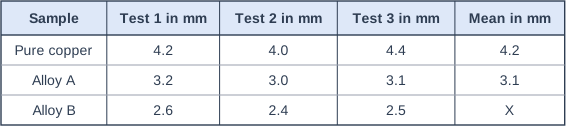
A student tested the hardness of pure copper and two copper alloys, A and B. She dropped a heavy weight onto a steel ball resting on each sample and measured the diameter of the dent made. A smaller dent means a harder sample. The table shows her results.

Calculate the mean dent diameter X for alloy B. Identify the hardest sample and explain why it is harder than pure copper.

Table with columns "Sample", "Test 1 in mm", "Test 2 in mm", "Test 3 in mm", "Mean in mm". Sample: Pure copper; Test 1 in mm: 4.2; Test 2 in mm: 4.0; Test 3 in mm: 4.4; Mean in mm: 4.2 | Sample: Alloy A; Test 1 in mm: 3.2; Test 2 in mm: 3.0; Test 3 in mm: 3.1; Mean in mm: 3.1 | Sample: Alloy B; Test 1 in mm: 2.6; Test 2 in mm: 2.4; Test 3 in mm: 2.5; Mean in mm: X.

Model answer

X = (2.6 + 2.4 + 2.5) ÷ 3 = 7.5 ÷ 3 = 2.5 mm
Alloy B is the hardest, because it made the smallest dents. Alloy B contains atoms of different sizes, which distort the regular layers of copper atoms, so the layers cannot slide over each other as easily as in pure copper.

Explanation

The mean is the sum of the repeat results divided by the number of results. A smaller dent shows a harder material; alloys are harder than pure metals because the different sized atoms distort the layers.

Mark scheme
  1. 1 mark

    X = (2.6 + 2.4 + 2.5) ÷ 3 = 2.5 (mm)

  2. 1 mark

    alloy B is the hardest because it has the smallest (mean) dent diameter

    allow ecf from an incorrect mean

  3. 1 mark

    the alloy contains atoms of different sizes which distort the layers

  4. 1 mark

    so the layers cannot slide over each other as easily

Ready to try the rest? Every answer you write is marked against the mark scheme, so you can see exactly where the marks are.

Revision notes

Properties of metals and alloys

The big idea

Metals have giant structures held together by strong metallic bonding, so most metals have high melting and boiling points. In a pure metal the atoms are arranged in layers that can slide over each other, so the metal can be bent and shaped. That also makes pure metals too soft for many uses, so they are mixed with other metals to make alloys, which are harder.

Metallic structure and bonding

In a metal, the electrons in the outer shells of the atoms are delocalised: they are free to move through the whole structure. This leaves positive metal ions, arranged in a regular pattern of layers, surrounded by a "sea" of delocalised electrons.

Metallic structure: a regular grid of positive metal ions (circles marked "+") with small dots (electrons) scattered between them. Label positive metal ion points to one of the circles. Label delocalised electron points to one of the small dots. (positive metal ion = positive metal ion; delocalised electron = delocalised electron.)
A metal: a regular arrangement of positive metal ions in a sea of delocalised electrons.

Metallic bonding is the strong electrostatic attraction between the positive metal ions and the delocalised electrons. It acts in all directions throughout the giant structure. A lot of energy is needed to overcome it, so most metals have high melting and boiling points: copper, for example, melts at 1085 °C.

"Most" matters. Mercury melts at −39 °C, so it is a liquid at room temperature, and sodium melts below 100 °C. These metals still have metallic bonding, but it is weaker, so less energy is needed to overcome it.

Why pure metals can be bent and shaped

In a pure metal all the atoms are the same size, so they pack into regular layers. When a force is applied, the layers can slide over each other. The metallic bonding still holds the atoms together as the layers move, so the metal changes shape instead of breaking: it can be hammered into sheets, bent into pipes and drawn out into wires.

The same sliding makes pure metals soft. Pure gold, copper, iron and aluminium are too soft for many uses: they bend, dent or wear away too easily.

Alloys

An alloy is a mixture of a metal with one or more other elements, usually other metals. For example, brass is copper mixed with zinc, and steel is iron mixed with a small amount of carbon. An alloy is a mixture, not a compound: the elements are not chemically combined in a fixed ratio, so the proportions can be changed to suit a use.

Particle diagram: box Pure metal shows single atoms of one element (all the same colour) in a regular, closely packed arrangement (solid); box Alloy shows two kinds of separate atoms mixed together in a regular, closely packed arrangement (solid).
A pure metal has layers of atoms that are all the same size. An alloy has atoms of a different size (orange) mixed in; in a real alloy these distort the layers, which this simple diagram does not show.

Why alloys are harder than pure metals:

  1. The atoms of the added element are a different size from the atoms of the main metal.
  2. They distort the layers of atoms in the structure.
  3. So it is more difficult for the layers to slide over each other, and the alloy is harder.

It does not matter whether the added atoms are bigger or smaller: the small carbon atoms in steel still distort the layers of iron atoms. The layers can still slide a little, but far less easily than in the pure metal, and an alloy can be harder than every metal in it. Alloys still have metallic bonding, so they usually have high melting points too.

Data from a bending test

A student measures the force needed to bend strips of pure aluminium and of an aluminium alloy, all the same size, by 1 cm.

StripTest 1 in NTest 2 in NTest 3 in N
Pure aluminium141315
Aluminium alloy413043

Identify the anomalous result, calculate each mean, and explain the difference.

The 30 N result is anomalous: it is far from the other two alloy results, so leave it out of the mean.

Pure aluminium: \(\dfrac{14 + 13 + 15}{3} = 14\) N

Alloy: \(\dfrac{41 + 43}{2} = 42\) N

The alloy needs three times the force to bend it, so it is harder. The atoms of the other metals in the alloy are a different size from the aluminium atoms, so they distort the layers and make it more difficult for the layers to slide over each other.

Common mistakes

  • Saying pure metals are soft because metallic bonding is weak. The bonding is strong; softness comes from the layers sliding over each other.
  • Writing "the atoms slide". Say the layers of atoms slide.
  • Calling an alloy a compound. It is a mixture with no fixed formula.
  • Saying the layers in an alloy "cannot move at all". They slide less easily.
  • Thinking only larger atoms make a metal harder. Atoms of any different size distort the layers.

Exam tip

"Explain why alloys are harder than pure metals" is usually worth 3 marks: atoms of a different size, which distort the layers, so the layers cannot slide over each other as easily. "Distort" is the specification's word, so use it. In longer questions about uses, link structure to property to use, for both the pure metal and the alloy.

Study Helper Hints first, answers after you try

Stuck on this one? Ask for a hint and I’ll point you in the right direction, without giving the answer away. Once you’ve checked your answer, I’ll show you how the marks are awarded.