Level:
Correct: 0
Incorrect: 0
Marks: 0/0
Exam Practice
Course:
Topics:
AQA GCSE Combined Science (Chemistry Paper 1) Smart practice A mixed round aimed at your weak spots
Unit 1
Atomic structure and the periodic table
Unit 2
Bonding, structure, and the properties of matter
Unit 3
Quantitative chemistry
Unit 4
Chemical changes
Unit 5
Energy changes
Avg
score:
–
Topics
done:
0/55

Covalent bonding

Practise 18 exam-style questions on Covalent bonding for AQA GCSE Combined Science (Chemistry Paper 1). Write your answer as you would in the exam and get it marked in seconds against the mark scheme, point by point, with the Study Helper on hand if you get stuck.

  • 18 questions
  • 1–6 marks each
  • Instant marking
  • No sign-up needed
18 questions, marked as you go

Sample questions with model answers

Here are 4 of the questions in this topic, each with a model answer, an explanation of why it earns the marks and the mark scheme an examiner would use.

Question 1

2 marks

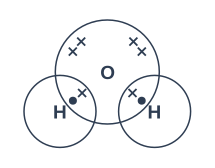
The diagram shows a dot and cross diagram for a molecule of water, H₂O. Only the outer shells are shown.

How many electrons are in the outer shell of the oxygen atom in the molecule?
How many of these electrons came from the hydrogen atoms?

Dot and cross diagram (outer shells only) of a water molecule, H₂O: overlapping circles for the atoms, 2 shared pairs of electrons in the overlaps and 2 lone pairs.

Model answer

The oxygen atom has 8 electrons in its outer shell: two shared pairs and two lone pairs. Two of these electrons came from the hydrogen atoms, one from each.

Explanation

Oxygen has 6 outer electrons of its own. It shares one electron with each hydrogen atom, and each hydrogen shares one electron back, so oxygen gains a share of 2 extra electrons, giving 8.

Mark scheme
  1. 1 mark

    8

  2. 1 mark

    2

Question 2

2 marks

A ball and stick model of a hydrogen peroxide molecule shows two oxygen atoms joined to each other, with one hydrogen atom joined to each oxygen atom. Each stick represents a single covalent bond.

Give the molecular formula of hydrogen peroxide and the number of covalent bonds in one molecule.

Model answer

The molecular formula is H₂O₂. There are 3 covalent bonds: one between the two oxygen atoms and one between each oxygen atom and a hydrogen atom.

Explanation

A molecular formula gives the actual number of each type of atom in one molecule, so it is not simplified: HO would be the simplest ratio, but the molecule has two of each atom. Each oxygen forms two bonds and each hydrogen forms one.

Mark scheme
  1. 1 mark

    H₂O₂

    do not accept HO

  2. 1 mark

    3

    one O–O and two O–H bonds

Question 3

3 marks

In a displayed formula, each covalent bond is shown as a line between two atoms.

How many lines are drawn between the two atoms in each of these molecules? Give a reason for each answer.
hydrogen chloride, HCl
oxygen, O₂
nitrogen, N₂

Model answer

Hydrogen chloride: 1 line (H–Cl), because one pair of electrons is shared.
Oxygen: 2 lines (O=O), because two pairs of electrons are shared - each oxygen atom needs two more electrons.
Nitrogen: 3 lines (N≡N), because three pairs of electrons are shared - each nitrogen atom needs three more electrons.

Explanation

Each line stands for one shared pair of electrons. The number of shared pairs between two atoms depends on how many electrons each atom needs to complete its outer shell.

Mark scheme
  1. 1 mark

    HCl: 1 line, because one pair of electrons is shared (H–Cl)

    number and reason needed for each mark

  2. 1 mark

    O₂: 2 lines, because two pairs of electrons are shared (O=O)

    allow each oxygen needs two more electrons

  3. 1 mark

    N₂: 3 lines, because three pairs of electrons are shared (N≡N)

    allow each nitrogen needs three more electrons

Question 4

4 marks

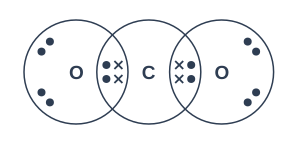
The diagram shows a dot and cross diagram for a molecule of carbon dioxide, CO₂. Only the outer shells are shown.

Explain how the diagram shows that each atom has a full outer shell, and why each carbon-oxygen bond is a double bond.

Dot and cross diagram (outer shells only) of a carbon dioxide molecule, CO₂: overlapping circles for the atoms, 4 shared pairs of electrons in the overlaps and 4 lone pairs.

Model answer

Carbon has 4 outer electrons and needs 4 more; each oxygen has 6 and needs 2 more. The carbon atom shares two pairs of electrons with each oxygen atom, so each carbon-oxygen bond is a double bond. Carbon then has 8 outer electrons, made up of four shared pairs, and each oxygen has 8 outer electrons: two shared pairs plus two lone pairs.

Explanation

Each oxygen atom needs two electrons, so it must share two pairs with carbon. Two double bonds give carbon its four extra electrons. The displayed formula is O=C=O.

Mark scheme
  1. 1 mark

    carbon shares two pairs of electrons with each oxygen atom

    max 4

  2. 1 mark

    so each bond is a double bond (two shared pairs)

  3. 1 mark

    carbon has 8 outer electrons (four shared pairs)

  4. 1 mark

    each oxygen has 8 outer electrons (two shared pairs and two lone pairs)

  5. 1 mark

    carbon has 4 outer electrons and needs 4 more; each oxygen has 6 and needs 2 more

Ready to try the rest? Every answer you write is marked against the mark scheme, so you can see exactly where the marks are.

Revision notes

Covalent bonding

The big idea

When atoms share pairs of electrons, they form covalent bonds. Covalent bonds form between non-metal atoms, and they are strong. Covalently bonded substances may be small molecules, very large molecules (such as polymers) or giant covalent structures. You need to draw and read diagrams of covalent bonds, and know what each kind of diagram cannot show.

What a covalent bond is

A covalent bond is a shared pair of electrons between two atoms. Usually each atom provides one electron of the pair. The negative shared pair is attracted to the positive nuclei of both atoms, and this holds the atoms together.

An atom usually forms enough bonds to fill its outer shell: eight electrons, or two for hydrogen.

AtomOuter electronsElectrons neededCovalent bonds formed
Hydrogen, H111
Chlorine, Cl (Group 7)711
Oxygen, O (Group 6)622
Nitrogen, N (Group 5)533
Carbon, C (Group 4)444

Elements in the same group form the same number of bonds.

Dot and cross diagrams of small molecules

In a dot and cross diagram the outer shells are drawn as overlapping circles. The shared pairs sit in the overlap. The other outer electrons are drawn in pairs called lone pairs (non-bonding pairs). Dots and crosses show which atom each electron came from.

Dot and cross diagram (outer shells only) of a water molecule, H₂O: overlapping circles for the atoms, 2 shared pairs of electrons in the overlaps and 2 lone pairs. Labelled: Water, H₂O.
Water: two shared pairs (one with each hydrogen atom) and two lone pairs on the oxygen atom.
MoleculeShared pairsLone pairsDisplayed formula
Hydrogen, H₂10H–H
Chlorine, Cl₂16 (3 on each Cl)Cl–Cl
Hydrogen chloride, HCl13 (on the Cl)H–Cl
Oxygen, O₂2 (a double bond)4 (2 on each O)O=O
Nitrogen, N₂3 (a triple bond)2 (1 on each N)N≡N
Water, H₂O22 (on the O)H–O–H
Ammonia, NH₃31 (on the N)N joined to three H atoms
Methane, CH₄40C joined to four H atoms

Check every diagram: count the outer electrons around each atom, counting each shared pair for both atoms. Every atom should have eight, except hydrogen, which has two.

Three kinds of covalent substance

  • Small molecules contain only a few atoms, such as H₂O, CO₂, NH₃ and CH₄. A formula with just a few non-metal atoms usually means small molecules.
  • Very large molecules, such as polymers, are long chains of thousands of atoms. A polymer is drawn as its repeating unit in brackets, followed by n, a large number: the number of repeating units in the chain.
  • Giant covalent structures, such as diamond and silicon dioxide, have a huge number of atoms all joined by covalent bonds in a network. There are no separate molecules, so the formula SiO₂ is a ratio of atoms. In a diagram of part of the structure, each line is one covalent bond: every carbon atom in diamond has four.
Displayed formula of the repeating unit of an addition polymer (substituent H) (labelled "Poly(ethene)"). (Poly(ethene) = the repeating unit of an addition polymer (substituent H).)
The repeating unit of poly(ethene): the bonds that cross the brackets join each unit to the next.

All three kinds contain strong covalent bonds. A structure is "giant" because its covalent bonds continue right through it, not because its bonds are stronger.

Representations and their limitations

RepresentationShows wellLimitations
Dot and cross diagramShared pairs, lone pairs and which atom each electron came fromNo 3D shape; atoms not to scale
Displayed formula (a line for each single bond, two lines for a double bond)Which atoms are joined, and by how many bondsNo electrons or lone pairs; no 3D shape (water looks straight but is bent)
Ball and stick modelThe 3D shape and the arrangement of the atomsSticks are not real; atoms too far apart and not to scale; no electrons
Space-filling modelRelative sizes of the atoms and the overall shapeBonds and electrons cannot be seen

To deduce the molecular formula from any of these, count every atom of each element. A molecular formula gives the actual numbers of atoms in one molecule, so ethane (two carbon atoms, six hydrogen atoms) is C₂H₆, not the simplest ratio CH₃.

Building a displayed formula from the bonds each atom forms

Hydrogen cyanide has the molecular formula HCN. Work out its displayed formula, the number of shared pairs and the number of lone pairs.

Bonds formed: hydrogen 1, carbon 4, nitrogen 3.

Hydrogen forms only one bond, so it goes at the end, joined to the carbon: H–C.

Carbon still needs 3 bonds and nitrogen needs 3, so they share three pairs, a triple bond: H–C≡N.

Shared pairs: \(1 + 3 = 4\)

Lone pairs: nitrogen has 5 outer electrons and uses 3 in bonds, so 2 are left: one lone pair on the nitrogen. Carbon and hydrogen have none.

Check: carbon has \(4 \times 2 = 8\) outer electrons, nitrogen has \(3 \times 2 + 2 = 8\) and hydrogen has 2.

Common mistakes

  • Defining a covalent bond as "sharing electrons". It is a shared pair of electrons.
  • Drawing two shared pairs in Cl₂. Each chlorine atom needs only one more electron, so there is one shared pair; two would give each atom nine outer electrons.
  • Counting lone pairs as bonds. Only the pairs in the overlap are shared.
  • Counting a double bond as one shared pair. A double bond is two shared pairs.
  • Thinking strong covalent bonds make a substance giant. Methane has strong covalent bonds but is made of small molecules.

Exam tip

For "give the limitations" questions, compare the diagram with a real molecule: real molecules are 3D, bonds are shared pairs of electrons rather than sticks or lines, and the atoms are much closer together than models suggest. Name exactly what the diagram does not show, such as the lone pairs, the shape or the relative sizes of the atoms.

Study Helper Hints first, answers after you try

Stuck on this one? Ask for a hint and I’ll point you in the right direction, without giving the answer away. Once you’ve checked your answer, I’ll show you how the marks are awarded.