Level:
Correct: 0
Incorrect: 0
Marks: 0/0
Exam Practice
Course:
Topics:
AQA GCSE Combined Science (Chemistry Paper 1) Smart practice A mixed round aimed at your weak spots
Unit 1
Atomic structure and the periodic table
Unit 2
Bonding, structure, and the properties of matter
Unit 3
Quantitative chemistry
Unit 4
Chemical changes
Unit 5
Energy changes
Avg
score:
–
Topics
done:
0/55

Chemical measurements

Practise 9 exam-style questions on Chemical measurements for AQA GCSE Combined Science (Chemistry Paper 1). Write your answer as you would in the exam and get it marked in seconds against the mark scheme, point by point, with the Study Helper on hand if you get stuck.

  • 9 questions
  • 1–5 marks each
  • Instant marking
  • No sign-up needed
9 questions, marked as you go

Sample questions with model answers

Here are 4 of the questions in this topic, each with a model answer, an explanation of why it earns the marks and the mark scheme an examiner would use.

Question 1

2 marks

A student measured the volume of gas produced in a reaction three times. Her results were 24.5 cm³, 24.0 cm³ and 25.5 cm³.

Calculate the mean volume of gas.
Give your answer to 3 significant figures.

Model answer

Mean = (24.5 + 24.0 + 25.5) ÷ 3 = 74.0 ÷ 3 = 24.666... = 24.7 cm³ (3 s.f.)

Explanation

Add all the repeat results and divide by the number of results. 24.666... rounds up to 24.7 to 3 significant figures.

Mark scheme
  1. 1 mark

    (24.5 + 24.0 + 25.5) ÷ 3

    an answer of 24.7 (cm³) scores 2 marks

  2. 1 mark

    = 24.7 (cm³)

    allow 24.67; do not accept 24.6

Question 2

2 marks

A student used a balance that reads to the nearest 0.1 g to weigh a piece of magnesium ribbon. The balance showed 0.3 g.

Explain why there is a large uncertainty in this measurement, and suggest how the student could reduce it.

Model answer

The balance only reads to 0.1 g, so the true mass could be anywhere between about 0.25 g and 0.35 g. This uncertainty is large compared with a mass of only 0.3 g. The student should use a balance with a higher resolution, for example one that reads to 0.01 g or 0.001 g.

Explanation

Every measurement has some uncertainty. It matters most when the uncertainty is large compared with the value measured, so small masses need balances with a high resolution.

Mark scheme
  1. 1 mark

    the resolution of the balance (0.1 g) is large compared with the mass being measured

    allow the true mass could be anywhere from 0.25 to 0.35 g, which is a large percentage of 0.3 g

  2. 1 mark

    use a balance with a higher resolution / that reads to 0.01 g or 0.001 g

    allow use a more precise balance; allow use a larger mass of magnesium

Question 3

3 marks

A student measured the volume of carbon dioxide produced by a reaction four times. Her results were 45 cm³, 46 cm³, 52 cm³ and 44 cm³.

Identify the anomalous result. Then calculate the mean and its uncertainty, ignoring the anomalous result.

Model answer

The anomalous result is 52 cm³, because it is much higher than the other three.
Mean of the other results = (45 + 46 + 44) ÷ 3 = 135 ÷ 3 = 45 cm³
Range = 46 − 44 = 2 cm³, so uncertainty = ± 1 cm³
Result = 45 ± 1 cm³

Explanation

An anomalous result does not fit with the others and should be left out of the mean. Including it would make both the mean and the uncertainty too large.

Mark scheme
  1. 1 mark

    52 (cm³) is anomalous

  2. 1 mark

    mean = (45 + 46 + 44) ÷ 3 = 45 (cm³)

    allow ecf if a different result is excluded

  3. 1 mark

    uncertainty = ± 1 (cm³)

    half the range (46 − 44) ÷ 2; allow 45 ± 1 cm³; allow ecf

Question 4

4 marks

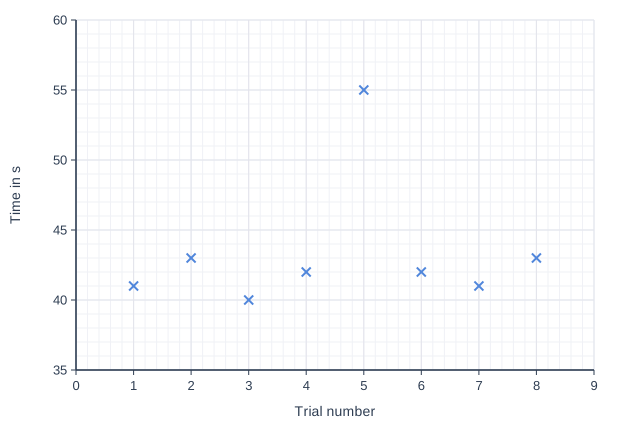
A student repeated an experiment eight times and recorded the time taken for a reaction to finish each time. The graph shows her results.

Identify the anomalous result. Ignoring this result, calculate the mean time and the uncertainty.
Give the mean to 3 significant figures.

Line graph of time in s (y-axis, 35 to 60) against trial number (x-axis, 0 to 9). The line is shown as plotted points only (no line), at (1, 41), (2, 43), (3, 40), (4, 42), (5, 55), (6, 42), (7, 41), (8, 43).

Model answer

The anomalous result is trial 5 (55 s).
Mean of the other seven results = (41 + 43 + 40 + 42 + 42 + 41 + 43) ÷ 7 = 292 ÷ 7 = 41.71... = 41.7 s (3 s.f.)
Range = 43 − 40 = 3 s, so uncertainty = 3 ÷ 2 = ± 1.5 s
Result = 41.7 ± 1.5 s

Explanation

Plotting the repeat results shows how they are distributed, so an anomaly stands out clearly. Leave it out, then use half the range of the remaining results as the uncertainty.

Mark scheme
  1. 1 mark

    trial 5 / 55 s is anomalous

  2. 1 mark

    mean = (41 + 43 + 40 + 42 + 42 + 41 + 43) ÷ 7 = 41.7 (s)

    allow 41.71; allow ecf if a different result is excluded

  3. 1 mark

    range = 43 − 40 = 3 (s)

  4. 1 mark

    uncertainty = ± 1.5 (s)

    allow 41.7 ± 1.5 s; allow ecf from an incorrect range

Ready to try the rest? Every answer you write is marked against the mark scheme, so you can see exactly where the marks are.

Revision notes

Chemical measurements

The big idea

Whenever a measurement is made, there is always some uncertainty about the result: the true value could be a little higher or lower. Chemists repeat measurements, look at how spread out the results are, and use that spread to say how certain the mean is.

Why measurements are uncertain

  • Resolution: an instrument can only be read to its smallest division, so a reading could be up to half a division away from the true value.
  • Random errors: small, unpredictable differences between repeats, such as judging when a colour changes.

The distribution of results

Listing or plotting all the repeat results shows their distribution: how spread out they are. Results that are close together are precise. A result that does not fit the pattern is anomalous and is left out of the mean.

  • Mean: add up the results you keep and divide by how many there are.
  • Range: the largest value minus the smallest value.
  • Uncertainty: half the range, either side of the mean. Write the result as mean ± uncertainty.
\[\text{uncertainty} = \dfrac{\text{range}}{2}\]

Mean and uncertainty

Five students did the same displacement reaction and weighed the copper formed: 1.24 g, 1.28 g, 1.25 g, 1.41 g and 1.27 g. The equation predicts 1.27 g of copper. Give the result as mean ± uncertainty, and say whether it agrees with the prediction.

1.41 g is far above the others, so it is anomalous: leave it out.

Mean: \(\dfrac{1.24 + 1.28 + 1.25 + 1.27}{4} = \dfrac{5.04}{4} = 1.26\) g

Range: \(1.28 - 1.24 = 0.04\) g, so the uncertainty is \(0.04 \div 2 = 0.02\) g

Result: 1.26 ± 0.02 g. The true value is likely to lie between 1.24 g and 1.28 g.

The predicted 1.27 g lies inside this range, so the result agrees with the prediction within its uncertainty.

Using uncertainty

  • A smaller uncertainty means a more precise result. An instrument with a higher resolution reduces it.
  • Two results are only clearly different if their ranges (mean ± uncertainty) do not overlap.
  • Precise is not the same as accurate (close to the true value). A balance that has not been set to zero shifts every reading equally: the mean is wrong but the range is not affected.

Common mistakes

  • Giving the whole range as the uncertainty. The uncertainty is half the range.
  • Including an anomalous result in the mean.
  • Saying repeats make a test "fair". Repeats reduce the effect of random errors and show the spread; a fair test is about controlling variables.
  • Writing just "human error". Say what the error is, such as misreading the scale.

Exam tip

When you compare two sets of results, use the numbers: quote each mean ± uncertainty, then say whether the ranges overlap. Give the mean to the same number of decimal places as the data.

Study Helper Hints first, answers after you try

Stuck on this one? Ask for a hint and I’ll point you in the right direction, without giving the answer away. Once you’ve checked your answer, I’ll show you how the marks are awarded.