Level:
Correct: 0
Incorrect: 0
Marks: 0/0
Exam Practice
Course:
Topics:
AQA GCSE Combined Science (Chemistry Paper 1) Smart practice A mixed round aimed at your weak spots
Unit 1
Atomic structure and the periodic table
Unit 2
Bonding, structure, and the properties of matter
Unit 3
Quantitative chemistry
Unit 4
Chemical changes
Unit 5
Energy changes
Avg
score:
–
Topics
done:
0/55

Mass changes when a reactant or product is a gas

Practise 13 exam-style questions on Mass changes when a reactant or product is a gas for AQA GCSE Combined Science (Chemistry Paper 1). Write your answer as you would in the exam and get it marked in seconds against the mark scheme, point by point, with the Study Helper on hand if you get stuck.

  • 13 questions
  • 1–6 marks each
  • Instant marking
  • No sign-up needed
13 questions, marked as you go

Sample questions with model answers

Here are 4 of the questions in this topic, each with a model answer, an explanation of why it earns the marks and the mark scheme an examiner would use.

Question 1

2 marks

A student heated calcium carbonate in a crucible to decompose it:

CaCO₃(s) → CaO(s) + CO₂(g)

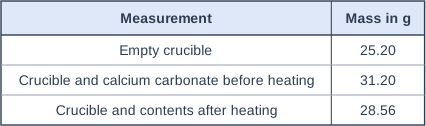
The table shows her results.

Calculate the mass of carbon dioxide given off.

Table with columns "Measurement", "Mass in g". Measurement: Empty crucible; Mass in g: 25.20 | Measurement: Crucible and calcium carbonate before heating; Mass in g: 31.20 | Measurement: Crucible and contents after heating; Mass in g: 28.56.

Model answer

Mass of carbon dioxide = mass before heating − mass after heating
= 31.20 − 28.56 = 2.64 g

Explanation

The decrease in mass is the mass of carbon dioxide that escaped. You do not need the mass of the empty crucible for this calculation, because it is the same before and after heating.

Mark scheme
  1. 1 mark

    31.20 − 28.56

    an answer of 2.64 g scores 2 marks

  2. 1 mark

    = 2.64 (g)

Question 2

2 marks

A student added 0.65 g of zinc to excess hydrochloric acid in an open flask on a balance:

Zn(s) + 2HCl(aq) → ZnCl₂(aq) + H₂(g)

All of the zinc reacted, but the mass on the balance decreased by only 0.02 g.

Explain why the mass decreased, and why the decrease was so small.

Model answer

The mass decreases because hydrogen gas is produced and escapes from the open flask. The decrease is very small because hydrogen is a very light gas: hydrogen molecules have a relative formula mass of only 2, so even though a lot of hydrogen molecules escape, their total mass is small.

Explanation

The mass lost from an open system equals the mass of gas that escapes. A light gas such as hydrogen causes a much smaller change than the same number of molecules of a heavier gas such as carbon dioxide.

Mark scheme
  1. 1 mark

    hydrogen gas is produced and escapes from the open flask

  2. 1 mark

    hydrogen has a very small mass / hydrogen molecules have a very low relative formula mass (Mr = 2)

    allow hydrogen is a very light gas

Question 3

3 marks

Magnesium carbonate reacts with dilute sulfuric acid to produce carbon dioxide gas:

MgCO₃(s) + H₂SO₄(aq) → MgSO₄(aq) + H₂O(l) + CO₂(g)

The reaction is carried out on a balance in a sealed flask fitted with a balloon to collect the gas.

Explain why the total mass on the balance stays the same.

Model answer

The carbon dioxide produced is trapped in the sealed flask and balloon, so it cannot escape. In the reaction, no atoms are lost or made; they are only rearranged into new substances. Because everything stays on the balance, the total mass of the products equals the total mass of the reactants, so the reading does not change.

Explanation

Mass is always conserved. It only appears to change when a gas can enter or leave an open system; in a closed system the balance reading stays constant.

Mark scheme
  1. 1 mark

    the carbon dioxide cannot escape / is trapped in the flask and balloon

  2. 1 mark

    no atoms are lost or made / atoms are only rearranged

  3. 1 mark

    so the mass of the products equals the mass of the reactants

    allow mass is conserved

Question 4

4 marks

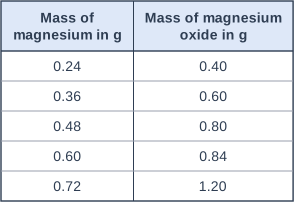
A student heated different masses of magnesium in a crucible and measured the mass of magnesium oxide formed. The table shows her results.

Identify the anomalous result, calculate the mass of magnesium oxide she should have obtained, and suggest two reasons for the anomalous result.

Table with columns "Mass of magnesium in g", "Mass of magnesium oxide in g". Mass of magnesium in g: 0.24; Mass of magnesium oxide in g: 0.40 | Mass of magnesium in g: 0.36; Mass of magnesium oxide in g: 0.60 | Mass of magnesium in g: 0.48; Mass of magnesium oxide in g: 0.80 | Mass of magnesium in g: 0.60; Mass of magnesium oxide in g: 0.84 | Mass of magnesium in g: 0.72; Mass of magnesium oxide in g: 1.20.

Model answer

The anomalous result is 0.84 g of magnesium oxide from 0.60 g of magnesium. The mass of magnesium oxide in the other results is 5/3 times the mass of magnesium (for example 0.48 g gives 0.80 g), so 0.60 g of magnesium should have given 1.00 g of magnesium oxide. The result may be low because not all of the magnesium reacted (it was not heated for long enough or not enough oxygen got in), or because some magnesium oxide smoke escaped when the lid was lifted.

Explanation

An anomalous result does not fit the pattern of the others. Here it is too low, so look for reasons why less oxygen was gained than expected or why some product was lost.

Mark scheme
  1. 1 mark

    the result for 0.60 g of magnesium (0.84 g of magnesium oxide) is anomalous

  2. 1 mark

    expected mass = 1.00 g

    allow 0.60 × 40 ÷ 24 = 1.00; allow follows the pattern of 0.40, 0.60, 0.80 ... 1.20

  3. 1 mark

    not all of the magnesium reacted / not heated for long enough / not enough oxygen got in

  4. 1 mark

    some magnesium oxide escaped (as smoke) when the lid was lifted

Ready to try the rest? Every answer you write is marked against the mark scheme, so you can see exactly where the marks are.

Revision notes

Mass changes when a reactant or product is a gas

The big idea

Some reactions seem to break the law of conservation of mass, because the reading on the balance goes up or down. Mass is still conserved. The change happens because a reactant or product is a gas whose mass has not been taken into account. With the state symbols in the equation and the particle model, you can explain every one of these changes.

Mass goes up: a gas from the air joins in

When a metal is heated in air, it reacts with oxygen to form a metal oxide:

2Cu(s) + O₂(g) → 2CuO(s)

The oxygen was not on the balance at the start, but its atoms become part of the solid oxide. So the mass of the oxide produced is greater than the mass of the metal, and the increase is the mass of oxygen that combined with it. Other gases in the air can do the same: rusting iron takes in oxygen (and water), and calcium oxide takes in carbon dioxide.

Mass goes down: a gas escapes

In the thermal decomposition of a metal carbonate, carbon dioxide is produced and escapes into the atmosphere, leaving the metal oxide as the only solid product:

CuCO₃(s) → CuO(s) + CO₂(g)

The same thing happens when an acid reacts with a carbonate or a metal in an open flask: carbon dioxide or hydrogen leaves, so the reading falls. The decrease is the mass of gas that escaped.

Line graph of mass of solid in g (y-axis, 2 to 5) against time of heating in min (x-axis, 0 to 10). "Copper heated in air" is a smooth curve through (0, 2.54), (1, 2.8), (2, 2.98), (3, 3.08), (4, 3.14), (5, 3.17), (6, 3.18), (8, 3.18), (10, 3.18). "Copper carbonate heated" (dashed) is a smooth curve through (0, 4.94), (1, 4.3), (2, 3.82), (3, 3.5), (4, 3.32), (5, 3.23), (6, 3.19), (8, 3.18), (10, 3.18).
Copper gains oxygen and copper carbonate loses carbon dioxide. Here both end as 3.18 g of copper oxide, and the mass stops changing when the reaction is complete.

Heating until the mass stops changing (heating to constant mass) shows that the reaction has finished.

Explaining changes with particles

Look for (g) in the equation, then explain with the particle model:

  • Gas particles are far apart and move quickly and randomly in all directions, so a gaseous product spreads out of an open container and takes its mass with it.
  • Gas particles from the air reach the solid and react, so their atoms become part of a solid product that stays in the container.
  • In a closed system no particles can enter or leave, so the mass stays the same. If no substance in the equation is a gas, the mass stays the same even in an open container.
Reaction in an open containerGas involvedMass of container and contents
4Fe(s) + 3O₂(g) → 2Fe₂O₃(s)oxygen from the air is a reactantincreases
Na₂CO₃(s) + 2HCl(aq) → 2NaCl(aq) + H₂O(l) + CO₂(g)carbon dioxide is a product and escapesdecreases
AgNO₃(aq) + NaCl(aq) → AgCl(s) + NaNO₃(aq)nonestays the same

A gas in and a gas out

Magnesium ribbon is heated in a tube while steam passes over it. The mass of solid in the tube increases.

Mg(s) + H₂O(g) → MgO(s) + H₂(g)

Explain the change in mass.

  • Steam is a gas, shown by (g), so its mass was not included when the solid was weighed at the start.
  • Water particles reach the magnesium and react. Their oxygen atoms join magnesium atoms to form solid magnesium oxide, which stays in the tube.
  • Their hydrogen atoms form hydrogen gas, (g), which moves away and leaves the tube.
  • So the solid gains the mass of the oxygen atoms only. No atoms are made or lost: the mass of magnesium and steam that reacted equals the mass of magnesium oxide and hydrogen formed.

A fizzy tablet

A beaker of water on a balance reads 152.30 g. A student drops in a fizzy vitamin tablet with a mass of 4.00 g. The tablet gives off carbon dioxide. When the fizzing stops, the reading is 155.42 g. Calculate the mass of carbon dioxide given off.

Total mass at the start: \(152.30 + 4.00 = 156.30\) g

Mass of carbon dioxide: \(156.30 - 155.42 = 0.88\) g

The final reading is higher than the beaker alone, but lower than everything that went in, because 0.88 g of gas escaped.

Common mistakes

  • Saying mass is "lost" or "destroyed". Mass is conserved; a gas has left the container, or joined from the air, without being weighed.
  • Writing that the metal "reacted with air". Name the gas: it reacted with oxygen from the air.
  • Saying the cotton wool in the neck of a mass-loss flask stops the gas escaping. It lets the gas out but stops acid spray escaping.
  • Thinking every reaction in an open beaker changes mass. If no reactant or product is a gas, the mass stays the same.

Exam tip

In "explain the change in mass" questions, name the gas, say whether it joined from the air or escaped, and say that its mass was not measured. For 6-mark questions, use the state symbols in the equations and the particle model (gas particles move quickly and randomly and spread out of an open container), and state that no atoms are made or lost.

Study Helper Hints first, answers after you try

Stuck on this one? Ask for a hint and I’ll point you in the right direction, without giving the answer away. Once you’ve checked your answer, I’ll show you how the marks are awarded.