Practise 14 exam-style questions on Metals and non-metals for AQA GCSE Combined Science (Chemistry Paper 1). Write your answer as you would in the exam and get it marked in seconds against the mark scheme, point by point, with the Study Helper on hand if you get stuck.
14 questions
1–6 marks each
Instant marking
No sign-up needed
14 questions, marked as you go
Sample questions with model answers
Here are 4 of the questions in this topic, each with a model answer, an explanation of why it earns the marks and the mark scheme an examiner would use.
Question 1
2 marks
The elements in the periodic table can be classified as metals or non-metals.
Describe where metals and non-metals are found in the periodic table.
Model answer
Metals are found on the left and towards the bottom of the periodic table. Non-metals are found towards the right and the top.
Explanation
The majority of elements are metals, so they take up most of the table. The dividing line between metals and non-metals runs in a staircase from the top middle towards the bottom right.
Mark scheme
1 mark
metals are found to the left and towards the bottom
both 'left' and 'bottom' ideas needed
1 mark
non-metals are found towards the right and top
both 'right' and 'top' ideas needed
Question 2
2 marks
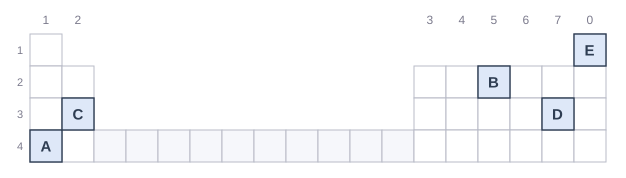
The diagram shows the positions of five elements, A, B, C, D and E, in the periodic table. The letters are not chemical symbols.
Which three letters represent non-metals? Give a reason for your answer.
Model answer
B, D and E are non-metals, because they are towards the right-hand side and top of the periodic table. A and C are on the left, so they are metals.
Explanation
Non-metals are found towards the right and top of the periodic table, including all of Group 0 and Group 7. A is in Group 1 and C is in Group 2, which are metals.
Mark scheme
1 mark
B, D and E
all three needed and no others
1 mark
they are towards the right / top of the periodic table
allow they are in Groups 5, 7 and 0 / they have 5 or more outer electrons or a full outer shell
Question 3
3 marks
Element X is in Group 2 and period 5 of the periodic table.
Predict whether X is a metal or a non-metal. Predict the charge on the ion formed by X. Predict one physical property of X.
Model answer
X is a metal, because it is on the left of the periodic table. It has 2 outer electrons, which it loses, so it forms an ion with a charge of 2+ (X²⁺). It will be a good conductor of electricity.
Explanation
Elements in Group 2 have two outer electrons and are found on the left of the table, so they are metals that form 2+ ions. You can predict the properties of an element you have not met from its position.
Mark scheme
1 mark
metal
1 mark
2+ / X²⁺
allow +2
1 mark
any one from: good conductor of electricity / heat; shiny; malleable; solid at room temperature; high melting point
Question 4
4 marks
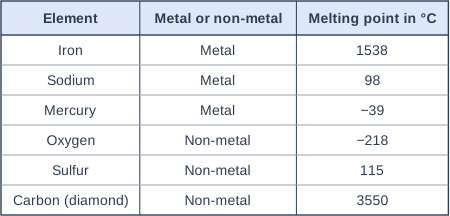
The table shows the melting points of six elements.
A student says: 'All metals have high melting points and all non-metals have low melting points.'
Evaluate the student's statement using the data in the table.
Model answer
The statement is true for some of the elements: iron, a metal, has a high melting point (1538 °C), and oxygen and sulfur, which are non-metals, have low melting points. However, mercury is a metal with a melting point of −39 °C, and sodium is a metal that melts at only 98 °C. Carbon is a non-metal but has a very high melting point of 3550 °C. So the statement is only a generalisation and is not true for all elements; melting point should not be used on its own to decide whether an element is a metal.
Explanation
Evaluating a statement means looking for data that supports it and data that contradicts it, then reaching a conclusion. A single clear exception is enough to show that 'all' is wrong.
Mark scheme
1 mark
the statement is true for some elements: iron (a metal) has a high melting point; oxygen and sulfur (non-metals) have low melting points
max 4; data or named elements needed
1 mark
mercury is a metal with a very low melting point (−39 °C) / sodium is a metal with a low melting point (98 °C)
1 mark
carbon is a non-metal with a very high melting point (3550 °C)
1 mark
so the statement is a generalisation / not true for all elements
1 mark
melting point alone cannot be used to classify an element; use other properties, e.g. whether it forms positive ions
Ready to try the rest? Every answer you write is marked against the mark scheme, so you can see exactly where the marks are.
Ctrl + Enter to check
Study HelperHints first, answers after you try
Stuck on this one? Ask for a hint and I’ll point you in the right direction, without giving the answer away. Once you’ve checked your answer, I’ll show you how the marks are awarded.