Level:
Correct: 0
Incorrect: 0
Marks: 0/0
Exam Practice
Course:
Topics:
AQA GCSE Combined Science (Chemistry Paper 1) Smart practice A mixed round aimed at your weak spots
Unit 1
Atomic structure and the periodic table
Unit 2
Bonding, structure, and the properties of matter
Unit 3
Quantitative chemistry
Unit 4
Chemical changes
Unit 5
Energy changes
Avg
score:
–
Topics
done:
0/55

The pH scale and neutralisation

Practise 14 exam-style questions on The pH scale and neutralisation for AQA GCSE Combined Science (Chemistry Paper 1). Write your answer as you would in the exam and get it marked in seconds against the mark scheme, point by point, with the Study Helper on hand if you get stuck.

  • 14 questions
  • 1–5 marks each
  • Instant marking
  • No sign-up needed
14 questions, marked as you go

Sample questions with model answers

Here are 4 of the questions in this topic, each with a model answer, an explanation of why it earns the marks and the mark scheme an examiner would use.

Question 1

1 mark

A solution has a pH of 11.

Is the solution acidic, neutral or alkaline?

Model answer

Alkaline

Explanation

Solutions with a pH greater than 7 are alkaline, pH 7 is neutral and a pH less than 7 is acidic. The further above 7, the more alkaline the solution.

Mark scheme
  1. 1 mark

    alkaline

Question 2

2 marks

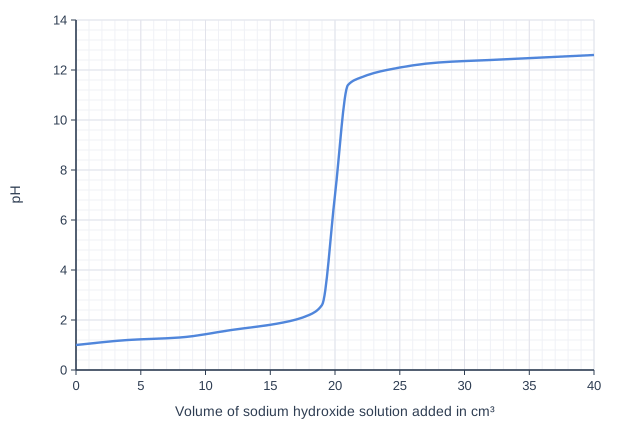
A student added sodium hydroxide solution, a little at a time, to 25 cm³ of dilute hydrochloric acid. She measured the pH with a pH probe after each addition. The graph shows her results.

Use the graph to give the pH of the acid at the start, and the volume of sodium hydroxide solution needed to neutralise the acid.

Line graph of pH (y-axis, 0 to 14) against volume of sodium hydroxide solution added in cm³ (x-axis, 0 to 40). The line is a smooth curve through (0, 1), (4, 1.2), (8, 1.3), (12, 1.6), (16, 1.9), (18, 2.2), (19, 2.6), (20, 7), (21, 11.4), (22, 11.7), (24, 12), (28, 12.3), (32, 12.4), (36, 12.5), (40, 12.6).

Model answer

The pH at the start is 1. The acid is neutralised when the pH reaches 7, which happens when 20 cm³ of sodium hydroxide solution has been added.

Explanation

Neutral is pH 7, so read across from pH 7 to the curve and down to the volume axis. The pH changes very sharply near this point, because only a little alkali is needed to go from excess acid to excess alkali.

Mark scheme
  1. 1 mark

    pH at the start = 1

    allow 0.8-1.2

  2. 1 mark

    20 cm³

    allow 19.5-20.5 cm³; the volume at which the pH is 7

Question 3

3 marks

Describe how a student could use universal indicator to find the approximate pH of a colourless solution.

Model answer

Put a small sample of the solution in a test tube and add a few drops of universal indicator. Compare the colour of the solution with a pH colour chart and read off the pH of the matching colour.

Explanation

Universal indicator is a wide range indicator: a mixture of indicators that gives a different colour at different pH values. Matching colours by eye only gives an approximate (whole-number) pH.

Mark scheme
  1. 1 mark

    add a few drops of universal indicator to a sample of the solution

    allow dip universal indicator paper into the solution / put a drop of the solution on indicator paper

  2. 1 mark

    compare the colour with a (pH) colour chart

  3. 1 mark

    read off the pH that matches the colour

    allow the matching colour gives the pH

Question 4

4 marks

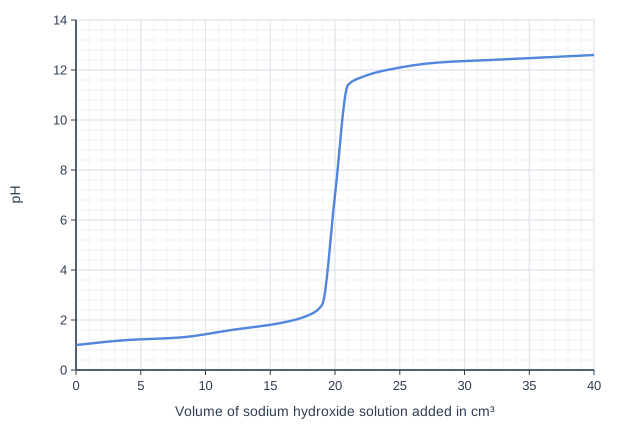
A student added sodium hydroxide solution, a little at a time, to 25 cm³ of dilute hydrochloric acid. She measured the pH with a pH probe after each addition. The graph shows her results.

Explain the changes in pH shown by the graph. Refer to the ions present.

Line graph of pH (y-axis, 0 to 14) against volume of sodium hydroxide solution added in cm³ (x-axis, 0 to 40). The line is a smooth curve through (0, 1), (4, 1.2), (8, 1.3), (12, 1.6), (16, 1.9), (18, 2.2), (19, 2.6), (20, 7), (21, 11.4), (22, 11.7), (24, 12), (28, 12.3), (32, 12.4), (36, 12.5), (40, 12.6).

Model answer

At the start the solution is acidic (pH 1) because it contains many H⁺ ions. As sodium hydroxide is added, its OH⁻ ions react with H⁺ ions to form water, so there are fewer H⁺ ions and the pH slowly rises. At 20 cm³ all the H⁺ ions have reacted and the solution is neutral, pH 7. After this, the extra OH⁻ ions added have no H⁺ ions to react with, so the solution becomes alkaline and the pH rises to about 12.5.

Explanation

Neutralisation is H⁺ + OH⁻ → H₂O. Before the neutral point there are more H⁺ ions than OH⁻ added; after it there are more OH⁻ ions, which makes the solution alkaline.

Mark scheme
  1. 1 mark

    at the start the pH is low because the acid contains (many) H⁺ ions

  2. 1 mark

    OH⁻ ions (from the sodium hydroxide) react with H⁺ ions to form water

    allow H⁺ + OH⁻ → H₂O

  3. 1 mark

    so the number / concentration of H⁺ ions decreases and the pH rises; at 20 cm³ all the H⁺ ions have reacted and the pH is 7 / neutral

  4. 1 mark

    after 20 cm³ there are excess / unreacted OH⁻ ions, so the solution is alkaline / pH is above 7

    allow pH rises to about 12.5

Ready to try the rest? Every answer you write is marked against the mark scheme, so you can see exactly where the marks are.

Revision notes

The pH scale and neutralisation

The big idea

Acids and alkalis are described by the ions they form in water: acids produce hydrogen ions, H⁺, and alkalis produce hydroxide ions, OH⁻. The pH scale measures how acidic or alkaline a solution is. In neutralisation, the hydrogen ions and hydroxide ions react together to make water.

Acids and alkalis in terms of ions

  • Acids produce hydrogen ions, H⁺(aq), in aqueous solution. The ions only form when the acid is dissolved in water: dry hydrogen chloride gas contains no H⁺ ions, so it does not behave as an acid until it dissolves.
  • Alkalis are bases that dissolve in water. Their solutions contain hydroxide ions, OH⁻(aq). Sodium hydroxide, potassium hydroxide, calcium hydroxide and ammonia solution are all alkalis.

The charge is part of the formula: write H⁺, not H, and OH⁻, not OH.

The pH scale

The pH scale runs from 0 to 14. A solution with pH 7 is neutral. Acids have a pH below 7, and the lower the pH, the more acidic the solution. Alkalis have a pH above 7, and the higher the pH, the more alkaline.

pHUniversal indicator colourType of solutionTypical example
0-2redvery acidicstomach acid
3-4orangeacidicvinegar
5-6yellowslightly acidicblack coffee
7greenneutralpure water, salt solution
8-10blueslightly alkalinesoap solution
11-14purplevery alkalineoven cleaner

The exact colours vary slightly between brands of indicator, so always use the chart that comes with it.

Measuring pH

  • Universal indicator is a wide range indicator: a mixture of indicators that changes through many colours across the pH scale. Add a few drops to the solution (or dip universal indicator paper into it) and compare the colour with the pH colour chart. This gives only an approximate pH, because the colour is judged by eye and each colour covers a range of values.
  • A pH probe connected to a meter gives a numerical reading that is more precise, does not depend on judging a colour and works in coloured solutions. Calibrate it first with a solution of known pH, rinse it with distilled water between solutions, and wait for a steady reading.
  • A single indicator such as litmus only shows whether a solution is acidic or alkaline. It cannot give the pH.

Neutralisation

When an acid reacts with an alkali, the hydrogen ions react with hydroxide ions to produce water:

H⁺(aq) + OH⁻(aq) → H₂O(l)

This ionic equation is the same for every acid-alkali reaction. The other ions, such as Na⁺ and Cl⁻, stay in solution unchanged, so they are left out.

Line graph of pH (y-axis, 0 to 14) against volume of sodium hydroxide solution added in cm³ (x-axis, 0 to 40). The line is a smooth curve through (0, 1), (5, 1.2), (10, 1.5), (15, 1.8), (18, 2.3), (19, 2.6), (19.5, 2.9), (20, 7), (20.5, 11.1), (21, 11.4), (22, 11.7), (25, 12.1), (30, 12.3), (35, 12.4), (40, 12.5).
Sodium hydroxide solution added to 20.0 cm³ of hydrochloric acid: the pH rises slowly, jumps through 7 at 20.0 cm³, then levels off.

At the start, hydrogen ions are in excess, so the pH is low. As the alkali is added, its hydroxide ions remove hydrogen ions by forming water, so the pH rises slowly. At pH 7 the acid has been exactly neutralised. Just a little more alkali then leaves hydroxide ions in excess, so the pH jumps up and levels off well above 7.

Higher tier only

Worked example: why every neutralisation has the same ionic equation. Show that the reaction between lithium hydroxide solution and nitric acid can be represented by H⁺ + OH⁻ → H₂O.

Symbol equation: LiOH(aq) + HNO₃(aq) → LiNO₃(aq) + H₂O(l)

Write each dissolved substance as its ions:

Li⁺ + OH⁻ + H⁺ + NO₃⁻ → Li⁺ + NO₃⁻ + H₂O

Li⁺ and NO₃⁻ are the same on both sides: they are spectator ions and take no part in the reaction. Cross them out to leave:

H⁺(aq) + OH⁻(aq) → H₂O(l)

Common mistakes

  • Writing "hydrogen" or "H" when you mean the hydrogen ion, H⁺, or writing OH without its negative charge.
  • Saying "compare the colour" without saying what with. Compare it with a pH colour chart.
  • Using litmus or phenolphthalein to find a pH. They only show acid or alkali.
  • Giving "quicker" or "easier" as the advantage of a pH probe. Say that it gives a numerical, more precise reading that does not depend on judging a colour.
  • Giving water the state symbol (aq) in the ionic equation. Water is a liquid: H₂O(l).

Exam tip

When a question says "refer to the ions", name H⁺ and OH⁻, say which one is in excess, and give the equation H⁺ + OH⁻ → H₂O. To lower a pH, add something acidic; to raise it, add something alkaline, and explain which ions are removed.

Study Helper Hints first, answers after you try

Stuck on this one? Ask for a hint and I’ll point you in the right direction, without giving the answer away. Once you’ve checked your answer, I’ll show you how the marks are awarded.