Practise 10 exam-style questions on Metallic bonding for AQA GCSE Combined Science (Chemistry Paper 1). Write your answer as you would in the exam and get it marked in seconds against the mark scheme, point by point, with the Study Helper on hand if you get stuck.
10 questions
1–6 marks each
Instant marking
No sign-up needed
10 questions, marked as you go
Sample questions with model answers
Here are 4 of the questions in this topic, each with a model answer, an explanation of why it earns the marks and the mark scheme an examiner would use.
Question 1
2 marks
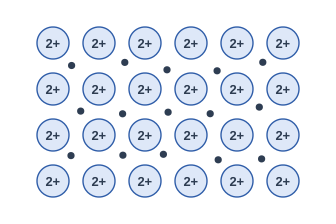
The diagram shows a model of the structure of magnesium metal. Each circle is a magnesium ion with a charge of 2+.
How many delocalised electrons does each magnesium atom provide to the structure? Give a reason for your answer.
Model answer
Each magnesium atom provides 2 delocalised electrons, because a magnesium atom has two outer shell electrons. Losing both of them leaves an ion with a 2+ charge, and the two electrons become delocalised.
Explanation
In metallic bonding the outer shell electrons of each atom become delocalised, leaving positive ions. The charge on the ion tells you how many electrons each atom gave up: a 2+ ion means two delocalised electrons per atom.
Mark scheme
1 mark
2 / two
1 mark
magnesium atoms have two electrons in their outer shell / magnesium is in Group 2 / each ion has a 2+ charge so each atom has lost two electrons
allow the electrons lost by each atom become delocalised
Question 2
2 marks
Aluminium is in Group 3 of the periodic table.
A small piece of aluminium contains 2.0 × 10²² atoms.
Calculate the number of delocalised electrons in the piece of aluminium.
Model answer
Aluminium is in Group 3, so each atom has 3 outer shell electrons, which all become delocalised. Number of delocalised electrons = 3 × 2.0 × 10²² = 6.0 × 10²²
Explanation
The number of outer shell electrons of a metal atom equals its group number, and in metallic bonding all of them become delocalised. Multiply the number of atoms by the number of delocalised electrons per atom; aluminium ions in the structure have a 3+ charge.
Mark scheme
1 mark
each aluminium atom provides 3 delocalised electrons
an answer of 6.0 × 10²² scores 2 marks
1 mark
3 × 2.0 × 10²² = 6.0 × 10²²
allow 6 × 10²²; allow ecf from an incorrect number of electrons per atom
Question 3
3 marks
Sodium is in Group 1 and magnesium is in Group 2.
The melting point of sodium is 98 °C. The melting point of magnesium is 650 °C.
Suggest why the metallic bonding in magnesium is stronger than the metallic bonding in sodium.
Model answer
Each magnesium atom gives two electrons to the sea of delocalised electrons, but each sodium atom gives only one. This means magnesium ions have a 2+ charge while sodium ions are only 1+. So in magnesium there are more delocalised electrons and more highly charged ions, giving a stronger electrostatic attraction between the positive ions and the delocalised electrons. More energy is needed to overcome this attraction, so magnesium has the higher melting point.
Explanation
Metallic bonding is the attraction between positive ions and delocalised electrons. More delocalised electrons and a higher ionic charge both increase this attraction, so the bonding is stronger and more energy is needed to melt the metal.
Mark scheme
1 mark
each magnesium atom provides two delocalised electrons but each sodium atom provides only one
allow magnesium has more delocalised electrons (per atom)
1 mark
magnesium ions have a 2+ charge but sodium ions have a 1+ charge
allow magnesium ions have a greater / higher charge
1 mark
so there is a stronger electrostatic attraction between the (positive) ions and the delocalised electrons (in magnesium)
this mark can be awarded if either of the first two points is given; allow more energy needed to overcome the bonding
Question 4
4 marks
Sodium metal and sodium chloride both contain sodium ions, Na⁺.
Compare the bonding in sodium metal with the bonding in sodium chloride.
Model answer
In sodium metal each atom loses its outer shell electron, which becomes delocalised and can move through the whole structure. The metallic bonding is the strong electrostatic attraction between the positive sodium ions and the sea of delocalised electrons. In sodium chloride the outer electron of each sodium atom is transferred to a chlorine atom, so there are Na⁺ ions and Cl⁻ ions. The ionic bonding is the strong electrostatic attraction between these oppositely charged ions. Both are giant structures held together by electrostatic attraction, but only the metal has electrons that are free to move.
Explanation
Both types of bonding are electrostatic and both form giant structures. The key difference is where the electrons go: in a metal they are shared by all the atoms as delocalised electrons, while in an ionic compound they are transferred to the non-metal atom to make negative ions.
Mark scheme
1 mark
in sodium metal, the outer shell electrons are delocalised / free to move through the structure
1 mark
in sodium metal, the bonding is the attraction between positive (sodium) ions and the delocalised electrons
1 mark
in sodium chloride, an electron is transferred from each sodium atom to a chlorine atom, forming Na⁺ and Cl⁻ ions
allow sodium chloride contains positive and negative ions
1 mark
in sodium chloride, the bonding is the attraction between oppositely charged ions
Ready to try the rest? Every answer you write is marked against the mark scheme, so you can see exactly where the marks are.
Ctrl + Enter to check
Study HelperHints first, answers after you try
Stuck on this one? Ask for a hint and I’ll point you in the right direction, without giving the answer away. Once you’ve checked your answer, I’ll show you how the marks are awarded.