Energy transfer during exothermic and endothermic reactions
Practise 18 exam-style questions on Energy transfer during exothermic and endothermic reactions for AQA GCSE Combined Science (Chemistry Paper 1). Write your answer as you would in the exam and get it marked in seconds against the mark scheme, point by point, with the Study Helper on hand if you get stuck.
18 questions
1–6 marks each
Instant marking
No sign-up needed
18 questions, marked as you go
Sample questions with model answers
Here are 4 of the questions in this topic, each with a model answer, an explanation of why it earns the marks and the mark scheme an examiner would use.
Question 1
1 mark
Give one everyday use of an exothermic reaction.
Model answer
Hand warmers.
Explanation
Hand warmers and self-heating cans use exothermic reactions to transfer energy to their surroundings and warm them up. Cold packs for sports injuries use endothermic reactions.
Mark scheme
1 mark
hand warmers / self-heating cans
allow burning fuels for heating or cooking; do not accept sports injury packs / cold packs
Question 2
2 marks
In experiments to measure temperature changes, the reaction mixture is often put in a polystyrene cup with a lid.
Explain why.
Model answer
Polystyrene is a good thermal insulator, and the lid stops energy escaping from the surface of the mixture. Together they reduce energy transfer between the mixture and the surroundings, so the measured temperature change is closer to the true value.
Explanation
If energy escapes to (or comes in from) the surroundings, the measured temperature change will be smaller than it should be. Insulation makes the results more accurate.
Mark scheme
1 mark
polystyrene is a (thermal) insulator / poor conductor
1 mark
it reduces energy transfer to or from the surroundings (so the temperature change is more accurate)
allow the lid reduces energy lost by evaporation / to the air
Question 3
3 marks
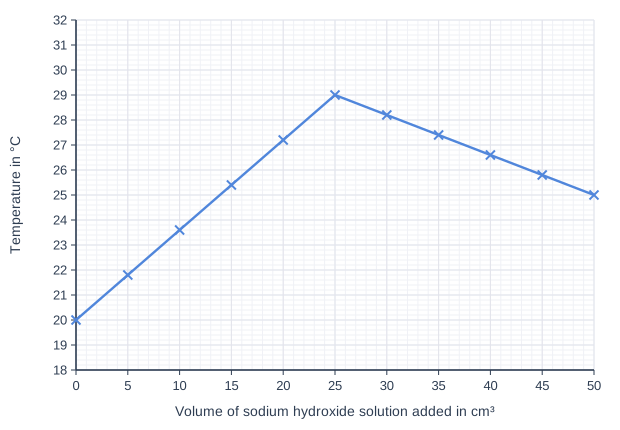
A student added sodium hydroxide solution, 5 cm³ at a time, to 25 cm³ of dilute hydrochloric acid in a polystyrene cup. She measured the highest temperature after each addition. The graph shows her results.
Explain the shape of the graph.
Model answer
Up to 25 cm³ the temperature rises because each portion of sodium hydroxide reacts with more of the acid, and neutralisation is exothermic. The maximum temperature, at 25 cm³, is when all the acid has been neutralised. After that there is no acid left to react, so no more energy is released; adding more cool sodium hydroxide solution, and energy transfer to the surroundings, makes the temperature fall.
Explanation
Two straight sections meeting at a peak are typical of a neutralisation followed by excess alkali. The peak marks the point where the acid and alkali have exactly reacted.
Mark scheme
1 mark
the temperature rises (up to 25 cm³) because neutralisation is exothermic / releases energy as more acid reacts
1 mark
the maximum temperature is when all the acid has been neutralised (at 25 cm³)
1 mark
after this no more reaction happens, so the cooler sodium hydroxide solution added lowers the temperature / energy is lost to the surroundings
allow excess alkali absorbs energy / cools the mixture
Question 4
4 marks
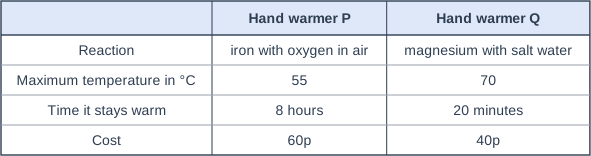
The table gives information about two types of single-use hand warmer, P and Q. Both use exothermic reactions. The reaction in hand warmer Q also produces hydrogen gas.
Evaluate which hand warmer would be better for keeping hands warm during a long day outdoors.
Model answer
Hand warmer P lasts 8 hours, but Q lasts only 20 minutes, so many Q hand warmers would be needed for a whole day. Q reaches 70 °C, which is hot enough to burn skin, whereas P reaches a safer 55 °C. Q is cheaper per hand warmer and heats up to a higher temperature, but it produces hydrogen, which is flammable. Overall P is better for a long day outdoors because one lasts all day and it is safer, even though it costs 20p more.
Explanation
An evaluation compares the options using the data and ends with a justified conclusion linked to the purpose. Here the purpose (a long day, held in the hand) makes duration and safety more important than cost or maximum temperature.
Mark scheme
1 mark
P lasts much longer (8 hours compared with 20 minutes)
max 3 for comparison points
1 mark
Q reaches 70 °C, which could burn the skin / P's 55 °C is safer
1 mark
Q is cheaper (40p compared with 60p) / Q warms up faster / gets hotter
1 mark
Q produces flammable hydrogen gas, which is a hazard
1 mark
justified conclusion: P, because it lasts all day and is safer, even though it costs more
allow Q only if justified, e.g. several could be used
Ready to try the rest? Every answer you write is marked against the mark scheme, so you can see exactly where the marks are.
Ctrl + Enter to check
Study HelperHints first, answers after you try
Stuck on this one? Ask for a hint and I’ll point you in the right direction, without giving the answer away. Once you’ve checked your answer, I’ll show you how the marks are awarded.