Level:
Correct: 0
Incorrect: 0
Marks: 0/0
Exam Practice
Course:
Topics:
AQA GCSE Combined Science (Chemistry Paper 1) Smart practice A mixed round aimed at your weak spots
Unit 1
Atomic structure and the periodic table
Unit 2
Bonding, structure, and the properties of matter
Unit 3
Quantitative chemistry
Unit 4
Chemical changes
Unit 5
Energy changes
Avg
score:
–
Topics
done:
0/55

Representation of reactions at electrodes as half equations (HT only)

Practise 11 exam-style questions on Representation of reactions at electrodes as half equations (HT only) for AQA GCSE Combined Science (Chemistry Paper 1). Write your answer as you would in the exam and get it marked in seconds against the mark scheme, point by point, with the Study Helper on hand if you get stuck.

  • 11 questions
  • 1–5 marks each
  • Instant marking
  • No sign-up needed
11 questions, marked as you go

Sample questions with model answers

Here are 4 of the questions in this topic, each with a model answer, an explanation of why it earns the marks and the mark scheme an examiner would use.

Question 1

1 mark

Which species is reduced in this half equation?

2H⁺ + 2e⁻ → H₂

Model answer

The hydrogen ions, H⁺.

Explanation

The species that gains electrons is reduced. Here the hydrogen ions gain electrons to form hydrogen molecules, so the hydrogen ions are reduced - H₂ is the product of the reduction.

Mark scheme
  1. 1 mark

    hydrogen ions / H⁺

    do not accept hydrogen / H₂

Question 2

2 marks

This half equation for the reaction at the anode is incomplete:

4OH⁻ → O₂ + ___ + 4e⁻

Write the complete half equation. Then write it again in the form that shows electrons being subtracted on the left-hand side.

Model answer

4OH⁻ → O₂ + 2H₂O + 4e⁻
4OH⁻ − 4e⁻ → O₂ + 2H₂O

Explanation

Four OH⁻ ions contain 4 oxygen and 4 hydrogen atoms: 2 oxygen atoms form O₂ and the rest form 2H₂O. Both forms show the same change - four electrons are lost by the hydroxide ions, so it is an oxidation.

Mark scheme
  1. 1 mark

    4OH⁻ → O₂ + 2H₂O + 4e⁻

  2. 1 mark

    4OH⁻ − 4e⁻ → O₂ + 2H₂O

    allow ecf from an incorrect number of water molecules

Question 3

3 marks

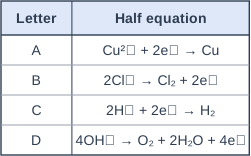
The table shows four half equations, A, B, C and D, for reactions that happen during electrolysis.

Which two half equations show oxidation? Explain your choice.

Table with columns "Letter", "Half equation". Letter: A; Half equation: Cu²⁺ + 2e⁻ → Cu | Letter: B; Half equation: 2Cl⁻ → Cl₂ + 2e⁻ | Letter: C; Half equation: 2H⁺ + 2e⁻ → H₂ | Letter: D; Half equation: 4OH⁻ → O₂ + 2H₂O + 4e⁻.

Model answer

B and D show oxidation, because in both the ions lose electrons - the electrons appear on the right-hand side as products. In A and C, ions gain electrons, so they are reductions.

Explanation

Look for where the electrons are: electrons on the left mean they are gained (reduction, at the cathode); electrons on the right mean they are lost (oxidation, at the anode).

Mark scheme
  1. 1 mark

    B

    max 2 for the letters; each extra letter cancels a correct one

  2. 1 mark

    D

  3. 1 mark

    the ions lose electrons (electrons are on the right / are products)

    allow these reactions happen at the anode where negative ions lose electrons

Question 4

4 marks

When sodium chloride solution and dilute sulfuric acid are electrolysed using inert electrodes, the same half equation describes the reaction at the cathode:

2H⁺ + 2e⁻ → H₂

However, the reactions at the anode are different. Write the half equation for the reaction at the anode for each solution. Explain why they are different.

Model answer

Sodium chloride solution: 2Cl⁻ → Cl₂ + 2e⁻
Dilute sulfuric acid: 4OH⁻ → O₂ + 2H₂O + 4e⁻
Sodium chloride solution contains chloride ions, which are halide ions, so chlorine is produced at the anode. Sulfuric acid contains sulfate ions, which are not halides, so hydroxide ions from the water are discharged instead and oxygen is produced.

Explanation

Hydrogen forms at the cathode in both because neither solution contains a metal less reactive than hydrogen. At the anode the rule is: halide ions present → halogen; otherwise → oxygen from hydroxide ions.

Mark scheme
  1. 1 mark

    sodium chloride solution: 2Cl⁻ → Cl₂ + 2e⁻

    allow 2Cl⁻ − 2e⁻ → Cl₂

  2. 1 mark

    dilute sulfuric acid: 4OH⁻ → O₂ + 2H₂O + 4e⁻

    allow 4OH⁻ − 4e⁻ → O₂ + 2H₂O

  3. 1 mark

    sodium chloride solution contains halide / chloride ions, so the halogen (chlorine) is produced

  4. 1 mark

    sulfuric acid has no halide ions, so hydroxide ions (from water) are discharged to form oxygen

Ready to try the rest? Every answer you write is marked against the mark scheme, so you can see exactly where the marks are.

Revision notes

Representation of reactions at electrodes as half equations (HT only)

The big idea

A half equation shows what happens at one electrode during electrolysis, with each electron written as e⁻. Every electrode reaction is either a gain of electrons or a loss of electrons, so half equations show exactly where reduction and oxidation take place.

Reduction at the cathode, oxidation at the anode

Remember OIL RIG: Oxidation Is Loss of electrons; Reduction Is Gain of electrons.

ElectrodeIons that arriveWhat happensType of reactionElectrons in the half equation
Cathode (−)positive ionsthey gain electronsreductionon the left
Anode (+)negative ionsthey lose electronsoxidationon the right

Electrons are not destroyed: every electron lost at the anode travels round the circuit and is gained at the cathode. So oxidation and reduction always happen together.

Writing a half equation

  1. Write the ion on the left and the product on the right. Hydrogen, oxygen and the halogens are diatomic: H₂, O₂, Cl₂, Br₂, I₂.
  2. Balance the atoms.
  3. Balance the charge by adding electrons, so that the total charge is the same on both sides.
  4. Check that the atoms and the total charge balance. Count each electron as 1−.

Anode half equations can also be written with the electrons taken away on the left, for example 2Cl⁻ − 2e⁻ → Cl₂. Both forms are accepted.

Half equations to know

At the cathode (reductions):

  • Metal ions gain as many electrons as their charge: Na⁺ + e⁻ → Na, Cu²⁺ + 2e⁻ → Cu, Al³⁺ + 3e⁻ → Al
  • Hydrogen ions (from acids or water): 2H⁺ + 2e⁻ → H₂

At the anode (oxidations):

  • Halide ions: 2Cl⁻ → Cl₂ + 2e⁻ (bromide and iodide ions work the same way)
  • Oxide ions, in molten oxides: 2O²⁻ → O₂ + 4e⁻
  • Hydroxide ions, such as those from water in aqueous solutions: 4OH⁻ → O₂ + 2H₂O + 4e⁻

The hydroxide half equation is the hardest to balance. Four OH⁻ ions contain four oxygen atoms and four hydrogen atoms, which make one O₂ molecule and two H₂O molecules. The left side has a total charge of 4−, so four electrons go on the right to make the right side 4− as well.

Ions you have not met before

Molten sodium sulfide, Na₂S, contains Na⁺ and S²⁻ ions. Sulfur forms at the anode. Write both half equations and state which one is oxidation.

Cathode: Na⁺ has a 1+ charge, so each ion gains one electron: Na⁺ + e⁻ → Na. This is reduction, because electrons are gained.

Anode: sulfur is written as S, not as a diatomic molecule, so one ion gives one atom. The ion has a 2− charge, so it loses two electrons: S²⁻ → S + 2e⁻. This is oxidation, because electrons are lost.

Check the charges at the anode: left side 2−; right side 0 + 2 × (1−) = 2−. They balance.

Combining half equations

Sodium was once manufactured by electrolysing molten sodium hydroxide, NaOH. Sodium forms at the cathode and oxygen forms at the anode. Use the half equations to find the overall ionic equation.

Cathode: Na⁺ + e⁻ → Na

Anode: 4OH⁻ → O₂ + 2H₂O + 4e⁻

The electrons gained must equal the electrons lost. The anode reaction releases 4 electrons, so multiply the cathode half equation by 4: 4Na⁺ + 4e⁻ → 4Na

Add the two half equations and cancel the 4e⁻ on each side: 4Na⁺ + 4OH⁻ → 4Na + O₂ + 2H₂O

Check: 4 Na, 4 O and 4 H atoms on each side, and a total charge of 0 on each side. Four sodium atoms form for every oxygen molecule.

Remember

  • OIL RIG: oxidation is loss of electrons, reduction is gain of electrons.
  • Cathode: reduction, electrons on the left. Anode: oxidation, electrons on the right.
  • Learn 2H⁺ + 2e⁻ → H₂ and 4OH⁻ → O₂ + 2H₂O + 4e⁻: they come up again and again.

Common mistakes

  • Writing Cl, Br or O as the product. Halogens, oxygen and hydrogen form diatomic molecules: Cl₂, Br₂, O₂, H₂.
  • Putting the electrons on the wrong side of a cathode half equation. Positive ions gain electrons, so the electrons go on the left.
  • Balancing the atoms but not the charge. Add up the total charge on each side, counting each electron as 1−.
  • Defining oxidation as "gain of oxygen" when the question asks about electrons. In terms of electrons, oxidation is loss of electrons.
  • Saying "the electrons balance" to explain why a half equation is balanced. Say that the atoms and the total charge are the same on both sides.

Exam tip

When you are given a half equation with gaps, fill in the formulae first, then the balancing numbers, and finish by counting charges. When asked whether a reaction is oxidation or reduction, always add the reason: "reduction, because the ions gain electrons".

Study Helper Hints first, answers after you try

Stuck on this one? Ask for a hint and I’ll point you in the right direction, without giving the answer away. Once you’ve checked your answer, I’ll show you how the marks are awarded.