Level:
Correct: 0
Incorrect: 0
Marks: 0/0
Exam Practice
Course:
Topics:
AQA GCSE Combined Science (Chemistry Paper 1) Smart practice A mixed round aimed at your weak spots
Unit 1
Atomic structure and the periodic table
Unit 2
Bonding, structure, and the properties of matter
Unit 3
Quantitative chemistry
Unit 4
Chemical changes
Unit 5
Energy changes
Avg
score:
–
Topics
done:
0/55

Graphite

Practise 11 exam-style questions on Graphite for AQA GCSE Combined Science (Chemistry Paper 1). Write your answer as you would in the exam and get it marked in seconds against the mark scheme, point by point, with the Study Helper on hand if you get stuck.

  • 11 questions
  • 1–6 marks each
  • Instant marking
  • No sign-up needed
11 questions, marked as you go

Sample questions with model answers

Here are 4 of the questions in this topic, each with a model answer, an explanation of why it earns the marks and the mark scheme an examiner would use.

Question 1

2 marks

Explain why graphite conducts electricity.

Model answer

In graphite each carbon atom forms only three covalent bonds, so one electron from each carbon atom is delocalised. These delocalised electrons are free to move through the structure (along the layers) and carry electrical charge.

Explanation

Graphite is unusual: it is a non-metal that conducts electricity. Like metals, it has delocalised electrons that can move and carry charge.

Mark scheme
  1. 1 mark

    one electron from each carbon atom is delocalised

    allow graphite has delocalised / free electrons

  2. 1 mark

    the delocalised electrons can move through the structure / along the layers and carry charge

Question 2

2 marks

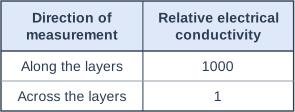
Scientists measured the electrical conductivity of a large crystal of graphite in two directions: along the layers and across the layers. The table shows their results.

Suggest why graphite conducts electricity much better along the layers than across them.

Table with columns "Direction of measurement", "Relative electrical conductivity". Direction of measurement: Along the layers; Relative electrical conductivity: 1000 | Direction of measurement: Across the layers; Relative electrical conductivity: 1.

Model answer

The delocalised electrons can move freely along each layer, so graphite conducts well in that direction. There are no covalent bonds between the layers and the layers are relatively far apart, so it is much harder for electrons to move from one layer to the next, and conduction across the layers is poor.

Explanation

The delocalised electrons belong to each layer of hexagonal rings. This question asks you to apply that idea to an unfamiliar result: the structure is not the same in every direction, so neither is the conductivity.

Mark scheme
  1. 1 mark

    the delocalised electrons can move freely along / within the layers

  2. 1 mark

    there are no covalent bonds between the layers so the electrons cannot easily move from one layer to the next

    allow the layers are separated / held only by weak forces

Question 3

3 marks

The layers in graphite are made of rings of carbon atoms.

How many carbon atoms are in each ring, and why does each carbon atom in graphite have one electron that is not used in a covalent bond?

Model answer

Each ring contains six carbon atoms (the rings are hexagons). A carbon atom has four outer shell electrons, but in graphite each carbon atom forms only three covalent bonds, with three other carbon atoms, so one outer electron is not used in bonding. This electron is delocalised.

Explanation

Graphite's layers are hexagonal rings, with each carbon atom bonded to three others. The spare electron from each atom is delocalised, which is why graphite conducts electricity.

Mark scheme
  1. 1 mark

    6 / six (hexagonal rings)

  2. 1 mark

    carbon has four outer shell electrons

  3. 1 mark

    each carbon atom forms only three covalent bonds, so one outer electron is left over (and is delocalised)

Question 4

4 marks

In diamond each carbon atom forms four covalent bonds. In graphite each carbon atom forms three covalent bonds.

Use this information to explain why graphite conducts electricity but diamond does not.

Model answer

A carbon atom has four electrons in its outer shell. In graphite each carbon atom uses only three of them to form three covalent bonds, so one electron from each atom is delocalised. These delocalised electrons can move through the structure and carry charge, so graphite conducts. In diamond, each carbon atom uses all four outer electrons to form four covalent bonds, so there are no delocalised electrons and diamond does not conduct.

Explanation

Count the outer electrons used in bonding. Any outer electron not in a bond in graphite becomes delocalised, which is what allows it to conduct.

Mark scheme
  1. 1 mark

    a carbon atom has four outer shell electrons

    allow this idea implied by the following points

  2. 1 mark

    in graphite only three of the four outer electrons are used in covalent bonds

  3. 1 mark

    so one electron from each carbon atom is delocalised and can move and carry charge

  4. 1 mark

    in diamond all four outer electrons are used in bonds, so there are no delocalised electrons

Ready to try the rest? Every answer you write is marked against the mark scheme, so you can see exactly where the marks are.

Revision notes

Graphite

The big idea

Graphite is a form of carbon with a giant covalent structure, like diamond, but its atoms are arranged very differently. Each carbon atom forms three covalent bonds, making flat layers of hexagonal rings with no covalent bonds between the layers, and one electron from each atom is delocalised. This explains why graphite is soft and slippery, has a very high melting point and conducts electricity.

Structure and bonding

  • Each carbon atom is joined to three other carbon atoms by strong covalent bonds.
  • The atoms form flat layers of hexagonal rings (rings of six carbon atoms), like sheets of chicken wire stacked on top of each other.
  • There are no covalent bonds between the layers, only weak forces.
  • A carbon atom has four outer electrons, but only three are used in bonds. The fourth is delocalised, so there is one delocalised electron from each carbon atom, free to move along the layers.

Explaining the properties

PropertyExplanationUse
Soft and slipperyThe forces between the layers are weak, so the layers can slide over each otherPencil leads (layers rub off onto the paper); lubricants
Very high melting pointTo melt graphite, the strong covalent bonds within the layers must be broken, which needs a lot of energyElectrodes and lubricants that must work at high temperatures
Conducts electricityThe delocalised electrons can move through the structure and carry chargeElectrodes

Graphite's softness and its melting point depend on different forces. Softness depends on the weak forces between the layers; melting depends on the strong covalent bonds within them. So being soft does not mean graphite melts easily: its melting point is about as high as diamond's.

Graphite and metals

Graphite is a non-metal, but it is similar to metals in one way: it has delocalised electrons. In both, these electrons move through the structure and carry charge, so both conduct electricity (and thermal energy). The bonding is different, though: graphite has covalent bonds, not metallic bonding. Its delocalised electrons move freely along the layers but not easily from one layer to the next, so graphite conducts much better along the layers than across them.

Diamond and graphite compared

DiamondGraphite
Covalent bonds per carbon atom43
ArrangementRigid three-dimensional networkLayers of hexagonal rings, with weak forces between the layers
Delocalised electronsNone: all four outer electrons are in bondsOne from each carbon atom
HardnessVery hardSoft and slippery
Conducts electricity?NoYes
Melting pointVery highVery high

Start any comparison by counting bonds. Four bonds use up every outer electron and lock the atoms in three dimensions. Three bonds give flat layers and leave one spare electron per atom.

Correcting a statement

A student writes: "Graphite conducts electricity because carbon is a metal." Explain why the student is wrong, and give the correct reason.

  • Carbon is a non-metal, and graphite has covalent bonds, not metallic bonding.
  • Each carbon atom in graphite forms only three covalent bonds, so one of its four outer electrons is delocalised.
  • These delocalised electrons can move through the layers and carry charge, so graphite conducts.
  • Graphite is like a metal only in having delocalised electrons.

Common mistakes

  • Writing "weak covalent bonds between the layers". There are no covalent bonds between the layers, only weak forces.
  • Saying graphite is soft, so it must have a low melting point. Melting means breaking the strong covalent bonds within the layers, not just separating the layers.
  • Saying ions carry the charge in graphite. Graphite has no ions: the delocalised electrons carry the charge.
  • Mixing up the numbers: graphite has three bonds per carbon atom, diamond has four.

Exam tip

For "explain why graphite is soft", give three points: it is made of layers; there are no covalent bonds (only weak forces) between them; so the layers slide over each other. For a question about a use, name every property the use needs and explain each one from the structure.

Study Helper Hints first, answers after you try

Stuck on this one? Ask for a hint and I’ll point you in the right direction, without giving the answer away. Once you’ve checked your answer, I’ll show you how the marks are awarded.