Practise 12 exam-style questions on Group 0 for AQA GCSE Combined Science (Chemistry Paper 1). Write your answer as you would in the exam and get it marked in seconds against the mark scheme, point by point, with the Study Helper on hand if you get stuck.
12 questions
1–6 marks each
Instant marking
No sign-up needed
12 questions, marked as you go
Sample questions with model answers
Here are 4 of the questions in this topic, each with a model answer, an explanation of why it earns the marks and the mark scheme an examiner would use.
Question 1
1 mark
The noble gases are very unreactive.
Explain why, in terms of electrons.
Model answer
Their atoms have a stable arrangement of electrons, with a full outer shell, so they do not need to gain, lose or share electrons.
Explanation
Chemical reactions involve atoms gaining, losing or sharing outer electrons to reach a stable arrangement. Noble gas atoms already have one, so they have very little tendency to react.
Mark scheme
1 mark
their atoms have a stable arrangement of electrons / a full outer shell
allow 8 electrons in the outer shell (2 for helium); do not accept full shells of atoms without reference to electrons
Question 2
2 marks
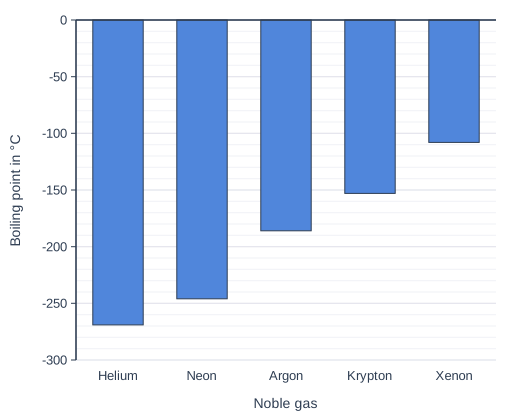
The bar chart shows the boiling points of five noble gases, in order going down Group 0.
Describe the trend in boiling point going down Group 0, and state how it is linked to relative atomic mass.
Model answer
The boiling point increases going down Group 0, from −269 °C for helium to −108 °C for xenon. The boiling points increase as the relative atomic mass of the elements increases.
Explanation
Negative numbers can be confusing: −108 °C is a higher temperature than −269 °C, so the boiling point rises down the group. Heavier noble gas atoms need more energy to separate, so the boiling point increases with relative atomic mass.
Mark scheme
1 mark
boiling point increases going down the group
allow gets less negative / higher; do not accept gets lower
1 mark
boiling point increases as relative atomic mass increases
allow heavier atoms have higher boiling points
Question 3
3 marks
Some filament lamps contain argon instead of air. The metal filament becomes very hot when the lamp is switched on.
Explain why argon is used instead of air.
Model answer
In air, the very hot metal filament would react with oxygen and burn out. Argon is unreactive because its atoms have a stable arrangement of electrons, with a full outer shell, so it does not react with the hot filament.
Explanation
The unreactivity of the noble gases comes directly from their stable outer shells. This makes them useful wherever a substance must be kept away from reactive gases such as oxygen, even at high temperatures.
Mark scheme
1 mark
the hot filament would react with oxygen in air / burn
1 mark
argon is unreactive / does not react with the filament
1 mark
because argon atoms have a stable arrangement of electrons / full outer shell
allow 8 outer electrons
Question 4
4 marks
Sodium is in Group 1 and neon is in Group 0. Sodium is very reactive, but neon is unreactive. The electronic structure of sodium is 2,8,1. The electronic structure of neon is 2,8.
Explain the difference in reactivity, in terms of the electronic structures of the atoms.
Model answer
Sodium has one electron in its outer shell. A sodium atom loses this electron easily when it reacts, forming a Na⁺ ion with the stable electronic structure 2,8, so sodium is very reactive. Neon already has a full outer shell of 8 electrons, which is a stable arrangement, so it does not need to gain, lose or share electrons and is unreactive.
Explanation
Reactivity depends on the outer electrons. The Na⁺ ion has the same electronic structure as a neon atom: sodium reacts to reach the arrangement that neon already has.
Mark scheme
1 mark
sodium has one electron in its outer shell
1 mark
sodium atoms easily lose this electron (to form Na⁺ with a stable / noble gas arrangement)
allow sodium reacts to get a full outer shell
1 mark
neon already has a full outer shell / stable arrangement of 8 electrons
1 mark
so neon does not need to gain, lose or share electrons
Ready to try the rest? Every answer you write is marked against the mark scheme, so you can see exactly where the marks are.
Ctrl + Enter to check
Study HelperHints first, answers after you try
Stuck on this one? Ask for a hint and I’ll point you in the right direction, without giving the answer away. Once you’ve checked your answer, I’ll show you how the marks are awarded.