Level:
Correct: 0
Incorrect: 0
Marks: 0/0
Exam Practice
Course:
Topics:
AQA GCSE Combined Science (Chemistry Paper 1) Smart practice A mixed round aimed at your weak spots
Unit 1
Atomic structure and the periodic table
Unit 2
Bonding, structure, and the properties of matter
Unit 3
Quantitative chemistry
Unit 4
Chemical changes
Unit 5
Energy changes
Avg
score:
–
Topics
done:
0/55

Reaction profiles

Practise 14 exam-style questions on Reaction profiles for AQA GCSE Combined Science (Chemistry Paper 1). Write your answer as you would in the exam and get it marked in seconds against the mark scheme, point by point, with the Study Helper on hand if you get stuck.

  • 14 questions
  • 1–6 marks each
  • Instant marking
  • No sign-up needed
14 questions, marked as you go

Sample questions with model answers

Here are 4 of the questions in this topic, each with a model answer, an explanation of why it earns the marks and the mark scheme an examiner would use.

Question 1

1 mark

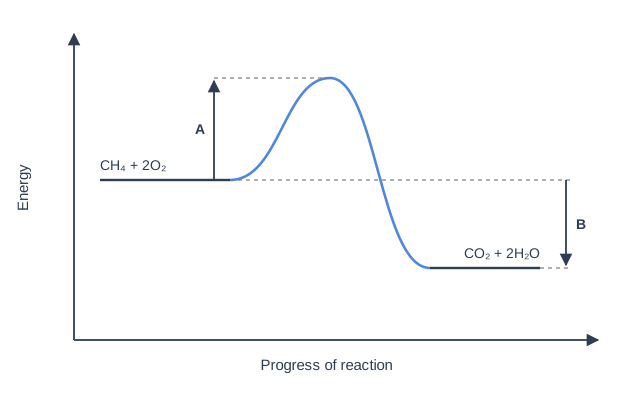
The diagram shows the reaction profile for the combustion of methane.

Which letter, A or B, represents the activation energy?

Reaction profile (energy against progress of reaction). The reactants (CH₄ + 2O₂) are higher in energy than the products (CO₂ + 2H₂O); the curve rises to a peak between them. An upward arrow labelled A goes from the reactants' energy level to the top of the peak. An arrow labelled B goes from the reactants' level down to the products' level.

Model answer

Letter A shows the activation energy.

Explanation

The activation energy is measured from the energy of the reactants up to the highest point of the curve. Arrow B, from the reactants down to the products, is the overall energy change.

Mark scheme
  1. 1 mark

    A

Question 2

2 marks

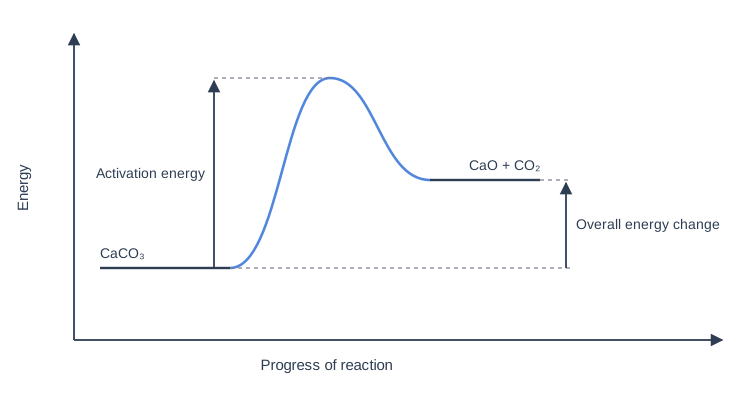
The diagram shows the reaction profile for the thermal decomposition of calcium carbonate.

Explain why the products are shown at a higher energy than the reactants.

Reaction profile (energy against progress of reaction). The reactants (CaCO₃) are lower in energy than the products (CaO + CO₂); the curve rises to a peak between them. An upward arrow from the reactants' level to the top of the peak is labelled "Activation energy". An arrow from the reactants' level up to the products' level is labelled "Overall energy change".

Model answer

Thermal decomposition is endothermic: the reaction takes in energy from the surroundings. Energy is conserved, so the products, calcium oxide and carbon dioxide, have more energy than the calcium carbonate by the amount taken in.

Explanation

On a reaction profile the vertical position shows the energy of the substances. An endothermic reaction ends higher than it starts because energy has been transferred into the chemicals.

Mark scheme
  1. 1 mark

    the reaction is endothermic / takes in energy from the surroundings

    allow thermal decomposition reactions are endothermic

  2. 1 mark

    so the products have more energy than the reactants, by the amount of energy taken in

    allow energy is conserved, so the energy taken in is stored in the products

Question 3

3 marks

On the reaction profile for a reaction:

• the reactants have an energy of 120 kJ
• the highest point of the curve is at 290 kJ
• the products have an energy of 40 kJ

Calculate the activation energy and the overall energy change. State whether the reaction is exothermic or endothermic.

Model answer

Activation energy = 290 − 120 = 170 kJ
Overall energy change = 120 − 40 = 80 kJ given out
The products have less energy than the reactants, so the reaction is exothermic.

Explanation

The activation energy is measured from the reactants, not the products, to the top of the curve. The overall energy change is the difference between reactants and products; energy is given out because the products are lower.

Mark scheme
  1. 1 mark

    activation energy = 290 − 120 = 170 kJ

    do not accept 250 (290 − 40)

  2. 1 mark

    overall energy change = 120 − 40 = 80 kJ (given out)

    allow −80 kJ

  3. 1 mark

    exothermic

Question 4

4 marks

A student described the reaction profile for an endothermic reaction like this:

"The products are at a lower energy than the reactants. The activation energy is measured from the products up to the top of the curve."

Identify the two mistakes in the student's description and correct them.

Model answer

First mistake: for an endothermic reaction the products are at a higher energy than the reactants, not lower, because energy is taken in from the surroundings. Second mistake: the activation energy is measured from the reactants up to the top of the curve, not from the products, because it is the energy the reactants need to react.

Explanation

The activation energy belongs to the reactants: it is the minimum energy reacting particles need. For both exothermic and endothermic reactions it starts at the reactant level.

Mark scheme
  1. 1 mark

    mistake: the products are not lower than the reactants

  2. 1 mark

    correction: in an endothermic reaction the products are at a higher energy than the reactants (energy is taken in)

  3. 1 mark

    mistake: the activation energy is not measured from the products

  4. 1 mark

    correction: the activation energy is measured from the reactants to the top of the curve

Ready to try the rest? Every answer you write is marked against the mark scheme, so you can see exactly where the marks are.

Revision notes

Reaction profiles

The big idea

Particles can only react when they collide with enough energy. A reaction profile is a simple energy diagram that shows how the energy changes as a reaction happens: how much energy is needed to start the reaction, and how much is given out or taken in overall.

Activation energy

Chemical reactions can occur only when reacting particles collide with each other with sufficient energy. The activation energy is the minimum amount of energy that particles must have to react. Collisions with less energy than this do not lead to a reaction: the particles just bounce apart.

Every reaction, exothermic or endothermic, has an activation energy. That is why a fuel does not burn until a flame or spark supplies energy to start it.

Higher tier only

Why activation energy is needed. Before new bonds can form, some bonds in the reactants must be broken, and breaking bonds needs energy (see also: The energy change of reactions).

Drawing a reaction profile

  1. Draw axes: energy up the side and progress of reaction along the bottom.
  2. Draw a short horizontal line for the reactants and another for the products, at the right heights compared with each other.
  3. Join them with a curved line that rises to a peak above both levels, then falls to the products.
  4. Draw the activation energy arrow from the reactants' level up to the peak.
  5. Draw the overall energy change arrow from the reactants' level to the products' level.

Exothermic reactions

Reaction profile (energy against progress of reaction). The reactants (Reactants) are higher in energy than the products (Products); the curve rises to a peak between them. An upward arrow from the reactants' level to the top of the peak is labelled "Activation energy". An arrow from the reactants' level down to the products' level is labelled "Overall energy change".
Exothermic: the products are lower in energy than the reactants, so the overall energy change arrow points down.

The products have less energy than the reactants, because energy has been transferred to the surroundings.

Endothermic reactions

Reaction profile (energy against progress of reaction). The reactants (Reactants) are lower in energy than the products (Products); the curve rises to a peak between them. An upward arrow from the reactants' level to the top of the peak is labelled "Activation energy". An arrow from the reactants' level up to the products' level is labelled "Overall energy change".
Endothermic: the products are higher in energy than the reactants, so the overall energy change arrow points up.

The products have more energy than the reactants, because energy has been taken in from the surroundings. The peak is still above the products, so the activation energy is always bigger than the overall energy change.

Reading a reaction profile

To findMeasure fromTo
Activation energythe reactantsthe top of the peak
Overall energy changethe reactantsthe products
  • Products lower than reactants: the reaction is exothermic. The overall energy change is given a negative sign, because energy is released.
  • Products higher than reactants: the reaction is endothermic. The overall energy change is positive, because energy is taken in.
  • The activation energy and the overall energy change are separate features. A reaction can release a lot of energy and still need a large activation energy to start.

A catalyst gives a different pathway with a lower activation energy (a lower peak), but the energies of the reactants and products, and so the overall energy change, stay the same (see also: Catalysts).

From a temperature change to a reaction profile

A student mixes citric acid solution with sodium hydrogencarbonate. The temperature of the mixture falls from 21 °C to 14 °C. Sketch and label the reaction profile for this reaction.

Step 1: the temperature of the surroundings falls, so energy is taken in from the surroundings: the reaction is endothermic.

Step 2: draw the reactants' line, then the products' line higher up, because the products have more energy than the reactants.

Step 3: draw a smooth curve from the reactants up to a peak above the products' level, then down to the products.

Step 4: label the activation energy (an arrow from the reactants up to the peak) and the overall energy change (an arrow from the reactants up to the products).

Common mistakes

  • Measuring the activation energy from the products, or from the bottom of the axis. It is always measured from the reactants to the peak.
  • Labelling the gap between the reactants and products as the activation energy. That gap is the overall energy change.
  • Drawing the overall energy change arrow upwards for an exothermic reaction. It points down, because the products have less energy.
  • Defining activation energy as "the energy given out by a reaction". It is the minimum energy particles must have to react.
  • Saying a catalyst changes the overall energy change. It only lowers the activation energy.

Exam tip

When you draw a profile, label everything: "reactants", "products", "activation energy" and "overall energy change", with both arrows starting at the reactants' level. Use one curved line from the reactants to the products, not straight lines.

Study Helper Hints first, answers after you try

Stuck on this one? Ask for a hint and I’ll point you in the right direction, without giving the answer away. Once you’ve checked your answer, I’ll show you how the marks are awarded.