Level:
Correct: 0
Incorrect: 0
Marks: 0/0
Exam Practice
Course:
Topics:
AQA GCSE Combined Science (Chemistry Paper 1) Smart practice A mixed round aimed at your weak spots
Unit 1
Atomic structure and the periodic table
Unit 2
Bonding, structure, and the properties of matter
Unit 3
Quantitative chemistry
Unit 4
Chemical changes
Unit 5
Energy changes
Avg
score:
–
Topics
done:
0/55

Properties of ionic compounds

Practise 12 exam-style questions on Properties of ionic compounds for AQA GCSE Combined Science (Chemistry Paper 1). Write your answer as you would in the exam and get it marked in seconds against the mark scheme, point by point, with the Study Helper on hand if you get stuck.

  • 12 questions
  • 1–6 marks each
  • Instant marking
  • No sign-up needed
12 questions, marked as you go

Sample questions with model answers

Here are 4 of the questions in this topic, each with a model answer, an explanation of why it earns the marks and the mark scheme an examiner would use.

Question 1

2 marks

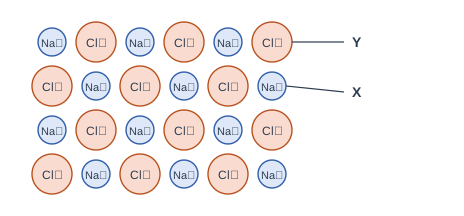
The diagram shows part of the giant ionic lattice of sodium chloride.

Describe the forces that hold ion X and ion Y together, and give the directions in which these forces act.

Part of a giant ionic lattice: a regular grid of alternating small Na⁺ ions and larger Cl⁻ ions. Label X points to a Na⁺ ion. Label Y points to a Cl⁻ ion.

Model answer

Ion X (Na⁺) and ion Y (Cl⁻) are held together by strong electrostatic forces of attraction between the oppositely charged ions. These forces act in all directions, so every ion is attracted to all the oppositely charged ions around it.

Explanation

Ionic bonding is not between one pair of ions: each ion attracts all the oppositely charged ions around it in every direction, which is why the lattice is so strong.

Mark scheme
  1. 1 mark

    strong electrostatic forces of attraction between oppositely charged ions

    allow attraction between positive and negative ions / Na⁺ and Cl⁻ ions; do not accept intermolecular forces or covalent bonds

  2. 1 mark

    they act in all directions (through the lattice)

Question 2

2 marks

Sodium chloride solution conducts electricity. Sugar solution does not conduct electricity.

Explain this difference.

Model answer

When sodium chloride dissolves, its Na⁺ and Cl⁻ ions are free to move through the solution and carry charge, so the solution conducts. Sugar is made of molecules, which have no overall electric charge, so a sugar solution contains no ions to carry charge and does not conduct.

Explanation

Dissolving alone does not make a solution conduct. The solution must contain charged particles that can move, which happens when an ionic compound dissolves but not when a molecular substance such as sugar dissolves.

Mark scheme
  1. 1 mark

    sodium chloride solution contains ions which are free to move and carry charge

    do not accept electrons moving

  2. 1 mark

    sugar is made of molecules which have no overall charge / sugar solution contains no ions

    allow sugar is covalent so has no ions

Question 3

3 marks

Solid potassium iodide does not conduct electricity. When potassium iodide is dissolved in water, the solution conducts electricity.

Explain these observations.

Model answer

Potassium iodide is made of K⁺ and I⁻ ions. In the solid, the ions are held in fixed positions in the lattice and cannot move, so no charge can flow. When it dissolves, the ions separate and are free to move through the solution, so they can carry charge and the solution conducts.

Explanation

An electric current needs charged particles that can move. Ionic compounds have charged particles (ions) but they can only move when the compound is melted or dissolved. It is the ions, not electrons, that carry the charge.

Mark scheme
  1. 1 mark

    potassium iodide contains ions

    allow K⁺ and I⁻ ions; do not accept electrons moving for any mark

  2. 1 mark

    in the solid the ions are held in fixed positions / cannot move

    allow ions held in a lattice

  3. 1 mark

    in solution the ions are free to move and carry charge

    allow charge can flow

Question 4

4 marks

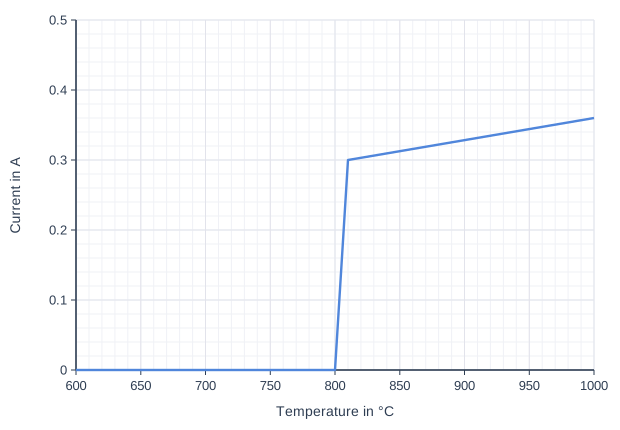
A sample of sodium chloride was heated in a laboratory furnace, and the current through it was measured as its temperature increased. The graph shows the results.

Use the graph to estimate the melting point of sodium chloride, and explain the shape of the graph.

Line graph of Current in A (y-axis, 0 to 0.5) against temperature in °C (x-axis, 600 to 1000). The line joins the points (600, 0), (800, 0), (810, 0.3), (1000, 0.36).

Model answer

The melting point is about 800 °C. Below this temperature the current is zero, because solid sodium chloride has its ions held in fixed positions in the lattice, so they cannot move to carry charge. When the sodium chloride melts, the ions become free to move, so they can carry charge and a current flows.

Explanation

The sudden rise in current marks the change of state: once the lattice breaks down on melting, the ions are free to move. Ionic compounds conduct electricity only when molten or dissolved.

Mark scheme
  1. 1 mark

    melting point = 800 °C

    allow any value from 790 to 810 °C

  2. 1 mark

    below this temperature the current is zero because the sodium chloride is solid and its ions are in fixed positions / cannot move

  3. 1 mark

    when it melts the ions are free to move

  4. 1 mark

    so the ions carry charge / charge can flow and there is a current

Ready to try the rest? Every answer you write is marked against the mark scheme, so you can see exactly where the marks are.

Revision notes

Properties of ionic compounds

The big idea

Ionic compounds have regular structures (giant ionic lattices) with strong electrostatic forces of attraction in all directions between oppositely charged ions. These two facts explain their properties: high melting and boiling points, and conducting electricity only when melted or dissolved in water. You only need to know the structure of sodium chloride, but the same ideas explain the properties of other ionic compounds.

The structure behind the properties

Part of a giant ionic lattice: a regular grid of alternating small Na⁺ ions and larger Cl⁻ ions. Label sodium ion points to a Na⁺ ion. Label chloride ion points to a Cl⁻ ion.
Part of the sodium chloride lattice. Each ion is held in place by the oppositely charged ions all around it.

Each ion is attracted to all the oppositely charged ions around it, and a crystal contains a huge number of ions, so there are many strong bonds holding the lattice together.

High melting and boiling points

To melt an ionic compound, the strong electrostatic forces between the ions must be overcome so that the ions can move around each other. Large amounts of energy are needed to break the many strong bonds, so ionic compounds have high melting points and are solids at room temperature. Sodium chloride melts at 801 °C.

  • Boiling needs even more energy than melting, because the ions must separate completely. Sodium chloride boils at 1413 °C.
  • Ions with larger charges attract each other more strongly. Magnesium oxide, made of Mg²⁺ and O²⁻ ions, melts at 2852 °C, far higher than sodium chloride, made of Na⁺ and Cl⁻ ions.

When an ionic compound melts, the ions themselves do not change: they just leave their fixed positions. There are no molecules, so never write about intermolecular forces for an ionic compound.

Electrical conductivity

To conduct electricity, a substance needs charged particles that are free to move. In an ionic compound the charge is carried by the ions, not by electrons.

StateConducts?Why
SolidNoThe ions are held in fixed positions in the lattice and can only vibrate
Molten (melted)YesThe ions are free to move, so charge can flow
Dissolved in waterYesThe lattice breaks up and the ions are free to move, so charge can flow

This is why sea water, which contains dissolved salts, conducts electricity well, while pure water hardly conducts at all.

To test a substance, dip two electrodes into it, connected in series with a power supply and a bulb or ammeter. Make solutions with distilled water, so the water adds no ions of its own. Molten compounds are very hot and may give off toxic gases such as chlorine at the electrodes, so wear eye protection and use a fume cupboard.

Two substances that contain sodium

Solid sodium metal conducts electricity, but solid sodium chloride does not. Both conduct when molten. Explain these observations.

  • Solid sodium has metallic bonding. Its delocalised electrons are free to move through the structure and carry charge, so it conducts.
  • Solid sodium chloride is a giant ionic lattice. Its ions are held in fixed positions by strong electrostatic forces, and there are no delocalised electrons, so no charged particles can move.
  • Molten sodium still has delocalised electrons, so it still conducts.
  • Molten sodium chloride conducts because melting frees the ions from the lattice: they can now move and carry charge.

So the charge is carried by different particles: electrons in the metal, but ions in the ionic compound.

Remember

  • Giant ionic lattice + strong electrostatic forces in all directions = high melting and boiling points.
  • Solid ionic compounds do not conduct: the ions cannot move.
  • Molten or dissolved ionic compounds conduct: the ions are free to move and carry charge.
  • Higher charges on the ions give stronger forces and a higher melting point.

Common mistakes

  • Saying electrons carry the charge in a molten or dissolved ionic compound. The ions move and carry the charge.
  • Saying solid sodium chloride does not conduct because it has no ions. It has ions, but they cannot move.
  • Writing about intermolecular forces or covalent bonds in an ionic compound. Write about electrostatic forces between oppositely charged ions.
  • Giving "it is ionic" or "it contains ions" as a property. A property is something you can observe or measure, such as a high melting point.

Exam tip

A melting point explanation usually scores with three linked ideas: a giant ionic lattice, strong electrostatic forces between oppositely charged ions, and a lot of energy needed to overcome them. For conductivity, always say the ions are free to move and carry charge.

Study Helper Hints first, answers after you try

Stuck on this one? Ask for a hint and I’ll point you in the right direction, without giving the answer away. Once you’ve checked your answer, I’ll show you how the marks are awarded.