The big idea
Many chemical reactions take place in solutions. The concentration of a solution tells you how much solute (the dissolved substance) there is in a given volume of the solution. Measured in grams per dm³ (g/dm³), it lets you work out how much solute is in any volume you measure out.
Concentration in g/dm³
\[\text{concentration} = \dfrac{\text{mass of solute}}{\text{volume of solution}}\]
with the mass in g, the volume in dm³ and the concentration in g/dm³. Rearranging it gives:
- mass of solute = concentration × volume of solution
- volume of solution = mass of solute ÷ concentration
Volumes in the lab are usually measured in cm³. There are 1000 cm³ in 1 dm³, so divide by 1000 to change cm³ into dm³: 250 cm³ = 0.250 dm³.
A solution with a concentration of 80 g/dm³ contains 80 g of solute in every 1 dm³ of solution, 40 g in every 0.5 dm³, and 8 g in every 100 cm³.
A cough mixture
A cough mixture is made by dissolving 3.6 g of the active ingredient in water and making the mixture up to 150 cm³. Calculate the concentration of the active ingredient in g/dm³, and the mass of it in one 5.0 cm³ spoonful.
Volume of mixture: \(150 \div 1000 = 0.150\) dm³
Concentration: \(\dfrac{3.6}{0.150} = 24\) g/dm³
Volume of a spoonful: \(5.0 \div 1000 = 0.0050\) dm³
Mass in a spoonful: \(24 \times 0.0050 = 0.12\) g
A quick check: 5.0 cm³ is one thirtieth of 150 cm³, and \(3.6 \div 30 = 0.12\) g.
Making a solution of known concentration
Concentration is measured per volume of solution, not per volume of water, because dissolving a solid changes the volume a little. To make a solution of known concentration:
- Weigh the solute on a balance.
- Dissolve it in a smaller volume of distilled water in a beaker.
- Pour the solution into a volumetric flask, rinse the beaker into the flask, then add water up to the mark.
Higher tier only
How mass and volume affect concentration. Concentration is the mass of solute divided by the volume of solution, so:
- more solute dissolved in the same volume gives a higher concentration, because there is more solute in each dm³; doubling the mass doubles the concentration;
- the same mass dissolved in a larger volume gives a lower concentration, because the solute is spread through more solution; doubling the volume halves the concentration (the concentration is inversely proportional to the volume);
- diluting a solution (adding water) keeps the mass of solute the same but increases the volume, so the concentration falls.
Worked example: a solution has a concentration of 12 g/dm³. If the same mass of solute is dissolved in half the volume, the concentration doubles to 24 g/dm³. If twice the mass is dissolved in three times the volume, the concentration is \(12 \times \dfrac{2}{3} = 8\) g/dm³.
Remember
- Concentration in g/dm³ = mass of solute in g ÷ volume of solution in dm³.
- Mass of solute = concentration × volume.
- 1 dm³ = 1000 cm³, so divide cm³ by 1000 to get dm³.
Common mistakes
- Forgetting to change cm³ into dm³ before using a concentration in g/dm³.
- Multiplying when you should divide: concentration = mass ÷ volume. Check that your answer is sensible.
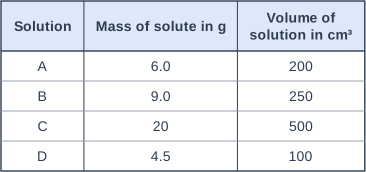
- Thinking the solution with more solute must be more concentrated. It depends on the volume too.
- Adding the solute to 1 dm³ of water and calling it 1 dm³ of solution. Make the solution up to the final volume.
Exam tip
Write the volume in dm³ as the first line of your working: many marks are lost on this one step. In "explain" questions about mass, volume and concentration, say what happens to the concentration and why, such as "the same mass of solute is spread through a larger volume".