Level:
Correct: 0
Incorrect: 0
Marks: 0/0
Exam Practice
Course:
Topics:
AQA GCSE Combined Science (Chemistry Paper 1) Smart practice A mixed round aimed at your weak spots
Unit 1
Atomic structure and the periodic table
Unit 2
Bonding, structure, and the properties of matter
Unit 3
Quantitative chemistry
Unit 4
Chemical changes
Unit 5
Energy changes
Avg
score:
–
Topics
done:
0/55

Ionic compounds

Practise 14 exam-style questions on Ionic compounds for AQA GCSE Combined Science (Chemistry Paper 1). Write your answer as you would in the exam and get it marked in seconds against the mark scheme, point by point, with the Study Helper on hand if you get stuck.

  • 14 questions
  • 1–6 marks each
  • Instant marking
  • No sign-up needed
14 questions, marked as you go

Sample questions with model answers

Here are 4 of the questions in this topic, each with a model answer, an explanation of why it earns the marks and the mark scheme an examiner would use.

Question 1

1 mark

In the three-dimensional structure of sodium chloride, each sodium ion is surrounded by chloride ions.

How many chloride ions surround each sodium ion?

Model answer

6 chloride ions.

Explanation

Each sodium ion has 4 chloride ions around it in its own layer, plus one directly above and one directly below, making 6. In the same way each chloride ion is surrounded by 6 sodium ions, so the ratio is 1 : 1 and the formula is NaCl.

Mark scheme
  1. 1 mark

    6

    do not accept 4 (that is in one layer only)

Question 2

2 marks

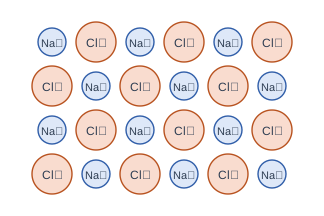
The diagram shows a two-dimensional representation of part of the structure of sodium chloride.

Give two limitations of this diagram.

Part of a giant ionic lattice: a regular grid of alternating small Na⁺ ions and larger Cl⁻ ions.

Model answer

The diagram shows only one layer of ions, but the real structure is three-dimensional, with more ions above and below each layer. It also shows only a small part of the giant lattice and does not show the electrostatic forces acting in all directions.

Explanation

A two-dimensional diagram is simple and clearly shows that positive and negative ions alternate, so you can deduce the formula. Its main limitation is that it cannot show the third dimension, so each sodium ion appears to have only 4 neighbouring chloride ions instead of 6.

Mark scheme
  1. 1 mark

    it shows only one layer / is 2D, but the real structure is three-dimensional (with ions above and below)

    max 2

  2. 1 mark

    it shows only a small part of the giant lattice

  3. 1 mark

    it does not show the forces / bonds between the ions

    allow does not show forces acting in all directions

  4. 1 mark

    the ions are shown with gaps between them / not to scale

Question 3

3 marks

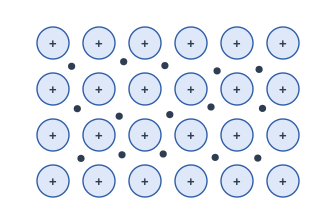
The diagram shows the structure of a substance. A student says: 'This is an ionic compound because it contains positive ions.'

Explain why the student is wrong.

Metallic structure: a regular grid of positive metal ions (circles marked "+") with small dots (electrons) scattered between them.

Model answer

An ionic compound contains both positive and negative ions, but this structure has only positive ions. The small dots between them are delocalised electrons, so this is the structure of a metal, with metallic bonding, not an ionic compound.

Explanation

To deduce that a substance is ionic from a diagram, look for a lattice of alternating positive and negative ions. Positive ions surrounded by a sea of electrons show metallic bonding.

Mark scheme
  1. 1 mark

    there are no negative ions / an ionic compound needs positive and negative ions

  2. 1 mark

    the small dots are (delocalised) electrons

  3. 1 mark

    so it is a metal / has metallic bonding

    allow metallic structure

Question 4

4 marks

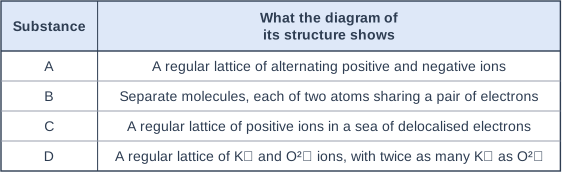
The table shows descriptions of diagrams of the structures of four substances, A, B, C and D.

Which two substances are ionic compounds?
Give the empirical formula of D.
Explain why C is not an ionic compound.

Table with columns "Substance", "What the diagram of its structure shows". Substance: A; What the diagram of its structure shows: A regular lattice of alternating positive and negative ions | Substance: B; What the diagram of its structure shows: Separate molecules, each of two atoms sharing a pair of electrons | Substance: C; What the diagram of its structure shows: A regular lattice of positive ions in a sea of delocalised electrons | Substance: D; What the diagram of its structure shows: A regular lattice of K⁺ and O²⁻ ions, with twice as many K⁺ as O²⁻.

Model answer

A and D are ionic compounds, because their structures are lattices of positive and negative ions.
The empirical formula of D is K₂O, because there are two K⁺ ions for every O²⁻ ion.
C is not ionic: it has positive ions surrounded by delocalised electrons and no negative ions, so it is a metal.

Explanation

An ionic compound is a giant lattice of oppositely charged ions. B is made of small molecules with shared electrons (covalent), and C is a metal. The empirical formula comes from the ratio of the ions: 2 K⁺ to 1 O²⁻.

Mark scheme
  1. 1 mark

    A

    deduct one mark for each extra substance given

  2. 1 mark

    D

  3. 1 mark

    K₂O

  4. 1 mark

    C has only positive ions (with delocalised electrons) / no negative ions, so it is a metal

    allow C has metallic bonding

Ready to try the rest? Every answer you write is marked against the mark scheme, so you can see exactly where the marks are.

Revision notes

Ionic compounds

The big idea

An ionic compound is a giant structure of ions, called a giant ionic lattice. It is held together by strong electrostatic forces of attraction between oppositely charged ions, which act in all directions in the lattice: this is ionic bonding. You need to know the structure of sodium chloride, recognise an ionic compound from a diagram, describe the limitations of each kind of diagram, and work out a formula from a model.

The structure of sodium chloride

Part of a giant ionic lattice: a regular grid of alternating small Na⁺ ions and larger Cl⁻ ions. Label sodium ion points to a Na⁺ ion. Label chloride ion points to a Cl⁻ ion.
One layer of the sodium chloride lattice: positive and negative ions alternate in a regular pattern.
  • Sodium ions (Na⁺) and chloride ions (Cl⁻) are arranged in a regular, repeating pattern that continues in all three dimensions.
  • In 3D, each sodium ion is surrounded by six chloride ions, and each chloride ion by six sodium ions.
  • Each ion attracts all the oppositely charged ions around it, not one partner. There are no NaCl molecules.
  • Giant means a very large number of ions with no fixed number: a bigger crystal just has more ions in the same pattern.

Because there are no molecules, NaCl is an empirical formula: it gives the simplest whole-number ratio of the ions (1 : 1), not the contents of a molecule.

Diagrams and their limitations

There are four common ways to show the structure: dot and cross diagrams, ball and stick models, flat two-dimensional (2D) diagrams and three-dimensional (3D) space-filling models. Each one shows some features well and misses others.

RepresentationWhat it shows wellLimitations
Dot and cross diagramThe transfer of electrons, the charges on the ions and their electronic structuresShows only one pair of ions: no lattice, no 3D arrangement, no relative sizes
Ball and stick modelThe 3D arrangement; each ion has six neighbours of opposite chargeThe sticks suggest bonds between pairs of ions, but the forces act in all directions; the gaps are exaggerated, as the ions really touch; sizes may be wrong
2D diagramThe alternating pattern, simply and clearlyShows one layer, so each ion seems to have 4 neighbours instead of 6
3D space-filling modelHow closely the ions are packed, and their relative sizesIons inside the structure are hidden, so the neighbours are hard to count

Every representation shows only a small part of a giant lattice. In an accurate model the chloride ions are larger than the sodium ions, because Cl⁻ has three occupied shells (2,8,8) and Na⁺ has only two (2,8).

Recognising an ionic compound

A diagram shows an ionic compound when it has both positive and negative ions, alternating in a regular giant lattice. Compare it with the other structures:

  • separate small groups of atoms joined together are molecules, so the substance is covalent;
  • positive ions with electrons between them, and no negative ions, show a metal;
  • alternating positive and negative ions show an ionic compound.

Working out the empirical formula

To find the formula from a model or diagram, count each type of ion, write the ratio and simplify it. Then check that the charges cancel, because an ionic compound has no overall charge. A small model has edges, so its counts can be slightly off the true ratio; the formula describes the whole lattice, so always choose the ratio that balances the charges.

Using the formula to find an unknown charge

Aluminium oxide has the empirical formula Al₂O₃. Oxygen is in Group 6, so each oxide ion is O²⁻. Work out the charge on each aluminium ion.

The formula shows 2 aluminium ions for every 3 oxide ions.

Total negative charge on three oxide ions: \(3 \times 2 = 6\), so 6−.

The compound has no overall charge, so the two aluminium ions carry 6+ in total: \(6 \div 2 = 3\). Each aluminium ion is Al³⁺.

Any model of the lattice, however big, keeps this 2 : 3 ratio of aluminium ions to oxide ions.

Remember

  • Ionic compounds are giant lattices of oppositely charged ions, with no molecules.
  • The electrostatic forces act in all directions, between each ion and all its oppositely charged neighbours.
  • In sodium chloride, each ion is surrounded by six ions of the opposite charge.
  • The formula of an ionic compound is the simplest ratio of its ions, and the charges always cancel.

Common mistakes

  • Calling sodium chloride a molecule, or saying it has intermolecular forces. It is a giant ionic lattice with no molecules.
  • Describing the bonding as one sodium ion bonded to one chloride ion. The forces act in all directions.
  • Giving the numbers counted in a model as the formula. Give the simplest ratio that balances the charges.
  • Saying a 2D diagram shows each ion with six neighbours. It shows four; the other two are above and below the layer.

Exam tip

In an "evaluate the representations" question, give a strength and a limitation of each one, then finish with a judgement that compares them: say which representation is best for which purpose, and why.

Study Helper Hints first, answers after you try

Stuck on this one? Ask for a hint and I’ll point you in the right direction, without giving the answer away. Once you’ve checked your answer, I’ll show you how the marks are awarded.