Practise 18 exam-style questions on The three states of matter for AQA GCSE Combined Science (Chemistry Paper 1). Write your answer as you would in the exam and get it marked in seconds against the mark scheme, point by point, with the Study Helper on hand if you get stuck.
18 questions
1–6 marks each
Instant marking
No sign-up needed
18 questions, marked as you go
Sample questions with model answers
Here are 4 of the questions in this topic, each with a model answer, an explanation of why it earns the marks and the mark scheme an examiner would use.
Question 1
2 marks
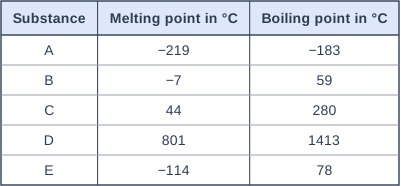
The table shows the melting points and boiling points of five substances, A to E.
Give the letters of the two substances that are liquids at 25 °C.
Model answer
B and E
Explanation
A substance is a liquid when the temperature is above its melting point but below its boiling point. At 25 °C, B (−7 to 59 °C) and E (−114 to 78 °C) are liquids; A is a gas, and C and D are still solids.
Mark scheme
1 mark
B
each correct letter scores 1 mark; if more than two letters are given, deduct 1 mark for each incorrect letter
1 mark
E
Question 2
2 marks
Mercury has a melting point of −39 °C and a boiling point of 357 °C.
Give the state of mercury at −50 °C and at 400 °C.
Model answer
At −50 °C mercury is a solid (below its melting point). At 400 °C mercury is a gas (above its boiling point).
Explanation
Compare the temperature with the melting and boiling points: below the melting point it is solid, between the two it is liquid, and above the boiling point it is gas.
Mark scheme
1 mark
−50 °C: solid
1 mark
400 °C: gas
Question 3
3 marks
On a cold morning, steam from a kettle condenses on a cold window.
Use the particle model to explain what happens when steam condenses.
Model answer
The water molecules in the steam collide with the cold window and transfer energy to it. They slow down and come closer together, and the forces of attraction between the molecules then hold them together as a liquid in which they are close together but randomly arranged.
Explanation
Condensing is the reverse of boiling: instead of energy being supplied to overcome forces, energy is transferred away and the forces of attraction pull the particles together into a liquid.
Mark scheme
1 mark
the particles / molecules transfer energy to the cold window / lose energy
allow particles cool down
1 mark
the particles move more slowly / come closer together
1 mark
forces of attraction between the particles hold them together (as a liquid)
allow particles are close together but randomly arranged / can still move past each other
Question 4
4 marks
The simple particle model represents particles as small solid spheres with no forces between them.
Explain why this model cannot fully explain changes of state such as melting and boiling.
Model answer
In the model there are no forces between the particles. In reality a substance melts or boils only when energy is transferred to overcome the forces between its particles, so the model cannot explain why energy is needed or why the temperature stays constant during a change of state. It also cannot explain why different substances melt and boil at different temperatures, because it shows every particle as the same solid sphere and so cannot show the different types and strengths of bonding between particles.
Explanation
Changes of state are all about the forces between particles, so a model with no forces cannot explain them. Real substances contain different particles (atoms, ions, molecules) held by bonds of different strengths, which is why their melting points vary so much.
Mark scheme
1 mark
the model has no forces between the particles
max 4
1 mark
but energy is needed to melt / boil a substance to overcome the forces between particles
1 mark
so the model cannot explain why energy must be transferred during a change of state / why the temperature stays constant while a substance changes state
1 mark
different substances have different melting and boiling points because the forces between their particles have different strengths, which the model cannot show
1 mark
all particles are shown as identical spheres, so the model cannot show the different types of bonding / particles (ions, atoms, molecules)
1 mark
particles are not solid spheres / atoms are mostly empty space
Ready to try the rest? Every answer you write is marked against the mark scheme, so you can see exactly where the marks are.
Ctrl + Enter to check
Study HelperHints first, answers after you try
Stuck on this one? Ask for a hint and I’ll point you in the right direction, without giving the answer away. Once you’ve checked your answer, I’ll show you how the marks are awarded.