Level:
Correct: 0
Incorrect: 0
Marks: 0/0
Exam Practice
Course:
Topics:
AQA GCSE Combined Science (Chemistry Paper 1) Smart practice A mixed round aimed at your weak spots
Unit 1
Atomic structure and the periodic table
Unit 2
Bonding, structure, and the properties of matter
Unit 3
Quantitative chemistry
Unit 4
Chemical changes
Unit 5
Energy changes
Avg
score:
–
Topics
done:
0/55

Electronic structure

Practise 11 exam-style questions on Electronic structure for AQA GCSE Combined Science (Chemistry Paper 1). Write your answer as you would in the exam and get it marked in seconds against the mark scheme, point by point, with the Study Helper on hand if you get stuck.

  • 11 questions
  • 1–4 marks each
  • Instant marking
  • No sign-up needed
11 questions, marked as you go

Sample questions with model answers

Here are 4 of the questions in this topic, each with a model answer, an explanation of why it earns the marks and the mark scheme an examiner would use.

Question 1

2 marks

The atomic number of potassium is 19.

Give the electronic structure of a potassium atom.
Explain why one electron is in the fourth energy level.

Model answer

2,8,8,1. Electrons occupy the lowest available energy levels. The first three levels hold 2, 8 and 8 electrons, which accounts for 18 electrons, so the 19th electron has to go into the next available level, the fourth.

Explanation

For the first 20 elements, the energy levels fill in the order 2, 8, 8, then the fourth level. An electron only goes into a higher energy level when all the lower ones are full.

Mark scheme
  1. 1 mark

    2,8,8,1

  2. 1 mark

    the first three energy levels are full (2 + 8 + 8 = 18 electrons), and electrons go into the lowest available energy level

    allow the third shell holds 8 so the 19th electron goes into the next shell

Question 2

2 marks

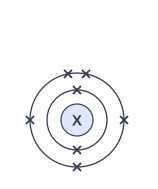
The diagram shows the electronic structure of an atom of element X.

Atomic numbers: B = 5, C = 6, N = 7, O = 8

Identify element X. Give a reason for your answer.

Electron shell diagram: particle with X in the centre and electrons 2,5 drawn on 2 shells.

Model answer

X is nitrogen. The atom has 2 + 5 = 7 electrons, so it must have 7 protons, and the element with atomic number 7 is nitrogen.

Explanation

Count all the electrons on all the shells, not just the outer shell. A neutral atom has as many electrons as protons, so the total gives the atomic number.

Mark scheme
  1. 1 mark

    nitrogen

    allow N

  2. 1 mark

    the atom has 7 electrons (2 + 5), so it has 7 protons / atomic number 7

Question 3

3 marks

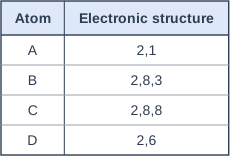
The table shows the electronic structures of four atoms, A, B, C and D.

Which atom has an atomic number of 13?
Which atom has 18 electrons?
How many electrons are in the outer shell of atom D?

Table with columns "Atom", "Electronic structure". Atom: A; Electronic structure: 2,1 | Atom: B; Electronic structure: 2,8,3 | Atom: C; Electronic structure: 2,8,8 | Atom: D; Electronic structure: 2,6.

Model answer

B has an atomic number of 13 (2 + 8 + 3 = 13 electrons).
C has 18 electrons (2 + 8 + 8).
Atom D has 6 electrons in its outer shell.

Explanation

Add the numbers in the electronic structure to find the total number of electrons, which equals the atomic number for an atom. The last number is the number of electrons in the outer (highest occupied) shell.

Mark scheme
  1. 1 mark

    B

  2. 1 mark

    C

  3. 1 mark

    6

Question 4

4 marks

The atomic number of argon is 18.

Describe how the electrons are arranged in an atom of argon. Use the idea of energy levels in your answer.

Model answer

An argon atom has 18 electrons, the same as its number of protons. The electrons occupy the lowest available energy levels, filling them from the innermost level outwards. There are 2 electrons in the first energy level, 8 in the second and 8 in the third, so the electronic structure is 2,8,8. The outer energy level is full, with 8 electrons.

Explanation

The atomic number tells you the number of electrons in an atom. Fill the energy levels from the inside: the first holds 2, then 8 in the second and 8 in the third for the first 20 elements. Argon's outer shell of 8 is a stable arrangement.

Mark scheme
  1. 1 mark

    an argon atom has 18 electrons (equal to the number of protons)

    max 4

  2. 1 mark

    electrons occupy the lowest available energy levels / innermost shells first

  3. 1 mark

    2 electrons in the first energy level

  4. 1 mark

    8 in the second and 8 in the third energy level: 2,8,8

  5. 1 mark

    the outer energy level is full / argon has 8 electrons in its outer shell

Ready to try the rest? Every answer you write is marked against the mark scheme, so you can see exactly where the marks are.

Revision notes

Electronic structure

The big idea

The electrons in an atom are arranged in energy levels, also called shells, around the nucleus. Electrons occupy the lowest available energy levels first, which are the innermost shells. The arrangement of the electrons, especially those in the outer shell, explains how an element reacts and where it sits in the periodic table.

Filling the shells

For the first 20 elements, hydrogen to calcium:

  • the first shell (the lowest energy level) holds up to 2 electrons;
  • the second shell holds up to 8;
  • the third shell takes 8, and then the fourth shell starts to fill.

An electron only goes into a higher energy level when all the lower levels are full. The number of electrons in an atom equals its atomic number (its number of protons), so the atomic number tells you how many electrons to place.

Writing and drawing electronic structures

The electronic structure of sodium is 2,8,1: two electrons in the lowest energy level, eight in the second energy level and one in the third. You can write it with numbers or draw it as a diagram, with the electrons shown as dots or crosses on circles around the nucleus.

Electron shell diagram: Carbon: 2,4: particle with C in the centre and electrons 2,4 drawn on 2 shells; Sodium: 2,8,1: particle with Na in the centre and electrons 2,8,1 drawn on 3 shells; Calcium: 2,8,8,2: particle with Ca in the centre and electrons 2,8,8,2 drawn on 4 shells.
Each circle is a shell. The inner shells fill first: 2, then 8, then 8.

To work out a structure, fill the shells from the inside out. Chlorine has 17 electrons: 2 fill the first shell (15 left), 8 fill the second (7 left), and the last 7 go into the third, so chlorine is 2,8,7.

Reading a structure:

  • the number of numbers is the number of occupied shells: 2,8,1 has three;
  • the last number is the number of electrons in the outer shell: 2,8,1 has one outer electron.

These two facts link an atom to its period and group (see also: The periodic table). Atoms with the same number of outer electrons, such as lithium (2,1) and sodium (2,8,1), have similar chemical properties.

Electronic structures of ions

When atoms form ions, only the outer electrons change.

  • A sodium atom, 2,8,1, loses its 1 outer electron to form Na⁺, which is 2,8.
  • A fluorine atom, 2,7, gains 1 electron to form F⁻, which is 2,8.

Both ions have the same electronic structure as the noble gas neon. An ion's structure can be written in square brackets with its charge, such as [2,8]⁺.

Comparing outer electrons

Which two of these atoms have the same number of electrons in their outer shell: nitrogen (atomic number 7), neon (10), phosphorus (15) and potassium (19)?

Fill each atom's shells in order (2, then 8, then 8):

  • nitrogen: 7 electrons, 2,5
  • neon: 10 electrons, 2,8
  • phosphorus: 15 electrons, 2,8,5
  • potassium: 19 electrons, 2,8,8,1 (the third shell takes only 8 here, so the 19th electron starts a fourth shell)

Nitrogen and phosphorus both have 5 outer electrons. Phosphorus has one more occupied shell.

Remember

  • Electrons occupy the lowest available energy level (innermost shell) first.
  • For the first 20 elements the shells fill 2, then 8, then 8, then the fourth shell.
  • In an atom, the number of electrons equals the atomic number.

Common mistakes

  • Writing potassium as 2,8,9. For the first 20 elements the third shell takes 8, so potassium is 2,8,8,1.
  • Putting electrons into an outer shell before an inner shell is full, such as 1,8,5 for silicon. It is 2,8,4.
  • Writing beryllium as 4. The first shell holds only 2, so beryllium is 2,2.
  • Working backwards from a negative ion the wrong way: an ion X³⁻ that is 2,8 has 10 electrons, so the atom has \(10 - 3 = 7\) electrons (2,5), not 13.
  • Giving two structures for a "compare" question without saying what is the same or different about them.

Exam tip

After writing a structure, add up the numbers: the total must equal the atomic number. In a diagram, draw the electrons as dots or crosses on the circles, with no more than 2 in the first shell and 8 in each of the next two. You can answer in terms of either energy levels or shells.

Study Helper Hints first, answers after you try

Stuck on this one? Ask for a hint and I’ll point you in the right direction, without giving the answer away. Once you’ve checked your answer, I’ll show you how the marks are awarded.