The big idea
When metals react with other substances, their atoms lose electrons and form positive ions. Some metals do this very easily and react vigorously; others hardly react at all. Putting metals in order of reactivity gives the reactivity series, which lets you predict which reactions will happen, including whether one metal can displace another from a compound.
Reactivity and positive ions
The reactivity of a metal is related to its tendency to form positive ions: the more easily its atoms lose their outer electrons, the more reactive the metal. Potassium forms K⁺ ions very easily, so it is at the top of the series. Copper has only a small tendency to form Cu²⁺ ions, so it is near the bottom.
In Group 1, potassium is more reactive than sodium because its outer electron is further from the nucleus, so it is less strongly attracted and is lost more easily.
From most to least reactive, the series is: potassium, sodium, lithium, calcium, magnesium, carbon, zinc, iron, hydrogen, copper. (Aluminium, if it is included, goes between magnesium and carbon.)
Two non-metals are included for comparison:
- Hydrogen: metals above hydrogen react with dilute acids and displace hydrogen gas. Metals below it, such as copper, do not react with dilute acids.
- Carbon: metals below carbon can be extracted from their oxides by heating with carbon (see also: Extraction of metals and reduction).
Reactions with water and dilute acids
At room temperature:
- metal + water → metal hydroxide + hydrogen
- metal + acid → salt + hydrogen
| Metal | With cold water | With dilute acid |
|---|
| Potassium | Very vigorous: floats, melts into a ball, fizzes and moves around; the hydrogen ignites with a lilac flame | Violent and dangerous, so never done in school |
| Sodium | Vigorous: floats, melts into a ball, fizzes and moves around; the hydrogen does not usually ignite | Violent and dangerous, so never done in school |
| Lithium | Steady: floats, fizzes, moves around and gets smaller, but does not melt | Very vigorous fizzing |
| Calcium | Steady fizzing; the calcium sinks and the water turns cloudy | Vigorous fizzing |
| Magnesium | Very slow: just a few bubbles | Vigorous fizzing; the tube gets warm |
| Zinc | No reaction | Steady fizzing |
| Iron | No reaction | Slow: a few bubbles |
| Copper | No reaction | No reaction |
The water turns cloudy with calcium because calcium hydroxide is only slightly soluble, so some of it appears as a white solid. The gas from all of these reactions is hydrogen: a lighted splint gives a squeaky pop.
Displacement reactions
A more reactive metal can displace a less reactive metal from a compound. The more reactive metal ends up as ions in the compound, and the less reactive metal is left as the element:
magnesium + iron(II) chloride → magnesium chloride + iron
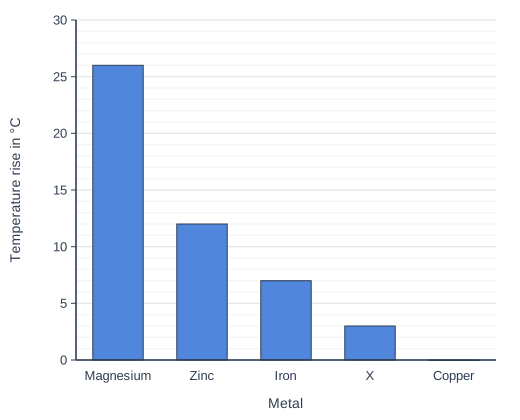
The reverse cannot happen: iron is less reactive than magnesium, so it cannot displace magnesium. A metal added to a solution of its own salt shows no reaction, which makes a useful control. Displacement reactions are exothermic, and the further apart the two metals are in the series, the bigger the temperature rise.
Deducing an order from results
You can rank metals by how vigorously they react with water or acid (how fast they fizz, how much gas forms in a set time, or the temperature rise), or by which displacement reactions happen. For a fair comparison, change only the metal: use pieces of the same size and form (all powders, say) and the same mass, with the same volume, concentration and starting temperature of acid.
Using competition reactions
A student heats mixtures of metal powders with metal oxides. A bright glow shows that a reaction has happened.
| Mixture | Result |
|---|
| metal A + oxide of B | glows |
| metal B + oxide of A | no reaction |
| metal C + oxide of A | glows |
| metal C + oxide of B | glows |
Place A, B and C in order of reactivity, most reactive first.
Each glow means the free metal has taken the oxygen from the other metal, so the free metal is the more reactive one.
- A reacts with the oxide of B, so A is more reactive than B.
- C reacts with the oxide of A, so C is more reactive than A.
- The order is C, A, B. The other two results agree: B cannot displace A, and C displaces B.
Common mistakes
- Giving "hydrogen is produced" as an observation. You cannot see that a gas is hydrogen: write fizzing or bubbles.
- Saying lithium melts or bursts into flames. Only sodium and potassium melt; lithium floats and fizzes steadily.
- Saying calcium and water form calcium oxide. The products are calcium hydroxide and hydrogen.
- Testing for hydrogen with a glowing splint. That is the test for oxygen; hydrogen needs a lighted splint.
- Comparing a powder of one metal with a ribbon of another. The powder has a larger surface area, so it reacts faster whatever the metal.
Exam tip
"Compare" questions need a similarity and a difference, for example "both fizz with dilute acid, but magnesium fizzes much faster than iron". In 6-mark questions, describe each metal's reaction, use the observations to give the order, then link the order to how easily each metal forms positive ions.