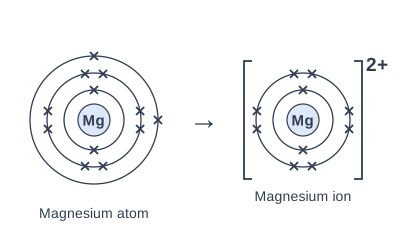
The big idea
At Higher tier, oxidation and reduction are also defined using electrons: oxidation is the loss of electrons and reduction is the gain of electrons. This explains reactions where no oxygen is involved at all, such as displacement reactions, and lets you write ionic equations and half equations that show exactly which particles change.
A useful memory aid is OIL RIG: Oxidation Is Loss, Reduction Is Gain (of electrons).
Half equations
A half equation shows what happens to one species (an atom, ion or molecule) in a reaction. Electrons are written as e⁻.
| Half equation | What happens to the electrons | So the species is |
|---|
| Mg → Mg²⁺ + 2e⁻ | lost (they are on the right) | oxidised |
| Ag⁺ + e⁻ → Ag | gained (they are on the left) | reduced |
| 2I⁻ → I₂ + 2e⁻ | lost | oxidised |
| Fe³⁺ + e⁻ → Fe²⁺ | gained | reduced |
- The charges must balance. In Ag⁺ + e⁻ → Ag, the 1+ and 1− on the left add up to 0, matching the uncharged silver atom on the right.
- An ion can be oxidised or reduced without becoming an atom, as Fe³⁺ + e⁻ → Fe²⁺ shows.
Ionic equations for displacement reactions
An ionic equation shows only the particles that change. Ions that are exactly the same before and after the reaction are spectator ions, and they are left out. For magnesium displacing zinc from zinc sulfate solution:
- Balanced symbol equation: Mg(s) + ZnSO₄(aq) → MgSO₄(aq) + Zn(s)
- Split the dissolved ionic compounds into ions: Mg + Zn²⁺ + SO₄²⁻ → Mg²⁺ + SO₄²⁻ + Zn
- Cross out the spectator ions (SO₄²⁻ is unchanged): Mg(s) + Zn²⁺(aq) → Mg²⁺(aq) + Zn(s)
- Check that the atoms balance and that the total charge is the same on both sides (2+ on each side).
Magnesium atoms lose electrons, so magnesium is oxidised. Zinc ions gain those electrons, so zinc ions are reduced. Both happen at the same time, so this is a redox reaction: electrons are transferred from the magnesium atoms to the zinc ions. Adding the two half equations, so that the electrons cancel, gives the ionic equation.
The two definitions agree: when magnesium burns, it gains oxygen and its atoms also lose electrons to form Mg²⁺ ions.
Building an ionic equation from half equations
Aluminium displaces silver from silver nitrate solution. Use the half equations to write the ionic equation.
Al → Al³⁺ + 3e⁻
Ag⁺ + e⁻ → Ag
Each aluminium atom loses 3 electrons, but each silver ion gains only 1. The electrons lost must equal the electrons gained, so multiply the silver half equation by 3: 3Ag⁺ + 3e⁻ → 3Ag
Add the two half equations and cancel the 3e⁻ on each side:
Al + 3Ag⁺ → Al³⁺ + 3Ag
Check the charge: 3+ on the left and 3+ on the right. Aluminium is oxidised and the silver ions are reduced.
Redox without a metal being displaced
Iron(III) chloride solution is used to etch away unwanted copper from circuit boards:
Cu + 2Fe³⁺ → Cu²⁺ + 2Fe²⁺
Identify the species oxidised and the species reduced. Explain your answers in terms of electrons.
- Cu → Cu²⁺ + 2e⁻: copper atoms lose electrons, so copper is oxidised.
- Fe³⁺ + e⁻ → Fe²⁺: iron(III) ions gain electrons, so iron(III) ions are reduced. They become iron(II) ions, not iron atoms.
Two iron(III) ions are needed to take the two electrons lost by each copper atom. Check: the charge is 6+ on each side.
Common mistakes
- Naming the product as the species oxidised. In Mg + Zn²⁺ → Mg²⁺ + Zn, magnesium (Mg) is oxidised, not magnesium ions (Mg²⁺).
- Saying an atom is reduced because it "gains a positive charge". Atoms only gain or lose electrons; losing negative electrons leaves a positive ion, and that is oxidation.
- Leaving spectator ions, such as sulfate or nitrate ions, in an ionic equation.
- Writing half equations whose charges do not balance, often by putting 1 electron where 2 or 3 are needed.
Exam tip
For "explain in terms of electrons" questions, say which species loses electrons and which gains them, name each one as oxidised or reduced, and back each statement with a half equation. Always check that the charges balance before you move on.