Practise 13 exam-style questions on The periodic table for AQA GCSE Combined Science (Chemistry Paper 1). Write your answer as you would in the exam and get it marked in seconds against the mark scheme, point by point, with the Study Helper on hand if you get stuck.
13 questions
1–6 marks each
Instant marking
No sign-up needed
13 questions, marked as you go
Sample questions with model answers
Here are 4 of the questions in this topic, each with a model answer, an explanation of why it earns the marks and the mark scheme an examiner would use.
Question 1
2 marks
Explain why the periodic table is called a 'periodic' table.
Model answer
When the elements are arranged in order of atomic number, similar properties occur again at regular intervals. This means elements with similar properties line up in the same columns, called groups.
Explanation
'Periodic' means repeating at regular intervals. For example, a reactive metal like lithium (3) is followed eight elements later by another, sodium (11), and then potassium (19), so they fall into the same column.
Mark scheme
1 mark
similar properties occur at regular intervals
allow properties repeat periodically / in a repeating pattern
1 mark
so elements with similar properties are placed in the same column / group
Question 2
2 marks
Fluorine and chlorine react in similar ways. The electronic structure of fluorine is 2,7. The electronic structure of chlorine is 2,8,7.
Explain why fluorine and chlorine have similar chemical properties.
Model answer
Fluorine and chlorine both have 7 electrons in their outer shell, so they are in the same group (Group 7). Chemical reactions involve the outer electrons, so elements with the same number of outer electrons have similar chemical properties.
Explanation
It is the number of outer electrons, not the total number of electrons, that decides how an atom reacts. That is why elements in the same group behave similarly even though their atoms are different sizes.
Mark scheme
1 mark
both have 7 electrons in their outer shell
allow same number of outer electrons
1 mark
so they are in the same group (Group 7) / the outer electrons decide how an element reacts
Question 3
3 marks
Lithium, sodium and potassium all react with water in a similar way.
Explain why, in terms of the electronic structures of their atoms.
Model answer
Lithium (2,1), sodium (2,8,1) and potassium (2,8,8,1) all have one electron in their outer shell. Chemical reactions involve the outer electrons, and each of these atoms loses its single outer electron when it reacts, so they react in similar ways.
Explanation
Having the same number of outer electrons puts elements in the same group and gives them similar chemical properties. The number of inner shells is different, which is why their reactivity is different even though the type of reaction is the same.
Mark scheme
1 mark
they all have the same number of electrons in their outer shell
1 mark
one outer electron each (Li 2,1; Na 2,8,1; K 2,8,8,1)
1 mark
reactions involve the outer electrons / each atom loses its one outer electron when it reacts
allow so they have similar chemical properties
Question 4
4 marks
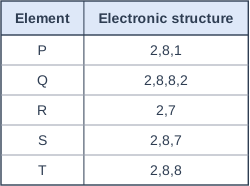
The table shows the electronic structures of five elements, P, Q, R, S and T. The letters are not chemical symbols.
Which two elements are in the same group? Which element is in Group 0? Which element is in period 4? Which group is element Q in?
Model answer
R and S are in the same group (both have 7 outer electrons, Group 7). T is in Group 0 (full outer shell of 8). Q is in period 4 (four occupied energy levels). Q is in Group 2 (2 outer electrons).
Explanation
Read the last number in each electronic structure for the group and count the numbers for the period. An atom with a full outer shell, such as 2,8,8, is in Group 0, not Group 8.
Mark scheme
1 mark
R and S
both needed
1 mark
T
1 mark
Q
1 mark
Group 2
Ready to try the rest? Every answer you write is marked against the mark scheme, so you can see exactly where the marks are.
Ctrl + Enter to check
Study HelperHints first, answers after you try
Stuck on this one? Ask for a hint and I’ll point you in the right direction, without giving the answer away. Once you’ve checked your answer, I’ll show you how the marks are awarded.