Practise 12 exam-style questions on Group 1 for AQA GCSE Combined Science (Chemistry Paper 1). Write your answer as you would in the exam and get it marked in seconds against the mark scheme, point by point, with the Study Helper on hand if you get stuck.
12 questions
1–6 marks each
Instant marking
No sign-up needed
12 questions, marked as you go
Sample questions with model answers
Here are 4 of the questions in this topic, each with a model answer, an explanation of why it earns the marks and the mark scheme an examiner would use.
Question 1
1 mark
Rubidium is in Group 1. Sodium reacts with oxygen to form sodium oxide, Na₂O.
Predict the formula of rubidium oxide.
Model answer
Rb₂O
Explanation
Elements in the same group have the same number of outer electrons, so they form compounds with similar formulae. Every Group 1 metal forms a 1+ ion, so two are needed to balance one 2− oxide ion, just as in Na₂O.
Mark scheme
1 mark
Rb₂O
do not accept RbO or Rb₂O₂
Question 2
2 marks
When a piece of sodium is cut, the freshly cut surface is shiny, but it goes dull within a few seconds.
Explain why the surface goes dull, and write a word equation for the reaction.
Model answer
Sodium is very reactive, so the freshly cut surface quickly reacts with oxygen in the air, forming a dull layer of sodium oxide. sodium + oxygen → sodium oxide
Explanation
All Group 1 metals react with oxygen to form metal oxides. They tarnish faster going down the group, and they are stored under oil to keep air and water away from them.
Mark scheme
1 mark
sodium reacts with oxygen in the air (forming a layer of sodium oxide)
allow sodium is very reactive and tarnishes in air
1 mark
sodium + oxygen → sodium oxide
Question 3
3 marks
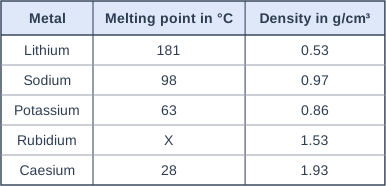
The table shows some properties of the Group 1 metals, in order going down the group. The melting point of rubidium is not given.
Predict the melting point of rubidium, X. Explain your prediction.
Model answer
About 45 °C. The melting points decrease going down Group 1, and rubidium is between potassium (63 °C) and caesium (28 °C), so its melting point should be between these two values.
Explanation
When an element is missing from the middle of a trend, its value should lie between those of its neighbours. Notice that density does not follow a smooth trend (potassium is less dense than sodium), so predictions from trends are estimates, not exact values.
Mark scheme
1 mark
a value between 30 °C and 60 °C
the actual value is 39 °C
1 mark
melting point decreases going down Group 1
1 mark
so rubidium's melting point is between those of potassium (63 °C) and caesium (28 °C)
Question 4
4 marks
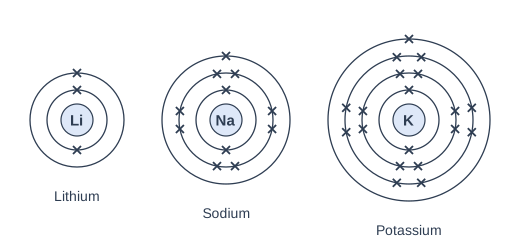
The diagram shows the electronic structures of atoms of lithium, sodium and potassium.
Explain why the reactivity of the Group 1 metals increases going down the group.
Model answer
All Group 1 atoms have one electron in their outer shell, which they lose when they react. Going down the group the atoms have more shells, so the outer electron is further from the nucleus: it is in the second shell in lithium, the third in sodium and the fourth in potassium. The attraction between the positive nucleus and the outer electron is weaker, so the outer electron is lost more easily, and the metal is more reactive.
Explanation
Group 1 reactions all involve losing the single outer electron. The easier that electron is to remove, the more reactive the metal. Distance from the nucleus is the key idea: more shells mean a weaker pull on the outer electron.
Mark scheme
1 mark
all Group 1 atoms have one outer electron, which is lost when they react
max 4
1 mark
going down the group the atoms have more shells / are larger, so the outer electron is further from the nucleus
1 mark
so there is weaker attraction between the nucleus and the outer electron
allow more shielding by inner electrons
1 mark
so the outer electron is lost more easily
Ready to try the rest? Every answer you write is marked against the mark scheme, so you can see exactly where the marks are.
Ctrl + Enter to check
Study HelperHints first, answers after you try
Stuck on this one? Ask for a hint and I’ll point you in the right direction, without giving the answer away. Once you’ve checked your answer, I’ll show you how the marks are awarded.