Level:
Correct: 0
Incorrect: 0
Marks: 0/0
Exam Practice
Course:
Topics:
AQA GCSE Combined Science (Chemistry Paper 1) Smart practice A mixed round aimed at your weak spots
Unit 1
Atomic structure and the periodic table
Unit 2
Bonding, structure, and the properties of matter
Unit 3
Quantitative chemistry
Unit 4
Chemical changes
Unit 5
Energy changes
Avg
score:
–
Topics
done:
0/55

The process of electrolysis

Practise 13 exam-style questions on The process of electrolysis for AQA GCSE Combined Science (Chemistry Paper 1). Write your answer as you would in the exam and get it marked in seconds against the mark scheme, point by point, with the Study Helper on hand if you get stuck.

  • 13 questions
  • 1–6 marks each
  • Instant marking
  • No sign-up needed
13 questions, marked as you go

Sample questions with model answers

Here are 4 of the questions in this topic, each with a model answer, an explanation of why it earns the marks and the mark scheme an examiner would use.

Question 1

1 mark

During electrolysis, two electrodes are placed in the electrolyte.

What is the name of the positive electrode?

Model answer

The anode.

Explanation

The positive electrode is the anode and the negative electrode is the cathode. Negative ions (anions) move to the anode and positive ions (cations) move to the cathode.

Mark scheme
  1. 1 mark

    anode

    do not accept cathode

Question 2

2 marks

In an electrolysis circuit, an electric current passes through the metal wires and through the electrolyte.

Describe how the electric charge is carried in the wires and in the electrolyte.

Model answer

In the metal wires the charge is carried by electrons moving through the metal. In the electrolyte the charge is carried by ions: positive ions move to the cathode and negative ions move to the anode.

Explanation

Electrons cannot travel through an electrolyte. At the electrodes, ions gain or lose electrons, which links the flow of ions in the electrolyte to the flow of electrons in the wires.

Mark scheme
  1. 1 mark

    in the wires, charge is carried by (moving) electrons

    allow delocalised electrons

  2. 1 mark

    in the electrolyte, charge is carried by (moving) ions

    allow positive ions move to the cathode and negative ions to the anode; do not accept electrons move through the electrolyte

Question 3

3 marks

During electrolysis, zinc ions, Zn²⁺, are discharged to form zinc atoms.

Write a balanced half equation for this reaction. State the electrode at which it happens.

Model answer

Zn²⁺ + 2e⁻ → Zn
This happens at the cathode (the negative electrode).

Explanation

A 2+ ion needs two electrons to become a neutral atom. Positive metal ions move to the negative electrode, the cathode, which supplies the electrons.

Mark scheme
  1. 1 mark

    Zn²⁺ + e⁻ → Zn (correct species, electrons on the left)

  2. 1 mark

    Zn²⁺ + 2e⁻ → Zn (balanced)

  3. 1 mark

    at the cathode / negative electrode

Question 4

4 marks

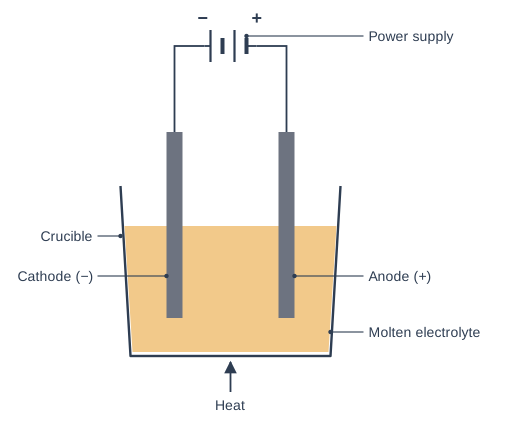
The diagram shows apparatus used to electrolyse molten potassium iodide.

Describe what happens to the potassium ions and to the iodide ions when the power supply is switched on.

Diagram of electrolysis of a molten compound. Labelled parts: Power supply, Cathode (−), Anode (+), Molten electrolyte, Crucible.

Model answer

The positive potassium ions move to the negative electrode (cathode), where each gains an electron and becomes a potassium atom: K⁺ + e⁻ → K. The negative iodide ions move to the positive electrode (anode), where they lose electrons and form iodine: 2I⁻ → I₂ + 2e⁻.

Explanation

In the molten compound the ions are free to move, and each moves to the electrode of opposite charge. At the electrodes the ions are discharged: metal ions gain electrons to form the metal, and non-metal ions lose electrons to form the non-metal element.

Mark scheme
  1. 1 mark

    potassium ions / K⁺ move to the cathode / negative electrode

  2. 1 mark

    potassium ions gain electrons to form potassium (atoms)

    allow K⁺ + e⁻ → K

  3. 1 mark

    iodide ions / I⁻ move to the anode / positive electrode

  4. 1 mark

    iodide ions lose electrons to form iodine

    allow 2I⁻ → I₂ + 2e⁻

Ready to try the rest? Every answer you write is marked against the mark scheme, so you can see exactly where the marks are.

Revision notes

The process of electrolysis

The big idea

Electrolysis means "splitting up with electricity". When an electric current passes through a melted or dissolved ionic compound, the compound is broken down into elements. It works because ions are charged: once they are free to move, each ion is pulled towards the electrode with the opposite charge.

Electrolytes

An ionic compound is made of positive and negative ions held in a giant lattice by strong electrostatic forces. In the solid, the ions are in fixed positions and cannot move, so the solid does not conduct electricity.

When the compound is melted (molten) or dissolved in water, the ions are free to move through the liquid or solution, so it can conduct electricity. A liquid or solution like this is called an electrolyte.

  • Covalent substances such as sugar dissolve as uncharged molecules. Their solutions contain no ions, so they are not electrolytes.
  • Metals conduct when solid, but their current is carried by delocalised electrons and they are not broken down, so a metal is not an electrolyte.

What happens in the cell

Diagram of an electrolysis cell. Labelled parts: Power supply, Cathode (−), Anode (+), Electrolyte, Beaker.
A simple electrolysis cell: two electrodes dip into the electrolyte and are connected to a d.c. power supply.

Two electrodes (rods that conduct electricity) dip into the electrolyte and are connected to a direct current (d.c.) power supply.

ElectrodeChargeIons attracted to it
Cathodenegativepositive ions (metal ions and hydrogen ions)
Anodepositivenegative ions (non-metal ions such as chloride and oxide ions)

When the current flows:

  1. Positive ions move to the negative electrode, the cathode, because opposite charges attract.
  2. Negative ions move to the positive electrode, the anode.
  3. At the electrodes the ions are discharged: positive ions gain electrons and negative ions lose electrons. Each ion becomes an uncharged atom or molecule, so elements are produced.

Carrying the current. In the wires the current is a flow of electrons. In the electrolyte the charge is carried by moving ions; electrons do not travel through the electrolyte. Electrons from the power supply reach the cathode, where positive ions take them. At the anode, negative ions give up electrons, which flow back to the power supply through the wire, completing the circuit.

Inert electrodes. Electrodes are usually made of an inert (unreactive) material such as graphite or platinum. They conduct electricity but do not react with the electrolyte or the products, so the products come only from the electrolyte. Graphite also has a very high melting point, so it can be used in molten compounds.

Remember

  • An electrolyte is an ionic compound that is molten or dissolved in water, so its ions are free to move.
  • Cathode = negative electrode, and positive ions go to it. Anode = positive electrode, and negative ions go to it.
  • At the electrodes, ions are discharged and form elements.
  • Wires carry electrons; the electrolyte carries ions.

Higher tier only

Half equations. A half equation shows what happens at one electrode, with each electron written as e⁻. Higher tier students must write half equations for the electrolysis reactions in this topic, and complete and balance half equations they are given.

  1. Write the ion on the left and the element it forms on the right. Hydrogen, oxygen and the halogens form diatomic molecules (H₂, O₂, F₂, Cl₂, Br₂, I₂).
  2. Balance the atoms.
  3. Add electrons so that the total charge is the same on both sides: on the left for positive ions at the cathode (they gain electrons), and on the right for negative ions at the anode (they lose electrons).

Worked example: when a molten metal oxide is electrolysed, oxide ions, O²⁻, are discharged at the anode. Build the half equation.

  • Ion and element: O²⁻ → O₂
  • Balance the atoms: 2O²⁻ → O₂
  • Balance the charge: the left side is 4− (two ions, each 2−), the right side is 0, so four electrons go on the right: 2O²⁻ → O₂ + 4e⁻

Anode half equations may also be written with the electrons taken away on the left: 2O²⁻ − 4e⁻ → O₂. Gaining electrons is reduction and losing electrons is oxidation, so cathode reactions are reductions and anode reactions are oxidations (see also: Representation of reactions at electrodes as half equations).

Common mistakes

  • Saying electrons flow through the electrolyte. In the electrolyte the charge is carried by ions; electrons flow only in the wires and electrodes.
  • Saying a solid ionic compound does not conduct because "the electrons cannot move". It is the ions that are held in fixed positions.
  • Mixing up the electrodes. The cathode is negative and attracts positive ions; the anode is positive and attracts negative ions.
  • Calling an electrolyte "any liquid" or "water". It must contain ions that are free to move, such as a molten or dissolved ionic compound.
  • Giving ions as the products. Discharged ions become uncharged elements, such as chlorine (not chloride).

Exam tip

In "explain" questions, link each step with a reason: the ions are free to move because the compound is molten or dissolved, and they move to an electrode because opposite charges attract. A memory aid for the electrodes is PANIC: "Positive is Anode, Negative Is Cathode".

Study Helper Hints first, answers after you try

Stuck on this one? Ask for a hint and I’ll point you in the right direction, without giving the answer away. Once you’ve checked your answer, I’ll show you how the marks are awarded.