Level:
Correct: 0
Incorrect: 0
Marks: 0/0
Exam Practice
Course:
Topics:
AQA GCSE Combined Science (Chemistry Paper 1) Smart practice A mixed round aimed at your weak spots
Unit 1
Atomic structure and the periodic table
Unit 2
Bonding, structure, and the properties of matter
Unit 3
Quantitative chemistry
Unit 4
Chemical changes
Unit 5
Energy changes
Avg
score:
–
Topics
done:
0/55

Moles (HT only)

Practise 15 exam-style questions on Moles (HT only) for AQA GCSE Combined Science (Chemistry Paper 1). Write your answer as you would in the exam and get it marked in seconds against the mark scheme, point by point, with the Study Helper on hand if you get stuck.

  • 15 questions
  • 1–5 marks each
  • Instant marking
  • No sign-up needed
15 questions, marked as you go

Sample questions with model answers

Here are 4 of the questions in this topic, each with a model answer, an explanation of why it earns the marks and the mark scheme an examiner would use.

Question 1

1 mark

Give the value of the Avogadro constant.

Model answer

6.02 × 10²³ per mole

Explanation

The Avogadro constant is the number of atoms, molecules or ions in one mole of a substance. It is the same for every substance.

Mark scheme
  1. 1 mark

    6.02 × 10²³ (per mole)

    allow 6.0 × 10²³; do not accept 6.02 × 10²² or 6.02²³

Question 2

2 marks

Calcium chloride, CaCl₂, is an ionic compound containing Ca²⁺ and Cl⁻ ions.

Calculate the total number of ions in 1 mole of calcium chloride.

The Avogadro constant is 6.02 × 10²³ per mole.

Model answer

Each formula unit CaCl₂ contains 1 Ca²⁺ ion and 2 Cl⁻ ions, so 1 mol of CaCl₂ contains 3 mol of ions.
Number of ions = 3 × 6.02 × 10²³ = 1.806 × 10²⁴

Explanation

Moles can be applied to any particle: formulae, ions, atoms or electrons. One mole of the formula CaCl₂ contains three moles of ions.

Mark scheme
  1. 1 mark

    1 mol CaCl₂ contains 3 mol of ions (1 mol Ca²⁺ and 2 mol Cl⁻)

    an answer of 1.81 × 10²⁴ scores 2 marks

  2. 1 mark

    3 × 6.02 × 10²³ = 1.806 × 10²⁴

    allow 1.81 × 10²⁴ or 1.8 × 10²⁴; allow ecf

Question 3

3 marks

Which contains more atoms: 4.0 g of helium or 4.0 g of carbon?

Relative atomic masses (Ar): He = 4, C = 12

Show your working.

Model answer

Moles of helium atoms = 4.0 ÷ 4 = 1.0 mol
Moles of carbon atoms = 4.0 ÷ 12 = 0.33 mol
Helium contains more atoms (three times as many as the carbon).

Explanation

Equal masses do not contain equal numbers of atoms. The lighter the atoms, the more of them there are in a given mass, so compare the numbers of moles.

Mark scheme
  1. 1 mark

    moles of helium = 4.0 ÷ 4 = 1.0 (mol)

  2. 1 mark

    moles of carbon = 4.0 ÷ 12 = 0.33 (mol)

  3. 1 mark

    helium (contains more atoms - three times as many)

    dependent on correct working

Question 4

4 marks

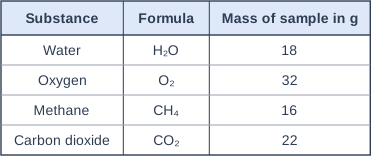
The table shows four samples of different substances.

Which sample contains the greatest number of atoms? Show your working, and calculate the number of atoms in that sample.

Relative atomic masses (Ar): H = 1, C = 12, O = 16
The Avogadro constant is 6.02 × 10²³ per mole.

Table with columns "Substance", "Formula", "Mass of sample in g". Substance: Water; Formula: H₂O; Mass of sample in g: 18 | Substance: Oxygen; Formula: O₂; Mass of sample in g: 32 | Substance: Methane; Formula: CH₄; Mass of sample in g: 16 | Substance: Carbon dioxide; Formula: CO₂; Mass of sample in g: 22.

Model answer

Moles of each substance: H₂O 18 ÷ 18 = 1.0 mol; O₂ 32 ÷ 32 = 1.0 mol; CH₄ 16 ÷ 16 = 1.0 mol; CO₂ 22 ÷ 44 = 0.50 mol
Moles of atoms: H₂O 1.0 × 3 = 3.0 mol; O₂ 1.0 × 2 = 2.0 mol; CH₄ 1.0 × 5 = 5.0 mol; CO₂ 0.50 × 3 = 1.5 mol
The methane sample contains the most atoms: 5.0 × 6.02 × 10²³ = 3.01 × 10²⁴ atoms.

Explanation

Three of the samples contain the same number of molecules (1 mol), but their molecules contain different numbers of atoms. Convert each mass to moles of molecules, then multiply by the number of atoms in one molecule.

Mark scheme
  1. 1 mark

    moles of each substance: H₂O 1.0, O₂ 1.0, CH₄ 1.0, CO₂ 0.50

    all four needed; allow 1 mark for any two correct

  2. 1 mark

    moles of atoms: H₂O 3.0, O₂ 2.0, CH₄ 5.0, CO₂ 1.5

    allow ecf from incorrect moles of substance; all four needed

  3. 1 mark

    methane / CH₄ contains the most atoms

    dependent on working

  4. 1 mark

    number of atoms = 5.0 × 6.02 × 10²³ = 3.01 × 10²⁴

    allow 3.0 × 10²⁴; this mark can be scored if a correct comparison in moles of atoms has been made

Ready to try the rest? Every answer you write is marked against the mark scheme, so you can see exactly where the marks are.

Revision notes

Moles (HT only)

The big idea

Atoms are far too small to count one by one, so chemists count them in huge, fixed batches called moles. Chemical amounts are measured in moles, and the symbol for the unit mole is mol. One mole of any substance contains the same number of particles, and its mass in grams equals its relative formula mass. This lets you turn a mass you can weigh into a number of particles you can use with equations.

What a mole is

  • The number of atoms, molecules or ions in a mole of a given substance is the Avogadro constant: \(6.02 \times 10^{23}\) per mole.
  • The mass of one mole of a substance in grams is numerically equal to its relative formula mass (Mr), or its Ar for an element made of single atoms. One mole of water (Mr 18) has a mass of 18 g.
  • A mole is a fixed number of particles, not a fixed mass. One mole of carbon (12 g) and one mole of carbon dioxide (44 g) contain the same number of particles: the number of atoms in one mole of C is the same as the number of molecules in one mole of CO₂.

Moles can count any stated particle: atoms, molecules, ions, electrons or formula units. The formula tells you how many smaller particles are inside each one.

One mole ofMassContains
iron, Fe56 g1 mol of iron atoms
nitrogen gas, N₂28 g1 mol of molecules, but 2 mol of nitrogen atoms
water, H₂O18 g1 mol of molecules, 2 mol of H atoms and 1 mol of O atoms
calcium chloride, CaCl₂111 g1 mol of Ca²⁺ ions and 2 mol of Cl⁻ ions

Mass and moles

\[\text{amount in moles} = \dfrac{\text{mass}}{M_r}\]

with the mass in grams. Changing the subject gives \(\text{mass} = \text{amount} \times M_r\) and \(M_r = \dfrac{\text{mass}}{\text{amount}}\). To count particles:

\[\text{number of particles} = \text{moles} \times 6.02 \times 10^{23}\]

Make sure the mass is in grams first: 1 kg = 1000 g and 1 g = 1000 mg.

Salt in a pan of water

A cook adds 11.7 g of salt (sodium chloride, NaCl) to a pan of water. Calculate the amount of sodium chloride in moles and the number of sodium ions added. Ar: Na = 23, Cl = 35.5

\(M_r = 23 + 35.5 = 58.5\)

Amount of NaCl: \(\dfrac{11.7}{58.5} = 0.200\) mol

Each formula unit contains one Na⁺ ion, so there are 0.200 mol of sodium ions.

Number of sodium ions: \(0.200 \times 6.02 \times 10^{23} = 1.20 \times 10^{23}\)

The same number of atoms

A student weighs out 1.2 g of magnesium. What mass of copper contains the same number of atoms? Ar: Mg = 24, Cu = 63.5

Amount of magnesium: \(\dfrac{1.2}{24} = 0.050\) mol

The same number of atoms means the same amount in moles, so the student needs 0.050 mol of copper.

Mass of copper: \(0.050 \times 63.5 = 3.175\) g, which is 3.2 g to 2 significant figures

The copper weighs more because each copper atom has a greater mass than a magnesium atom.

Remember

  • The unit of amount is the mole, mol. The Avogadro constant is 6.02 × 10²³ per mole.
  • The mass of 1 mol in grams equals the Mr (or the Ar for atoms).
  • Amount in moles = mass ÷ Mr, so mass = amount × Mr.
  • Always say which particle you are counting: 1 mol of O₂ molecules contains 2 mol of O atoms.

Common mistakes

  • Using a mass in kg or mg without changing it to grams first.
  • Using 16 as the Mr of oxygen gas, or 1 for hydrogen gas. O₂ is 32 and H₂ is 2.
  • Giving the number of molecules when the question asks for atoms or ions. Multiply by the number of that particle in one formula.
  • Standard form slips: \(0.050 \times 6.02 \times 10^{23} = 3.01 \times 10^{22}\), not \(3.01 \times 10^{21}\).
  • Writing the unit as M or m. The unit is mol.

Exam tip

Set out each step on its own line (Mr, then moles, then the answer, with units). Most marks in moles questions are for the method, so a slip early on can still be followed through if your working is clear. Give very large and very small numbers in standard form.

Study Helper Hints first, answers after you try

Stuck on this one? Ask for a hint and I’ll point you in the right direction, without giving the answer away. Once you’ve checked your answer, I’ll show you how the marks are awarded.