Level:
Correct: 0
Incorrect: 0
Marks: 0/0
Exam Practice
Course:
Topics:
AQA GCSE Combined Science (Chemistry Paper 1) Smart practice A mixed round aimed at your weak spots
Unit 1
Atomic structure and the periodic table
Unit 2
Bonding, structure, and the properties of matter
Unit 3
Quantitative chemistry
Unit 4
Chemical changes
Unit 5
Energy changes
Avg
score:
–
Topics
done:
0/55

Properties of small molecules

Practise 13 exam-style questions on Properties of small molecules for AQA GCSE Combined Science (Chemistry Paper 1). Write your answer as you would in the exam and get it marked in seconds against the mark scheme, point by point, with the Study Helper on hand if you get stuck.

  • 13 questions
  • 1–6 marks each
  • Instant marking
  • No sign-up needed
13 questions, marked as you go

Sample questions with model answers

Here are 4 of the questions in this topic, each with a model answer, an explanation of why it earns the marks and the mark scheme an examiner would use.

Question 1

2 marks

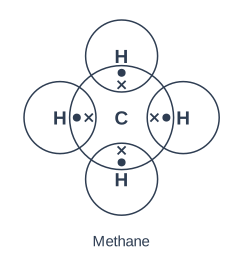
The diagram shows a molecule of methane, CH₄.

A student says: "When methane boils, the covalent bonds between the carbon and hydrogen atoms break."

Explain why the student is wrong.

Dot and cross diagram (outer shells only) of a methane molecule, CH₄: overlapping circles for the atoms, 4 shared pairs of electrons in the overlaps and 0 lone pairs. Labelled: Methane.

Model answer

The covalent bonds between the carbon and hydrogen atoms are strong and do not break when methane boils; the gas is still made of CH₄ molecules. Boiling only overcomes the weak intermolecular forces between the methane molecules.

Explanation

Intermolecular forces are much weaker than covalent bonds. Boiling a molecular substance needs only enough energy to separate the molecules from each other, not to break the molecules apart.

Mark scheme
  1. 1 mark

    the covalent bonds (between C and H atoms) are strong and are not broken / the molecules stay as CH₄

  2. 1 mark

    only the weak intermolecular forces / forces between the methane molecules are overcome

Question 2

2 marks

Ice melts at 0 °C. Water molecules can be split into hydrogen and oxygen atoms only at temperatures of thousands of degrees Celsius.

Explain this difference.

Model answer

When ice melts, only the weak intermolecular forces between the water molecules are overcome, which needs little energy. Splitting the molecules into atoms means breaking the strong covalent bonds between the oxygen and hydrogen atoms, which needs far more energy.

Explanation

Intermolecular forces are weak compared with covalent bonds. Melting and boiling a molecular substance leave the molecules intact; breaking the molecules apart is a chemical change that needs much more energy.

Mark scheme
  1. 1 mark

    melting ice only overcomes the weak intermolecular forces / forces between water molecules

  2. 1 mark

    splitting water molecules requires breaking the (O–H) covalent bonds, which are much stronger (so need much more energy)

Question 3

3 marks

Petrol contains molecules with about 8 carbon atoms. Lubricating oil contains molecules with about 30 carbon atoms. Both are made of small molecules.

Explain why petrol has a much lower boiling point than lubricating oil.

Model answer

Petrol molecules are much smaller than lubricating oil molecules. Intermolecular forces increase with the size of the molecules, so the forces between petrol molecules are weaker. Less energy is needed to overcome them, so petrol boils at a lower temperature.

Explanation

The bigger the molecule, the stronger the intermolecular forces and the higher the boiling point. This is why the small molecules in petrol evaporate easily while lubricating oil does not.

Mark scheme
  1. 1 mark

    petrol molecules are smaller (than lubricating oil molecules)

    allow lubricating oil molecules are larger

  2. 1 mark

    so the intermolecular forces in petrol are weaker

    allow intermolecular forces increase with the size of the molecules

  3. 1 mark

    so less energy is needed to overcome the intermolecular forces in petrol

    do not accept covalent bonds broken

Question 4

4 marks

Chlorine consists of Cl₂ molecules. The covalent bond between the two chlorine atoms in a molecule is strong.

Explain why chlorine is a gas at room temperature, even though the covalent bond in each molecule is strong.

Model answer

Chlorine is made of small Cl₂ molecules. The covalent bond inside each molecule is strong, but the intermolecular forces between the molecules are weak. When chlorine boils, only these weak forces are overcome, and the covalent bonds do not break. Very little energy is needed, so the boiling point is far below room temperature and chlorine is a gas at 20 °C.

Explanation

The state of a molecular substance depends on the forces between its molecules, not on the strength of the covalent bonds within them. Keep the two kinds of force separate in your answer.

Mark scheme
  1. 1 mark

    chlorine consists of small molecules

  2. 1 mark

    the forces between the molecules / intermolecular forces are weak (compared with covalent bonds)

  3. 1 mark

    so little energy is needed to overcome the intermolecular forces / the boiling point is low (below room temperature)

    allow boiling point −34 °C

  4. 1 mark

    the covalent bonds are not broken when chlorine boils / changes state

Ready to try the rest? Every answer you write is marked against the mark scheme, so you can see exactly where the marks are.

Revision notes

Properties of small molecules

The big idea

Substances made of small molecules, such as oxygen, water and methane, are usually gases or liquids with relatively low melting points and boiling points, and they do not conduct electricity. The key idea is that the covalent bonds inside each molecule are strong, but the forces between the molecules are weak.

Two kinds of force

FeatureCovalent bondsIntermolecular forces
Where they actBetween the atoms inside a moleculeBetween separate molecules
StrengthStrongWeak
When the substance melts or boilsNot brokenOvercome

When a substance made of molecules melts or boils, the molecules move apart but each one stays whole. Steam is still made of H₂O molecules: boiling water does not split it into hydrogen and oxygen.

Particle diagram: box Bromine gas shows molecules made of two identical atoms joined together far apart and randomly arranged (gas).
Bromine gas: boiling moved the Br₂ molecules far apart, but each molecule is still two atoms joined by a covalent bond. Only the intermolecular forces were overcome.

Low melting and boiling points

The intermolecular forces are weak, so only a little energy is needed to overcome them. That is why most substances made of small molecules are gases or liquids at room temperature (20 °C).

SubstanceFormulaMelting point in °CBoiling point in °CState at 20 °C
OxygenO₂−218−183gas
ChlorineCl₂−101−34gas
BromineBr₂−759liquid
IodineI₂114184solid

Even a molecular solid has a low melting point compared with a giant structure: iodine melts at 114 °C, but sodium chloride melts at 801 °C.

Larger molecules, higher melting points

The intermolecular forces increase with the size of the molecules, so larger molecules have higher melting and boiling points. The three halogens in the table show this: the molecules get larger from Cl₂ to Br₂ to I₂, and their melting and boiling points rise. In the alkanes, each extra carbon atom makes the molecule larger: methane, CH₄, boils at −162 °C, but octane, C₈H₁₈, boils at 126 °C.

No electrical conductivity

Molecules do not have an overall electric charge, so there are no charged particles (no ions and no delocalised electrons) free to move and carry charge. Substances made of small molecules do not conduct electricity, even as liquids.

Bond strength or intermolecular forces?

A student says: "Iodine melts at a higher temperature than chlorine because the covalent bond in an I₂ molecule is stronger than the bond in a Cl₂ molecule." Use the data to explain why the student is wrong.

SubstanceMelting point in °CEnergy to break 1 mole of its covalent bonds in kJ
Chlorine, Cl₂−101242
Iodine, I₂114151
  • The data show that the I–I bond is actually weaker than the Cl–Cl bond (151 kJ compared with 242 kJ), yet iodine has the higher melting point. So bond strength cannot explain the difference.
  • When either substance melts, the covalent bonds are not broken: only the intermolecular forces are overcome.
  • I₂ molecules are larger than Cl₂ molecules, so the intermolecular forces between them are stronger, and more energy is needed to overcome them.

Remember

  • Covalent bonds inside molecules are strong; intermolecular forces between molecules are weak.
  • Melting and boiling overcome the intermolecular forces, not the covalent bonds.
  • Larger molecules have stronger intermolecular forces, so higher melting and boiling points.
  • Molecules have no overall charge, so molecular substances do not conduct.

Common mistakes

  • Saying covalent bonds break when a molecular substance melts or boils. Only the intermolecular forces are overcome.
  • Saying a molecular substance has "weak covalent bonds". The covalent bonds are strong; it is the forces between the molecules that are weak.
  • Saying larger molecules have stronger covalent bonds. It is the intermolecular forces that increase with size.
  • Thinking a molecular liquid conducts because it is a liquid. Conducting needs charged particles that can move, and molecules have no overall charge.

Exam tip

In any explanation of the properties of a molecular substance, name the intermolecular forces (or "forces between molecules"), say they are weak, and say that little energy is needed to overcome them. Writing "weak bonds" on its own is ambiguous and often loses the mark.

Study Helper Hints first, answers after you try

Stuck on this one? Ask for a hint and I’ll point you in the right direction, without giving the answer away. Once you’ve checked your answer, I’ll show you how the marks are awarded.