Practise 14 exam-style questions on Group 7 for AQA GCSE Combined Science (Chemistry Paper 1). Write your answer as you would in the exam and get it marked in seconds against the mark scheme, point by point, with the Study Helper on hand if you get stuck.
14 questions
1–6 marks each
Instant marking
No sign-up needed
14 questions, marked as you go
Sample questions with model answers
Here are 4 of the questions in this topic, each with a model answer, an explanation of why it earns the marks and the mark scheme an examiner would use.
Question 1
1 mark
Potassium reacts with bromine.
Name the compound formed.
Model answer
Potassium bromide.
Explanation
When a halogen reacts with a metal, the halogen's name changes its ending to -ide: chlorine forms chlorides, bromine forms bromides and iodine forms iodides. The formula is KBr.
Mark scheme
1 mark
potassium bromide
do not accept potassium bromine
Question 2
2 marks
A student adds bromine water to potassium fluoride solution.
Predict whether a reaction will take place. Give a reason for your answer.
Model answer
There will be no reaction. Fluorine is higher in Group 7 than bromine, so it is more reactive, and a less reactive halogen cannot displace a more reactive one from its salt.
Explanation
Displacement only happens when the halogen added is more reactive than the halogen in the salt. Reactivity decreases down Group 7: fluorine > chlorine > bromine > iodine.
Mark scheme
1 mark
no reaction
allow the solution stays orange
1 mark
fluorine is more reactive than bromine, so bromine cannot displace fluorine
allow bromine is lower in Group 7 than fluorine
Question 3
3 marks
Bromine water reacts with potassium iodide solution.
Br₂(aq) + 2KI(aq) → 2KBr(aq) + I₂(aq)
Write the ionic equation for this reaction. Which particle gains electrons in this reaction?
Model answer
Br₂ + 2I⁻ → 2Br⁻ + I₂ The bromine molecules gain electrons (from the iodide ions) to form bromide ions.
Explanation
The potassium ions are unchanged, so they are left out of the ionic equation. Each iodide ion loses one electron, and the bromine molecule gains two electrons to become two bromide ions. Bromine gains electrons more readily than iodine, which is why it is more reactive.
Mark scheme
1 mark
Br₂ + I⁻ → Br⁻ + I₂ (correct species, no K⁺)
an answer of Br₂ + 2I⁻ → 2Br⁻ + I₂ scores the first 2 marks
1 mark
Br₂ + 2I⁻ → 2Br⁻ + I₂ (balanced)
ignore state symbols
1 mark
bromine (molecules / atoms) gain electrons
allow Br₂ gains electrons to form bromide ions; do not accept bromide ions gain electrons
Question 4
4 marks
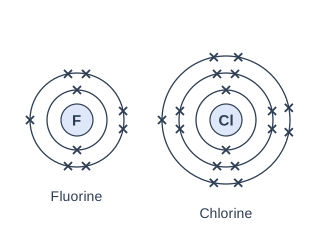
The diagram shows the electronic structures of fluorine and chlorine atoms.
Explain why the reactivity of the halogens decreases going down Group 7.
Model answer
Halogen atoms have seven outer electrons and react by gaining one electron to complete their outer shell. Going down the group the atoms have more shells, so the outer shell is further from the nucleus - in fluorine it is the second shell and in chlorine the third. The attraction between the positive nucleus and an incoming electron is weaker, so it is harder for the atom to gain an electron, and the halogen is less reactive.
Explanation
This is the opposite trend to Group 1. Group 1 atoms react by losing an electron, which gets easier down the group; halogen atoms react by gaining an electron, which gets harder as the outer shell gets further from the nucleus.
Mark scheme
1 mark
halogen atoms react by gaining one electron (to complete the outer shell)
max 4
1 mark
going down the group the atoms have more shells, so the outer shell is further from the nucleus
1 mark
so there is weaker attraction between the nucleus and an incoming electron
allow more shielding
1 mark
so it is harder to gain an electron
allow an electron is gained less easily
Ready to try the rest? Every answer you write is marked against the mark scheme, so you can see exactly where the marks are.
Ctrl + Enter to check
Study HelperHints first, answers after you try
Stuck on this one? Ask for a hint and I’ll point you in the right direction, without giving the answer away. Once you’ve checked your answer, I’ll show you how the marks are awarded.