
Level:
Correct: 0
Incorrect: 0
Marks: 0/0
Exam Practice
Course:
Topics:
OCR GCSE Maths (Foundation calculator) Smart practice A mixed round aimed at your weak spots
Unit 1
Number Operations and Integers
Unit 2
Fractions, Decimals and Percentages
Unit 3
Indices and Surds
Unit 4
Approximation and Estimation
Unit 5
Ratio, Proportion and Rates of Change
Unit 6
Algebra
Unit 7
Graphs of Equations and Functions
Unit 8
Basic Geometry
Unit 9
Congruence and Similarity
Unit 10
Mensuration
Unit 11
Probability
Unit 12
Statistics
Avg
score:
–
Topics
done:
0/100

Writing expressions and formulae

Practise 13 exam-style questions on Writing expressions and formulae for OCR GCSE Maths (Foundation calculator). Write your answer as you would in the exam and get it marked in seconds against the mark scheme, point by point, with the Study Helper on hand if you get stuck.

  • 13 questions
  • 2–4 marks each
  • Instant marking
  • No sign-up needed
13 questions, marked as you go

Sample questions with model answers

Here are 4 of the questions in this topic, each with a model answer, an explanation of why it earns the marks and the mark scheme an examiner would use.

Question 1

2 marks

A charity sells raffle tickets for £2.50 each.
The prizes cost the charity £35 altogether.

Write a formula for the profit, \(P\) pounds, that the charity makes when it sells \(t\) tickets.

Model answer

Money from \(t\) tickets \(= 2.5t\) pounds
Profit \(=\) money taken \(-\) cost of prizes
\(P = 2.5t - 35\)

Explanation

Profit is the money taken minus the costs. Each ticket brings in £2.50, so \(t\) tickets bring in \(2.5t\) pounds, and the £35 for prizes is taken away. Check: selling 20 tickets gives \(50 - 35 = £15\) profit.

Mark scheme
  1. 2 marks

    B2 for \(P = 2.5t - 35\)

    Accept \(P = 2.50t - 35\) or \(P = 2.5 \times t - 35\). B1 for \(2.5t - 35\) without '\(P =\)', or for \(P = 2.5t + k\) or \(P = kt - 35\) (\(k\) not 0), or for \(P = 250t - 3500\) (in pence). \(P = 35 - 2.5t\) scores B1.
Question 2

2 marks

A company hires out vans.
It charges £58.50 for each day plus 12p for each mile driven.

Kerry hires a van for 3 days.

Write a formula for the total cost, \(C\) pounds, when Kerry drives \(m\) miles.

Model answer

Cost of 3 days \(= 3 \times 58.50 = £175.50\)
12p per mile \(= £0.12\) per mile, so \(m\) miles cost \(0.12m\) pounds
\(C = 175.5 + 0.12m\)

Explanation

Work out the fixed part (3 days at £58.50) and the part that depends on \(m\), then add them. The cost must be in pounds, so change 12p to £0.12 before writing \(0.12m\). Mixing pence and pounds, as in \(175.5 + 12m\), is the most common error.

Mark scheme
  1. 2 marks

    B2 for \(C = 175.5 + 0.12m\) oe

    Accept \(C = 3 \times 58.5 + 0.12m\), \(C = 175.50 + 0.12m\) or \(C = 0.12m + 175.5\). B1 for \(175.5 + 0.12m\) without '\(C =\)', or for \(C = 175.5 + 12m\) (mixing pounds and pence), or for \(C = 58.5 + 0.12m\) (only one day), or for \(C = 17550 + 12m\) (all in pence).

Question 3

3 marks

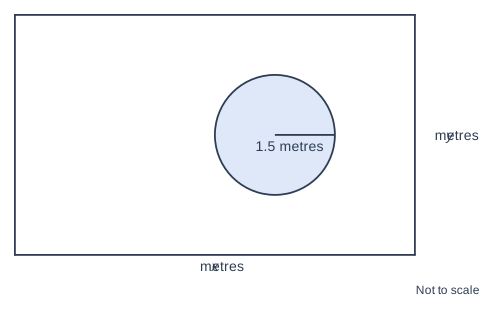
The diagram shows a rectangular lawn \(x\) metres long and \(y\) metres wide.

A circular pond of radius 1.5 metres is dug in the lawn.

Write a formula for the area, \(A\) m\(^2\), of the grass that is left.

Geometry diagram, marked "Not to scale". A circle (shaded). A rectangle (its vertices are not labelled). A horizontal line with no labelled ends is drawn. The unlabelled side going to the right is labelled x metres. The unlabelled side going upwards is labelled y metres. The line between the centre of the circle and an unlabelled point is labelled 1.5 metres.

Model answer

Area of lawn \(= xy\) m\(^2\)
Area of pond \(= \pi \times 1.5^2 = 2.25\pi\) m\(^2\) (\(= 7.068...\) m\(^2\))
\(A = xy - 2.25\pi\)

Explanation

The grass left is the area of the rectangle minus the area of the circle. The area of a circle is \(\pi r^2\), so square the radius before multiplying by \(\pi\): \(1.5^2 = 2.25\). Common errors are using the circumference or the diameter instead of the radius.

Mark scheme
  1. 1 mark

    M1 for \(xy\) as the area of the lawn

    Accept \(x \times y\); correct answer with no working scores full marks

  2. 1 mark

    M1 for \(\pi \times 1.5^2\) or \(2.25\pi\) or 7.07 or better

    The area of the pond; \(\pi \times 1.5^2 = 7.068...\) (7.0695 with \(\pi = 3.142\)); accept 7.06 to 7.07. \(\pi \times 3\) (= 9.42...), \(2 \times \pi \times 1.5\) or \(\pi \times 3^2\) (diameter used, = 28.27...) scores M0.

  3. 1 mark

    A1 for \(A = xy - 2.25\pi\) oe

    Accept \(A = xy - \pi \times 1.5^2\) or \(A = xy - k\) with \(k\) from 7.06 to 7.07. Correct expression without '\(A =\)' scores M1 M1 A0. \(A = 2.25\pi - xy\) scores M1 M1 A0.

Question 4

4 marks

A fence is made from \(n\) panels in a straight line.
There is a post at each end of the fence and a post between each pair of panels.

Each panel costs £24.99.
Each post costs £7.45.

Write a formula for the total cost, \(C\) pounds, of the panels and posts.
Give your formula in its simplest form.

Model answer

With \(n\) panels there are \(n + 1\) posts (one more post than panels).
Cost of panels \(= 24.99n\)
Cost of posts \(= 7.45(n + 1) = 7.45n + 7.45\)
\(C = 24.99n + 7.45n + 7.45\)
\(C = 32.44n + 7.45\)

Explanation

Draw a small fence to see the pattern: 1 panel needs 2 posts, 2 panels need 3 posts, so \(n\) panels need \(n + 1\) posts. Then add the cost of the panels and the posts and collect like terms. Using \(n\) posts is the most common error.

Mark scheme
  1. 1 mark

    B1 for \(n + 1\) posts

    Seen or implied, e.g. by \(7.45(n + 1)\); correct answer with no working scores full marks

  2. 1 mark

    M1 for \(24.99n\)

    The cost of the panels.

  3. 1 mark

    M1 for \(7.45 \times\) their number of posts, added to \(24.99n\)

    e.g. \(24.99n + 7.45(n + 1)\). FT their number of posts in terms of \(n\) (e.g. \(n - 1\) or \(n\)).

  4. 1 mark

    A1 for \(C = 32.44n + 7.45\)

    Accept \(C = 7.45 + 32.44n\). \(C = 24.99n + 7.45(n + 1)\) not simplified scores B1 M1 M1 A0, as does the correct expression without '\(C =\)'. Common error: \(n\) posts gives \(C = 32.44n\), which scores B0 M1 M1 A0.

Ready to try the rest? Every answer you write is marked against the mark scheme, so you can see exactly where the marks are.

Study Helper Hints first, answers after you try

Stuck on this one? Ask for a hint and I’ll point you in the right direction, without giving the answer away. Once you’ve checked your answer, I’ll show you how the marks are awarded.