Practise 13 exam-style questions on Calculating with standard form for OCR GCSE Maths (Foundation calculator). Write your answer as you would in the exam and get it marked in seconds against the mark scheme, point by point, with the Study Helper on hand if you get stuck.
13 questions
1–4 marks each
Instant marking
No sign-up needed
13 questions, marked as you go
Sample questions with model answers
Here are 4 of the questions in this topic, each with a model answer, an explanation of why it earns the marks and the mark scheme an examiner would use.
Question 1
2 marks
A garden snail moves at a speed of \(1.3 \times 10^{-3}\) metres per second.
How far does the snail move in 1 hour? Give your answer in metres, as an ordinary number.
The snail moves \(1.3 \times 10^{-3}\) m, which is 0.0013 m, every second, and there are 3600 seconds in an hour. Multiplying gives 4.68 m. A common error is to multiply by 60 only, which gives the distance in one minute.
Mark scheme
1 mark
M1 for \(1.3 \times 10^{-3} \times 3600\) oe
Or \(0.0013 \times 60 \times 60\). Exact values from the question; correct answer with no working scores full marks
1 mark
A1 for 4.68
Exact value. Accept 4.68 m. \(4.68 \times 10^0\) is acceptable. 0.078 (one minute only) scores M0 A0. A correct answer with no working scores 2 marks.
Question 2
2 marks
A square computer chip has sides of length \(3.4 \times 10^{-3}\) m.
Work out the area of the chip, in m². Give your answer in standard form.
Model answer
Area \(= (3.4 \times 10^{-3})^2\) \(3.4^2 = 11.56\) and \((10^{-3})^2 = 10^{-6}\) \(11.56 \times 10^{-6} = 1.156 \times 10^{-5}\) m²
Explanation
The area of a square is the side length squared. Squaring \(3.4 \times 10^{-3}\) gives \(11.56 \times 10^{-6}\), but 11.56 is not between 1 and 10, so adjust it: \(1.156 \times 10^{-5}\). On a calculator, put brackets round \(3.4 \times 10^{-3}\) before squaring.
Mark scheme
1 mark
M1 for \((3.4 \times 10^{-3})^2\) oe
e.g. \(3.4 \times 10^{-3} \times 3.4 \times 10^{-3}\) or \(0.0034^2\). Exact values. \(4 \times 3.4 \times 10^{-3}\) (perimeter) scores M0; correct answer with no working scores full marks
1 mark
A1 for \(1.156 \times 10^{-5}\)
Exact value. 0.00001156 scores M1 A0 (not standard form). \(11.56 \times 10^{-6}\) scores M1 A0. A correct answer with no working scores 2 marks.
Question 3
2 marks
Leo works out \((8.4 \times 10^6) \div (2.1 \times 10^{-2})\)
Explain the mistake Leo has made. Write down the correct answer in standard form.
Model answer
When dividing, subtract the powers: \(6 - (-2) = 6 + 2 = 8\). Leo worked out \(6 - 2\) and lost the negative sign. \((8.4 \times 10^6) \div (2.1 \times 10^{-2}) = 4 \times 10^8\)
Explanation
Dividing by \(10^{-2}\) is the same as dividing by 0.01, which makes the number 100 times bigger, so the power should go up, not down. The rule is to subtract the powers, and \(6 - (-2) = 8\). Check on a calculator: \(8\,400\,000 \div 0.021 = 400\,000\,000\).
Mark scheme
1 mark
B1 for a correct explanation
e.g. 'he should work out \(6 - (-2)\), which is 8, not \(6 - 2\)', 'he ignored the negative sign in the power', 'subtracting a negative power means adding'. Do not accept 'he subtracted the powers' (that is correct) or 'he should add 6 and 2' with no reason.
1 mark
B1 for \(4 \times 10^8\)
Exact value. Independent of the explanation. Accept 400 000 000 written as \(4 \times 10^8\).
Question 4
4 marks
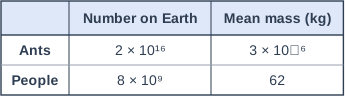
The table shows estimates of the number of ants and the number of people on Earth, and their mean masses.
Is the total mass of all the ants greater than the total mass of all the people? Show how you decide.
Model answer
Total mass of the ants \(= 2 \times 10^{16} \times 3 \times 10^{-6} = 6 \times 10^{10}\) kg Total mass of the people \(= 8 \times 10^9 \times 62 = 4.96 \times 10^{11}\) kg \(4.96 \times 10^{11} = 49.6 \times 10^{10}\), which is more than \(6 \times 10^{10}\). No, the total mass of the ants is less than the total mass of the people.
Explanation
Multiply the number of ants by the mass of one ant, and the number of people by the mass of one person. To multiply, multiply the number parts and add the powers: \(16 + (-6) = 10\). To compare, look at the powers first: \(10^{11}\) is bigger than \(10^{10}\), so the people's total is larger (about 8 times the ants' total).
Mark scheme
1 mark
M1 for \(2 \times 10^{16} \times 3 \times 10^{-6}\)
Exact values from the question.
1 mark
A1 for \(6 \times 10^{10}\) (kg)
Accept 60 000 000 000. Exact value.
1 mark
M1 for \(8 \times 10^9 \times 62\)
May be implied by \(4.96 \times 10^{11}\) or 496 000 000 000 (exact value).
1 mark
A1 for No with \(4.96 \times 10^{11}\) and their \(6 \times 10^{10}\) compared
e.g. '\(6 \times 10^{10}\) is less than \(4.96 \times 10^{11}\), so the ants have less mass'. Accept a comparison of ordinary numbers. 'No' with no correct figures scores 0. \(6 \times 10^{-96}\) (powers multiplied) or \(6 \times 10^{22}\) (16 + 6, sign ignored) scores M1 A0 for the ants.
Ready to try the rest? Every answer you write is marked against the mark scheme, so you can see exactly where the marks are.
Ctrl + Enter to check
Study HelperHints first, answers after you try
Stuck on this one? Ask for a hint and I’ll point you in the right direction, without giving the answer away. Once you’ve checked your answer, I’ll show you how the marks are awarded.