
Level:
Correct: 0
Incorrect: 0
Marks: 0/0
Exam Practice
Course:
Topics:
OCR GCSE Maths (Foundation calculator) Smart practice A mixed round aimed at your weak spots
Unit 1
Number Operations and Integers
Unit 2
Fractions, Decimals and Percentages
Unit 3
Indices and Surds
Unit 4
Approximation and Estimation
Unit 5
Ratio, Proportion and Rates of Change
Unit 6
Algebra
Unit 7
Graphs of Equations and Functions
Unit 8
Basic Geometry
Unit 9
Congruence and Similarity
Unit 10
Mensuration
Unit 11
Probability
Unit 12
Statistics
Avg
score:
–
Topics
done:
0/100

Perimeter of rectilinear and composite shapes

Practise 14 exam-style questions on Perimeter of rectilinear and composite shapes for OCR GCSE Maths (Foundation calculator). Write your answer as you would in the exam and get it marked in seconds against the mark scheme, point by point, with the Study Helper on hand if you get stuck.

  • 14 questions
  • 1–5 marks each
  • Instant marking
  • No sign-up needed
14 questions, marked as you go

Sample questions with model answers

Here are 4 of the questions in this topic, each with a model answer, an explanation of why it earns the marks and the mark scheme an examiner would use.

Question 1

1 mark

The diagram shows an isosceles triangle.

Work out the perimeter of the triangle.
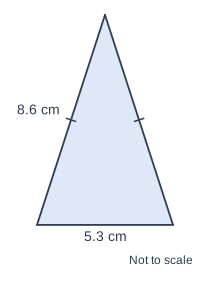
Geometry diagram, marked "Not to scale". An isosceles triangle (its vertices are not labelled) (shaded). The unlabelled side going upwards is labelled 8.6 cm. The unlabelled side going to the right is labelled 5.3 cm. An unlabelled line going downwards and an unlabelled line going downwards are each marked with one short dash (equal lengths).

Model answer

The two sloping sides are equal, so both are 8.6 cm.
Perimeter = \(8.6 + 8.6 + 5.3\)
= 22.5 cm

Explanation

The dashes on the two sloping sides show that they are the same length, so both are 8.6 cm. Add all three sides to get the perimeter. A common mistake is to add only the two sides that have their lengths written on the diagram.

Mark scheme
  1. 1 mark

    B1 for 22.5

    Accept 22.5 cm. 13.9 (only the two labelled sides added) scores 0. 19.2 (taking the two equal sides as the 5.3 cm side) scores 0.
Question 2

2 marks

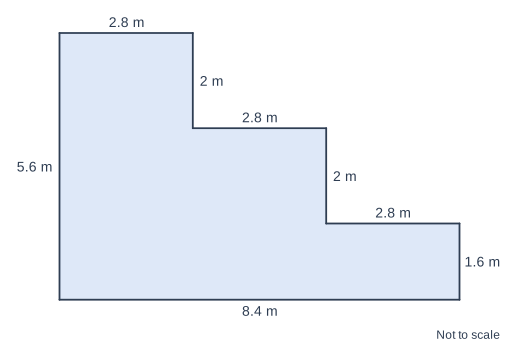
The diagram shows the plan of a patio.
All the corners are right angles.

Leah says,
"The perimeter of the patio is the same as the perimeter of a rectangle 8.4 m long and 5.6 m wide."

Is Leah correct?
Show how you decide.

Geometry diagram, marked "Not to scale". A stepped shape (its vertices are not labelled) (shaded). The unlabelled side going to the right is labelled 8.4 m. The unlabelled side going upwards is labelled 1.6 m. The unlabelled side going to the left is labelled 2.8 m. The unlabelled side going upwards is labelled 2 m. The unlabelled side going to the left is labelled 2.8 m. The unlabelled side going upwards is labelled 2 m. The unlabelled side going to the left is labelled 2.8 m. The unlabelled side going downwards is labelled 5.6 m.

Model answer

Patio: \(8.4 + 1.6 + 2.8 + 2 + 2.8 + 2 + 2.8 + 5.6 = 28\) m
Rectangle: \(8.4 + 5.6 + 8.4 + 5.6 = 28\) m
Both perimeters are 28 m, so Leah is correct.

Explanation

Add all eight edges of the patio and compare with the perimeter of the rectangle. They are the same because the three short horizontal edges of the steps add up to 8.4 m and the short vertical edges add up to 5.6 m, so moving each step outwards would make the rectangle without changing the length of the edge. Comparing areas instead of perimeters is a common mistake.

Mark scheme
  1. 1 mark

    M1 for \(8.4 + 1.6 + 2.8 + 2 + 2.8 + 2 + 2.8 + 5.6\) oe or 28 seen for the patio

    Award for 28 from either the patio or the rectangle, \(2 \times 8.4 + 2 \times 5.6\) oe, with a correct method (exact values from the question).

  2. 1 mark

    A1 for Yes, with both perimeters 28 m

    Needs the decision (Yes oe) and 28 for the patio and 28 for the rectangle. Also accept Yes with a correct explanation that the three short horizontal edges add up to 8.4 m (\(3 \times 2.8\)) and the short vertical edges add up to 5.6 m (\(1.6 + 2 + 2\)), so the patio has the same edges as the rectangle. 'Yes' with no working scores 0. Comparing areas scores 0.

Question 3

3 marks

Ella has six square tiles.
Each tile has sides of length 12.5 cm.

She puts all six tiles together, with no gaps or overlaps, to make a rectangle.

- First she makes a rectangle with all six tiles in one row.
- Then she makes a rectangle with two rows of three tiles.

Work out the difference between the perimeters of these two rectangles.

Model answer

One row: the rectangle is \(6 \times 12.5 = 75\) cm long and 12.5 cm wide.
Perimeter = \(75 + 12.5 + 75 + 12.5 = 175\) cm
Two rows of three: the rectangle is \(3 \times 12.5 = 37.5\) cm long and \(2 \times 12.5 = 25\) cm wide.
Perimeter = \(37.5 + 25 + 37.5 + 25 = 125\) cm
Difference = \(175 - 125 = 50\) cm

Explanation

Work out the length and width of each rectangle from the number of tiles along each side, then find each perimeter. The two rectangles have the same area, but the long thin one has a much bigger perimeter: it has 14 tile edges round the outside, the other has only 10. A common mistake is to assume that shapes with the same area have the same perimeter.

Mark scheme
  1. 1 mark

    M1 for the perimeter of one rectangle: \(2 \times (75 + 12.5)\) or 175, or \(2 \times (37.5 + 25)\) or 125

    Exact values from the question. The one-row rectangle is 75 cm by 12.5 cm; the two-row rectangle is 37.5 cm by 25 cm. Also award for counting outside edges: \(14 \times 12.5\) or \(10 \times 12.5\); correct answer with no working scores full marks

  2. 1 mark

    M1 for the perimeters of both rectangles found

    175 and 125, or \(14 \times 12.5\) and \(10 \times 12.5\). Also award M2 for \((14 - 10) \times 12.5\) oe.

  3. 1 mark

    A1 for 50

    Accept 50 cm. 0 (thinking the perimeters are the same because the area is the same) scores 0. 937.5 or 937.5 cm² (the area) scores 0.

Question 4

4 marks

Bilal wants to put edging all the way round a rectangular lawn.
The lawn is 9.6 m long and 7.25 m wide.

Two shops sell the edging.

Shop A: £3.80 per metre, any length
Shop B: rolls of 5 m, £17.50 per roll

Bilal wants to spend as little as possible.
Which shop should he buy the edging from?
Show how you decide.

Model answer

Perimeter of the lawn = \(9.6 + 7.25 + 9.6 + 7.25 = 33.7\) m
Shop A: \(33.7 \times 3.80 = 128.06\), so £128.06
Shop B: \(33.7 \div 5 = 6.74\), so Bilal needs 7 rolls.
\(7 \times 17.50 = 122.50\), so £122.50
£122.50 is less than £128.06, so Bilal should buy the edging from Shop B.

Explanation

The edging goes round the outside of the lawn, so you need the perimeter, 33.7 m. At Shop A Bilal pays for exactly 33.7 m. At Shop B he must buy whole rolls, so 6.74 rolls means 7 rolls (6 rolls give only 30 m). A common mistake is to work out the cost of 6.74 rolls, or to use the area of the lawn instead of the perimeter.

Mark scheme
  1. 1 mark

    M1 for \(2 \times (9.6 + 7.25)\) oe or 33.7 seen

    Perimeter of the lawn (exact values from the question). Using the area (69.6) scores M0 for this mark and the next two.

  2. 1 mark

    M1 for their \(33.7 \times 3.80\)

    Cost at Shop A, £128.06 (exact). FT their perimeter.

  3. 1 mark

    M1 for 7 rolls, or \(7 \times 17.50\) or 122.50 seen

    Cost at Shop B. Award for their \(33.7 \div 5\) rounded up to a whole number of rolls and multiplied by 17.50. \(6.74 \times 17.50 = 117.95\) (part of a roll bought) scores M0 for this mark.

  4. 1 mark

    A1 for Shop B, with £128.06 and £122.50

    Needs the decision and both correct costs; accept 128.06 and 122.5. Also accept Shop B, with a saving of £5.56 and both costs shown. 'Shop B' with no working or from incorrect working (e.g. from 117.95) scores 0 for this mark.

Ready to try the rest? Every answer you write is marked against the mark scheme, so you can see exactly where the marks are.

Study Helper Hints first, answers after you try

Stuck on this one? Ask for a hint and I’ll point you in the right direction, without giving the answer away. Once you’ve checked your answer, I’ll show you how the marks are awarded.