
Level:
Correct: 0
Incorrect: 0
Marks: 0/0
Exam Practice
Course:
Topics:
OCR GCSE Maths (Foundation calculator) Smart practice A mixed round aimed at your weak spots
Unit 1
Number Operations and Integers
Unit 2
Fractions, Decimals and Percentages
Unit 3
Indices and Surds
Unit 4
Approximation and Estimation
Unit 5
Ratio, Proportion and Rates of Change
Unit 6
Algebra
Unit 7
Graphs of Equations and Functions
Unit 8
Basic Geometry
Unit 9
Congruence and Similarity
Unit 10
Mensuration
Unit 11
Probability
Unit 12
Statistics
Avg
score:
–
Topics
done:
0/100

Quadratic equations

Practise 13 exam-style questions on Quadratic equations for OCR GCSE Maths (Foundation calculator). Write your answer as you would in the exam and get it marked in seconds against the mark scheme, point by point, with the Study Helper on hand if you get stuck.

  • 13 questions
  • 1–5 marks each
  • Instant marking
  • No sign-up needed
13 questions, marked as you go

Sample questions with model answers

Here are 4 of the questions in this topic, each with a model answer, an explanation of why it earns the marks and the mark scheme an examiner would use.

Question 1

2 marks

Mia factorises \(x^2 - 2x - 143\) correctly.

\(x^2 - 2x - 143 = (x - 13)(x + 11)\)

Use this to write down the two solutions of the equation \(x^2 - 2x - 143 = 0\).

Model answer

\((x - 13)(x + 11) = 0\)
Either \(x - 13 = 0\), so \(x = 13\)
or \(x + 11 = 0\), so \(x = -11\)

Explanation

If two numbers multiply to give 0, one of them must be 0. So either x − 13 = 0 or x + 11 = 0, giving x = 13 or x = −11. A common error is to copy the numbers from the brackets with the same signs (−13 and 11); the solutions have the opposite signs.

Mark scheme
  1. 1 mark

    B1 for \(x = 13\)

    Accept 13 in either order with the other solution; correct answer with no working scores full marks

  2. 1 mark

    B1 for \(x = -11\)

    If 0 scored, SC1 for −13 and 11 (both signs wrong).
Question 2

3 marks

Solve.

\(x^2 - 3x - 70 = 0\)

Model answer

Two numbers that multiply to −70 and add to −3 are −10 and 7.
\((x - 10)(x + 7) = 0\)
\(x = 10\) or \(x = -7\)

Explanation

The constant is negative, so the two numbers in the brackets have different signs; the bigger one must be negative because they add to −3. −10 and +7 work: −10 × 7 = −70 and −10 + 7 = −3. Then each bracket equal to zero gives x = 10 or x = −7.

Mark scheme
  1. 2 marks

    M2 for \((x - 10)(x + 7)\)

    Accept \(x - 10 = 0\) and \(x + 7 = 0\) for M2. M1 for \((x + a)(x + b)\) where \(ab = -70\) or \(a + b = -3\), e.g. \((x + 10)(x - 7)\); correct answer with no working scores full marks

  2. 1 mark

    B1FT for \(x = 10\) and \(x = -7\)

    FT correct solutions from their two brackets (strict FT): \((x + 10)(x - 7)\) with answers −10 and 7 scores M1 B1. Correct answers with no working score 3 marks.

Question 3

3 marks

The solutions of the equation \(x^2 + bx + c = 0\) are \(x = 4\) and \(x = -9\)

Find the value of \(b\) and the value of \(c\).

Model answer

\(x = 4\) comes from the bracket \((x - 4)\) and \(x = -9\) comes from \((x + 9)\).
\((x - 4)(x + 9) = x^2 + 9x - 4x - 36 = x^2 + 5x - 36\)
\(b = 5\) and \(c = -36\)

Explanation

Work backwards: a solution x = 4 means (x − 4) is a factor, and x = −9 means (x + 9) is a factor. Expanding (x − 4)(x + 9) gives x² + 5x − 36, so b = 5 and c = −36. A common error is to use (x + 4)(x − 9), which has the wrong signs.

Mark scheme
  1. 1 mark

    M1 for \((x - 4)(x + 9)\)

    Or for substituting both solutions, e.g. \(16 + 4b + c = 0\) and \(81 - 9b + c = 0\); correct answer with no working scores full marks

  2. 1 mark

    B1 for \(b = 5\)

    Accept \(x^2 + 5x - 36\) seen.

  3. 1 mark

    B1 for \(c = -36\)

    b = −5 and c = −36 (from \((x + 4)(x - 9)\)) scores M0 B0 B1.

Question 4

4 marks

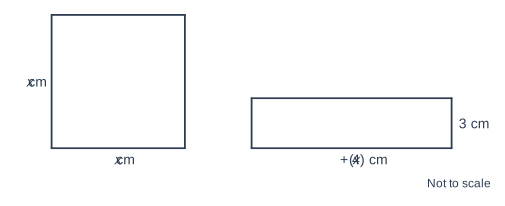
The diagram shows a square and a rectangle.

The square has sides of length \(x\) cm.
The rectangle is \((x + 4)\) cm long and 3 cm wide.

The area of the square is 28 cm² more than the area of the rectangle.

Use algebra to work out the area of the square.

Geometry diagram, marked "Not to scale". A square (its vertices are not labelled). A rectangle (its vertices are not labelled). The unlabelled side going to the right is labelled x cm. The unlabelled side going upwards is labelled x cm. The unlabelled side going to the right is labelled (x + 4) cm. The unlabelled side going upwards is labelled 3 cm.

Model answer

Area of square \(= x^2\)
Area of rectangle \(= 3(x + 4) = 3x + 12\)
\(x^2 = 3x + 12 + 28\)
\(x^2 - 3x - 40 = 0\)
\((x - 8)(x + 5) = 0\)
\(x = 8\) or \(x = -5\)
A length cannot be negative, so \(x = 8\).
Area of square \(= 8^2 = 64\) cm²
(Check: rectangle \(= 3 \times 12 = 36\) cm², and \(64 - 36 = 28\).)

Explanation

Write both areas in terms of x and use '28 more than' to make an equation: x² = 3(x + 4) + 28. Rearranging gives x² − 3x − 40 = 0, which factorises as (x − 8)(x + 5) = 0. Only x = 8 is a possible length, and the question asks for the area, 64 cm².

Mark scheme
  1. 1 mark

    M1 for \(x^2 = 3(x + 4) + 28\) oe

    Or \(x^2 - 3(x + 4) = 28\) oe; correct answer with no working scores full marks

  2. 1 mark

    M1 for \(x^2 - 3x - 40 = 0\)

    Correctly expanded and rearranged, in any order.

  3. 1 mark

    M1 for \((x - 8)(x + 5)\) or \(x = 8\)

    FT their three-term quadratic if it factorises.

  4. 1 mark

    A1 for 64 cm²

    Accept 64. 8 (the side) as the final answer scores M1 M1 M1 A0. \(x^2 = 3x + 4 + 28\) (bracket not expanded) gives \(x^2 - 3x - 32 = 0\), which does not factorise: M1 M0. 64 from trials with no algebra scores SC2.

Ready to try the rest? Every answer you write is marked against the mark scheme, so you can see exactly where the marks are.

Study Helper Hints first, answers after you try

Stuck on this one? Ask for a hint and I’ll point you in the right direction, without giving the answer away. Once you’ve checked your answer, I’ll show you how the marks are awarded.