
Level:
Correct: 0
Incorrect: 0
Marks: 0/0
Exam Practice
Course:
Topics:
OCR GCSE Maths (Foundation calculator) Smart practice A mixed round aimed at your weak spots
Unit 1
Number Operations and Integers
Unit 2
Fractions, Decimals and Percentages
Unit 3
Indices and Surds
Unit 4
Approximation and Estimation
Unit 5
Ratio, Proportion and Rates of Change
Unit 6
Algebra
Unit 7
Graphs of Equations and Functions
Unit 8
Basic Geometry
Unit 9
Congruence and Similarity
Unit 10
Mensuration
Unit 11
Probability
Unit 12
Statistics
Avg
score:
–
Topics
done:
0/100

Order of operations

Practise 13 exam-style questions on Order of operations for OCR GCSE Maths (Foundation calculator). Write your answer as you would in the exam and get it marked in seconds against the mark scheme, point by point, with the Study Helper on hand if you get stuck.

  • 13 questions
  • 1–4 marks each
  • Instant marking
  • No sign-up needed
13 questions, marked as you go

Sample questions with model answers

Here are 4 of the questions in this topic, each with a model answer, an explanation of why it earns the marks and the mark scheme an examiner would use.

Question 1

1 mark

Work out.

\((9.3 - 2.7) \div 1.5\)

Model answer

Brackets first: \(9.3 - 2.7 = 6.6\)
Then divide: \(6.6 \div 1.5 = 4.4\)

Explanation

Work out the bracket first, then divide the result by 1.5. If you type it into a calculator, type the brackets too. Without them the calculator divides 2.7 by 1.5 first and gives 7.5.

Mark scheme
  1. 1 mark

    B1 for 4.4

    Exact value. 7.5 (from \(9.3 - 2.7 \div 1.5\), ignoring the brackets) scores 0.
Question 2

2 marks

Work out.

\(\dfrac{15.3 - 2.8^2}{0.4}\)

Model answer

\(2.8^2 = 7.84\)
Numerator: \(15.3 - 7.84 = 7.46\)
\(7.46 \div 0.4 = 18.65\)

Explanation

The fraction line works like brackets: the whole of the top is divided by 0.4. Square 2.8 first (power before subtraction), subtract from 15.3, then divide. On a calculator use the fraction key, or type \((15.3 - 2.8^2) \div 0.4\) with brackets.

Mark scheme
  1. 1 mark

    M1 for 7.84 or 7.46 seen

    Exact values: \(2.8^2 = 7.84\) and \(15.3 - 7.84 = 7.46\); correct answer with no working scores full marks

  2. 1 mark

    A1 for 18.65

    Exact value. A correct answer with no working scores 2 marks. \(-4.3\) (from \(15.3 - 2.8^2 \div 0.4\), keyed without brackets) scores M1 A0. 24.25 (from \(15.3 - 5.6\), using \(2.8 \times 2\)) scores M0 A0.

Question 3

2 marks

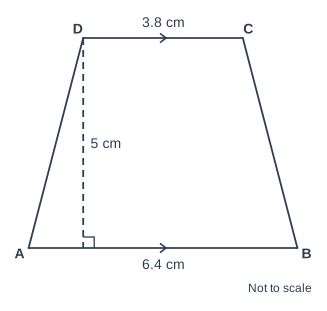
The diagram shows trapezium ABCD.

Ethan wants to work out the area of the trapezium.
He types this into his calculator.

\(1 \div 2 \times 6.4 + 3.8 \times 5 =\)

His calculator shows 22.2

Explain why Ethan's answer is wrong.
Work out the correct area of the trapezium.

Geometry diagram, marked "Not to scale". Trapezium ABCD. A dashed line is drawn from D going downwards. Side AB is labelled 6.4 cm. Side DC is labelled 3.8 cm. The line going downwards from D is labelled 5 cm. The angle at an unlabelled point between the lines to D and B is marked as a right angle (90°). AB and DC are each marked with an arrowhead (parallel lines).

Model answer

The calculator does the multiplications first, so it works out \(\dfrac{1}{2} \times 6.4 = 3.2\) and \(3.8 \times 5 = 19\), then adds: \(3.2 + 19 = 22.2\).
The two parallel sides must be added first, so Ethan needs brackets: \(1 \div 2 \times (6.4 + 3.8) \times 5\)
Area \(= \dfrac{1}{2} \times (6.4 + 3.8) \times 5 = \dfrac{1}{2} \times 10.2 \times 5 = 25.5\) cm²

Explanation

The area of a trapezium is half the sum of the parallel sides times the height, so the sum \(6.4 + 3.8\) must be worked out first. Without brackets the calculator follows the order of operations: it halves only 6.4 and multiplies only 3.8 by 5. With brackets the answer is 25.5 cm².

Mark scheme
  1. 1 mark

    B1 for a correct explanation

    e.g. 'he needs brackets round 6.4 + 3.8', 'the calculator multiplies 3.8 by 5 before adding, so only 3.8 is multiplied by 5 and only 6.4 is halved', 'he should type \(1 \div 2 \times (6.4 + 3.8) \times 5\)'. Do not accept 'he typed it in wrong' or 'he used the wrong formula' with no detail.

  2. 1 mark

    B1 for 25.5

    Exact value. Accept 25.5 cm². Independent of the explanation.

Question 4

4 marks

Kai cycles 12.4 km in 36 minutes.
He stops for a rest.
He then cycles 8.75 km in 21 minutes.

Work out his average speed, in km/h, for the time he is cycling.
Give your answer correct to 1 decimal place.

Model answer

Total distance \(= 12.4 + 8.75 = 21.15\) km
Total time \(= 36 + 21 = 57\) minutes \(= 57 \div 60 = 0.95\) hours
Average speed \(= 21.15 \div 0.95 = 22.26315789...\)
Correct to 1 decimal place: 22.3 km/h

Explanation

Average speed is total distance divided by total time, so add the distances and add the times first; on a calculator this needs brackets: \((12.4 + 8.75) \div (57 \div 60)\). Change minutes into hours by dividing by 60. Working out the two speeds and finding their mean (22.8) is a common error, because Kai spends different lengths of time at each speed.

Mark scheme
  1. 1 mark

    M1 for \(12.4 + 8.75\)

    Exact values from the question. May be implied by 21.15 (km); correct answer with no working scores full marks

  2. 1 mark

    M1 for \((36 + 21) \div 60\)

    May be implied by 0.95 (hours), or 57 minutes seen with a later division by 60.

  3. 1 mark

    M1 for their total distance \(\div\) their total time in hours

    Or their \(21.15 \div 57 \times 60\). May be implied by 22.26...

  4. 1 mark

    A1 for 22.3

    Accept 22.26 to 22.3 (the full value is 22.263157...). A correct answer with no working scores 4 marks. 22.8 (from the mean of the two speeds, 20.66... and 25) scores M0 M0 M0 A0. 0.37... km per minute not converted scores M1 M1 M0 A0. 21.6 (from \(12.4 + 8.75 \div 0.95\), no brackets) scores M1 M1 M0 A0.

Ready to try the rest? Every answer you write is marked against the mark scheme, so you can see exactly where the marks are.

Study Helper Hints first, answers after you try

Stuck on this one? Ask for a hint and I’ll point you in the right direction, without giving the answer away. Once you’ve checked your answer, I’ll show you how the marks are awarded.