
Level:
Correct: 0
Incorrect: 0
Marks: 0/0
Exam Practice
Course:
Topics:
OCR GCSE Maths (Foundation calculator) Smart practice A mixed round aimed at your weak spots
Unit 1
Number Operations and Integers
Unit 2
Fractions, Decimals and Percentages
Unit 3
Indices and Surds
Unit 4
Approximation and Estimation
Unit 5
Ratio, Proportion and Rates of Change
Unit 6
Algebra
Unit 7
Graphs of Equations and Functions
Unit 8
Basic Geometry
Unit 9
Congruence and Similarity
Unit 10
Mensuration
Unit 11
Probability
Unit 12
Statistics
Avg
score:
–
Topics
done:
0/100

Converting units

Practise 16 exam-style questions on Converting units for OCR GCSE Maths (Foundation calculator). Write your answer as you would in the exam and get it marked in seconds against the mark scheme, point by point, with the Study Helper on hand if you get stuck.

  • 16 questions
  • 1–4 marks each
  • Instant marking
  • No sign-up needed
16 questions, marked as you go

Sample questions with model answers

Here are 4 of the questions in this topic, each with a model answer, an explanation of why it earns the marks and the mark scheme an examiner would use.

Question 1

2 marks

The diagram shows the scale on a set of kitchen scales.
Arrow A shows the mass of a bag of potatoes.

Write down the mass of the bag of potatoes.
Give your answer in grams.

A horizontal scale from 0 to 3 kg, divided into 3 equal parts by long marks, each split into 10 small divisions by short marks. Every long mark is numbered (0, 1, 2 and 3). An arrow labelled A points halfway between two marks on the scale.

Model answer

Each small division is 0.1 kg.
Arrow A is halfway between 1.7 kg and 1.8 kg, so it shows 1.75 kg.
\(1.75 \times 1000 = 1750\)
The mass is 1750 g.

Explanation

There are 10 small divisions between 1 kg and 2 kg, so each one is 0.1 kg. The arrow is halfway between 1.7 and 1.8, which is 1.75 kg. Multiply by 1000 to change kilograms into grams.

Mark scheme
  1. 1 mark

    B1 for 1.75 (kg) seen

    Exact value. Implied by a correct final answer; correct answer with no working scores full marks

  2. 1 mark

    B1 for 1750 (g)

    FT their reading in kg × 1000, provided their reading is between 1 and 2 kg. 1.75 kg as the final answer scores B1 B0. 1705 g or 1075 g scores 0.
Question 2

2 marks

A train journey takes 2 hours 54 minutes.

Nina says,

"2 hours 54 minutes is the same as 2.54 hours."

Explain why Nina is wrong.
Write 2 hours 54 minutes in hours as a decimal.

Model answer

There are 60 minutes in an hour, not 100, so 54 minutes is not 0.54 of an hour.
54 minutes = \(54 \div 60 = 0.9\) hours
2 hours 54 minutes = 2.9 hours

Explanation

Decimal hours are parts of 60 minutes, not of 100. To change minutes into a decimal part of an hour, divide by 60: \(54 \div 60 = 0.9\). So 2 hours 54 minutes is 2.9 hours, while 2.54 hours would be 2 hours 32.4 minutes.

Mark scheme
  1. 1 mark

    B1 for an explanation that there are 60 minutes in an hour, not 100 oe

    Accept e.g. '54 minutes is \(\dfrac{54}{60}\) of an hour, not 0.54 of an hour', '0.54 hours is 32.4 minutes'. Do not accept 'she is wrong because it is 2.9' with no reason.

  2. 1 mark

    B1 for 2.9 (hours)

    Exact answer. Independent of the explanation. Implied by \(54 \div 60 = 0.9\) then 2.9.

Question 3

2 marks

A tin holds \(p\) litres of paint.
Each coat of paint on a door uses 250 ml of paint.

Write an expression, in terms of \(p\), for the number of coats of paint that can be put on a door using the whole tin.
Give your expression in its simplest form.

Model answer

\(p\) litres = \(1000p\) ml
Number of coats = \(1000p \div 250 = 4p\)

Explanation

Change \(p\) litres into millilitres by multiplying by 1000, so that both amounts are in millilitres. Dividing \(1000p\) by 250 gives \(4p\). Check with a number: a 2-litre tin would give 8 coats of 250 ml.

Mark scheme
  1. 1 mark

    M1 for \(1000p\) (ml) or 250 ml = 0.25 litres seen

    Also M1 for \(\dfrac{1000p}{250}\) or \(\dfrac{p}{0.25}\) not simplified; correct answer with no working scores full marks

  2. 1 mark

    A1 for \(4p\)

    \(\dfrac{1000p}{250}\) or \(\dfrac{p}{0.25}\) as the final answer scores M1 A0. \(\dfrac{p}{250}\) or \(250p\) scores M0 A0.

Question 4

4 marks

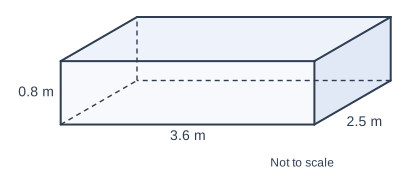
The diagram shows a garden pond in the shape of a cuboid.
The pond is 3.6 m long, 2.5 m wide and 0.8 m deep.

Owen fills the pond completely with water.
He adds pond treatment to the water.
He needs 5 ml of treatment for every 100 litres of water.

The treatment is sold in 250 ml bottles.

How many bottles of treatment does Owen need to buy?

A cuboid drawn in 3D with hidden edges shown as dashed lines. The length is labelled 3.6 m (along the front bottom edge). The width (the edge going back) is labelled 2.5 m (along the bottom edge going back on the right). The height is labelled 0.8 m (along the front left vertical edge). The diagram is labelled "Not to scale".

Model answer

Volume = \(3.6 \times 2.5 \times 0.8 = 7.2\) m³
1 m³ = 1000 litres, so 7.2 m³ = 7200 litres
Number of lots of 100 litres = \(7200 \div 100 = 72\)
Treatment needed = \(72 \times 5 = 360\) ml
Bottles = \(360 \div 250 = 1.44\)
One bottle is not enough, so Owen needs to buy 2 bottles.

Explanation

Find the volume of the cuboid in cubic metres and change it into litres (1 m³ = 1000 litres). The dose is 5 ml for every 100 litres, so 7200 litres needs \(72 \times 5 = 360\) ml. Owen can only buy whole bottles and 1 bottle (250 ml) is not enough, so he must round up to 2.

Mark scheme
  1. 1 mark

    M1 for \(3.6 \times 2.5 \times 0.8\) (= 7.2 m³)

    Exact values from the question. Also M1 for \(360 \times 250 \times 80\) (= 7 200 000 cm³); correct answer with no working scores full marks

  2. 1 mark

    M1 for their 7.2 \(\times 1000\) (= 7200 litres)

    Or their 7 200 000 \(\div 1000\). 1 m³ = 1000 litres.

  3. 1 mark

    M1 for their 7200 \(\div 100 \times 5\) (= 360 ml)

    Also M1 for their \(360 \div 250\) (= 1.44 bottles) seen, provided their 360 comes from a correct method.

  4. 1 mark

    A1 for 2 (bottles)

    2 with no working scores 4 marks. 1.44 or 1 (not rounded up) scores M1 M1 M1 A0. Using 1 m³ = 100 litres (720 litres, 36 ml) leads to 1 bottle and scores M1 M0 M1 A0.

Ready to try the rest? Every answer you write is marked against the mark scheme, so you can see exactly where the marks are.

Study Helper Hints first, answers after you try

Stuck on this one? Ask for a hint and I’ll point you in the right direction, without giving the answer away. Once you’ve checked your answer, I’ll show you how the marks are awarded.