Level:
Correct: 0
Incorrect: 0
Marks: 0/0
Exam Practice
Course:
Topics:
OCR GCSE Maths (Foundation calculator) Smart practice A mixed round aimed at your weak spots
Unit 1
Number Operations and Integers
Unit 2
Fractions, Decimals and Percentages
Unit 3
Indices and Surds
Unit 4
Approximation and Estimation
Unit 5
Ratio, Proportion and Rates of Change
Unit 6
Algebra
Unit 7
Graphs of Equations and Functions
Unit 8
Basic Geometry
Unit 9
Congruence and Similarity
Unit 10
Mensuration
Unit 11
Probability
Unit 12
Statistics
Avg
score:
–
Topics
done:
0/100

Plans and elevations

Practise 13 exam-style questions on Plans and elevations for OCR GCSE Maths (Foundation calculator). Write your answer as you would in the exam and get it marked in seconds against the mark scheme, point by point, with the Study Helper on hand if you get stuck.

  • 13 questions
  • 1–4 marks each
  • Instant marking
  • No sign-up needed
13 questions, marked as you go

Sample questions with model answers

Here are 4 of the questions in this topic, each with a model answer, an explanation of why it earns the marks and the mark scheme an examiner would use.

Question 1

1 mark

The diagram shows the plan of a solid made from cubes.
The number on each square is the number of cubes in that stack.
The back row has stacks of 3, 2 and 1 cubes. The front row has stacks of 2, 2 and 1 cubes.

Work out the total number of cubes in the solid.
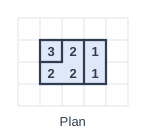
Drawings of a solid made from cubes, on squared paper. Cubes in each stack, as seen from above (back row first, each row left to right): [3, 2, 1], [2, 2, 1]. They are its plan, drawn on squared paper. Plan (looking down, back row at the top): ■■■ / ■■■, 6 squares, each square showing the number of cubes in its stack.

Model answer

\(3 + 2 + 1 + 2 + 2 + 1 = 11\) cubes

Explanation

Each square of the plan is the top of one stack, and the number tells you how many cubes are in that stack. Add up all the numbers. Counting the squares only gives the number of stacks.

Mark scheme
  1. 1 mark

    B1 for 11

    6 (the number of squares in the plan) scores 0.
Question 2

2 marks

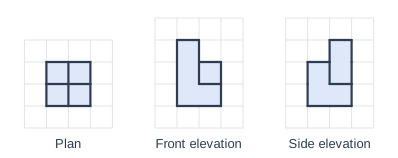
The diagram shows the plan, the front elevation and the side elevation of a solid made from cubes.

Write down the number of stacks of cubes in the solid.
Write down the number of cubes in the tallest stack.

Drawings of a solid made from cubes, on squared paper. Cubes in each stack, as seen from above (back row first, each row left to right): [1, 2], [3, 1]. They are its plan, front elevation and side elevation, drawn on squared paper. Plan (looking down, back row at the top): ■■ / ■■, 4 squares. Front elevation (seen from the front): columns of 3 and 2 squares from left to right (5 squares). Side elevation (seen from the right-hand side, so the back of the solid is on the left): columns of 2 and 3 squares from left to right (5 squares).

Model answer

The plan has 4 squares, so there are 4 stacks.
The tallest column in the front elevation is 3 squares high, so the tallest stack has 3 cubes.

Explanation

The plan shows one square for each stack, seen from above. The elevations show how high the stacks are, so the tallest column in either elevation gives the height of the tallest stack.

Mark scheme
  1. 1 mark

    B1 for 4 (stacks)

    The number of squares in the plan; correct answer with no working scores full marks

  2. 1 mark

    B1 for 3 (cubes)

    The tallest column of the front (or side) elevation.

Question 3

3 marks

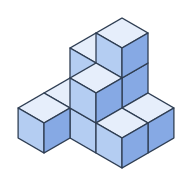
The diagram shows a solid made from cubes.
There are no hidden gaps in the solid.
The stacks in the back row have 2, 3 and 1 cubes, the middle row 1, 2 and 1 cubes, and the front row has one stack of 1 cube.

Each cube has a mass of 38.5 g.

Work out the mass of the solid.
Give your answer in kilograms.

A solid made from cubes, drawn on isometric paper: 3 cubes wide, 3 deep and up to 3 high, standing on a flat base (every stack goes down to the base).

Model answer

Number of cubes = \(2 + 3 + 1 + 1 + 2 + 1 + 1 = 11\)
Mass = \(11 \times 38.5 = 423.5\) g
\(423.5 \div 1000 = 0.4235\) kg

Explanation

Count the cubes stack by stack, including any you cannot see under the top cubes. Multiply by the mass of one cube, then divide by 1000 to change grams to kilograms.

Mark scheme
  1. 1 mark

    B1 for 11 (cubes)

    correct answer with no working scores full marks

  2. 1 mark

    M1 for their 11 × 38.5 or 423.5

  3. 1 mark

    A1 for 0.4235 (kg)

    Exact values from the question; the answer is exactly 0.4235. 423.5 as the final answer (not in kilograms) scores B1 M1 A0. FT their mass in grams ÷ 1000 for A1 if their number of cubes is from a clear count.

Question 4

4 marks

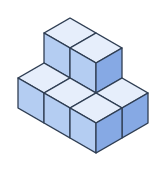
The diagram shows a stage built from 8 cube-shaped blocks.
Each block has edges of length 0.5 m.
The back row has stacks of 2, 2 and 1 blocks, and the front row has three stacks of 1 block. There are no gaps.

All the outside faces of the stage are painted, except the base, which is on the floor.
Paint costs £4.80 per square metre.

Work out the cost of the paint needed.

A solid made from cubes, drawn on isometric paper: 3 cubes wide, 2 deep and up to 2 high, standing on a flat base (every stack goes down to the base). Cubes in each stack, as seen from above (back row first, each row left to right): [2, 2, 1], [1, 1, 1].

Model answer

Faces seen from above: 6
Front: \(1 + 1 + 1\) from the front row and \(1 + 1 + 0\) of the back row above it = 5
Back: \(2 + 2 + 1 = 5\)
Left side: 3 and right side: 3
Total painted faces = \(6 + 5 + 5 + 3 + 3 = 22\)
Area of one face = \(0.5 \times 0.5 = 0.25\) m²
Area painted = \(22 \times 0.25 = 5.5\) m²
Cost = \(5.5 \times 4.80 = £26.40\)

Explanation

Count the visible block faces from each direction: from above (one per stack), the front, the back, and the two sides, leaving out the base. Each face is a 0.5 m by 0.5 m square, so its area is 0.25 m², not 0.5 m². Then multiply the total area by the cost per square metre.

Mark scheme
  1. 1 mark

    B1 for 22 (block faces painted)

    Accept 28 − 6. 28 (base included) scores B0 but the M marks can still be earned; correct answer with no working scores full marks

  2. 1 mark

    M1 for their 22 × 0.5 × 0.5 or their 22 × 0.25 or 5.5

    Area of one block face is 0.25 m².

  3. 1 mark

    M1 for their 5.5 × 4.80

  4. 1 mark

    A1 for £26.40

    Exact values from the question; the answer is exactly 26.4. Accept £26.4. 33.60 (from 28 faces) scores B0 M1 M1 A0. 52.80 (using 0.5 instead of 0.25 for the area of a face) scores B1 M0 M1 A0.

Ready to try the rest? Every answer you write is marked against the mark scheme, so you can see exactly where the marks are.

Study Helper Hints first, answers after you try

Stuck on this one? Ask for a hint and I’ll point you in the right direction, without giving the answer away. Once you’ve checked your answer, I’ll show you how the marks are awarded.