
Level:
Correct: 0
Incorrect: 0
Marks: 0/0
Exam Practice
Course:
Topics:
OCR GCSE Maths (Foundation calculator) Smart practice A mixed round aimed at your weak spots
Unit 1
Number Operations and Integers
Unit 2
Fractions, Decimals and Percentages
Unit 3
Indices and Surds
Unit 4
Approximation and Estimation
Unit 5
Ratio, Proportion and Rates of Change
Unit 6
Algebra
Unit 7
Graphs of Equations and Functions
Unit 8
Basic Geometry
Unit 9
Congruence and Similarity
Unit 10
Mensuration
Unit 11
Probability
Unit 12
Statistics
Avg
score:
–
Topics
done:
0/100

Rotations

Practise 12 exam-style questions on Rotations for OCR GCSE Maths (Foundation calculator). Write your answer as you would in the exam and get it marked in seconds against the mark scheme, point by point, with the Study Helper on hand if you get stuck.

  • 12 questions
  • 1–4 marks each
  • Instant marking
  • No sign-up needed
12 questions, marked as you go

Sample questions with model answers

Here are 4 of the questions in this topic, each with a model answer, an explanation of why it earns the marks and the mark scheme an examiner would use.

Question 1

1 mark

The arrow on a weather vane is pointing north-east.

The arrow turns through 270° clockwise.

In which direction is the arrow pointing now?

Model answer

Each quarter turn clockwise is 90°: north-east \(\rightarrow\) south-east \(\rightarrow\) south-west \(\rightarrow\) north-west.
270° is three quarter turns.
North-west

Explanation

270° is three quarter turns, and turning 270° clockwise ends in the same place as turning 90° anticlockwise. Step round the compass one quarter turn at a time in the clockwise direction (N, E, S, W order). A common error is to turn the wrong way and get south-east.

Mark scheme
  1. 1 mark

    B1 for north-west

    Accept NW. South-east (from turning 270° anticlockwise) and south-west (from turning 180°) score 0.
Question 2

2 marks

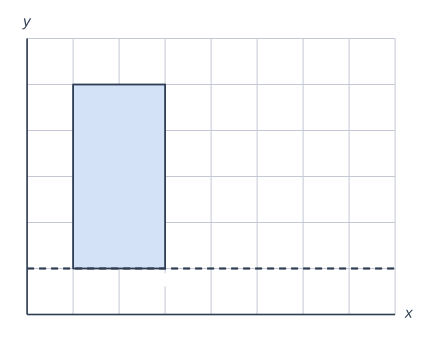
The diagram shows the side view of a crate standing on a floor.
One unit on the grid represents 1 metre.

The crate tips over by rotating 90° clockwise about its corner P\((3, 1)\).

Write down the coordinates of the other three corners of the crate after it has tipped over.

A coordinate grid with x from 0 to 8 and y from 0 to 6; each grid square is 1 unit across, and the axes cross at the origin O. A shaded quadrilateral with vertices (1, 1), P(3, 1), (3, 5) and (1, 5). The line labelled "floor" is a horizontal straight line crossing the y-axis at (0, 1) (the line y = 1).

Model answer

P stays where it is, at \((3, 1)\).
The side from P to \((3, 5)\) points up 4 m; after a quarter turn clockwise it points 4 m to the right: \((7, 1)\).
The side from P to \((1, 1)\) points 2 m to the left; after a quarter turn clockwise it points 2 m up: \((3, 3)\).
The last corner \((1, 5)\) is 2 m left and 4 m up from P; it moves to 4 m right and 2 m up: \((7, 3)\).
Corners: \((3, 3)\), \((7, 1)\), \((7, 3)\)

Explanation

The centre of rotation, P, does not move. Rotate each side that starts at P through a quarter turn clockwise: up becomes right, and left becomes up. The crate ends up lying on its side along the floor, 4 m long and 2 m high. Turning the wrong way would put the crate under the floor.

Mark scheme
  1. 2 marks

    B2 for \((3, 3)\), \((7, 1)\) and \((7, 3)\)

    In any order. Condone missing brackets. Ignore \((3, 1)\) if it is also listed.
    B1 for two correct corners.
    An anticlockwise rotation, giving \((3, -1)\), \((-1, 1)\), \((-1, -1)\), scores 0.

Question 3

2 marks

The point \((5, 2)\) is rotated 90° anticlockwise about the point \((1, 1)\).

Show that the image of the point lies on the y-axis.

Model answer

From the centre \((1, 1)\), the point \((5, 2)\) is 4 units right and 1 unit up.
After a quarter turn anticlockwise, 'right' becomes 'up' and 'up' becomes 'left'.
So the image is 4 units up and 1 unit left of \((1, 1)\): \((1 - 1, 1 + 4) = (0, 5)\).
The x-coordinate is 0, so the image lies on the y-axis.

Explanation

When the centre is not the origin, work from the centre: describe how to get from the centre to the point, then turn those moves through a quarter turn. The y-axis is the line x = 0, so any point with x-coordinate 0 lies on it. A common error is to rotate about the origin instead of (1, 1).

Mark scheme
  1. 1 mark

    M1 for a correct method, e.g. '\((5, 2)\) is 4 right and 1 up from \((1, 1)\), so its image is 1 left and 4 up from \((1, 1)\)'

    Accept a clear description of a correct grid method or a correctly described sketch.

  2. 1 mark

    A1 for image \((0, 5)\) and a statement that its x-coordinate is 0, so it is on the y-axis

    \((0, 5)\) stated with no method scores M0 A0. A clockwise rotation gives \((2, -3)\): M0 A0.

Question 4

4 marks

O is the origin and P is the point \((6, 2.5)\).

P is rotated 90° anticlockwise about O to give the point Q.

Work out the area of triangle OPQ.

Model answer

A rotation of 90° anticlockwise about O maps \((a, b)\) to \((-b, a)\), so Q is \((-2.5, 6)\).
OP \(= \sqrt{6^2 + 2.5^2} = \sqrt{42.25} = 6.5\)
A rotation does not change lengths, so OQ \(= 6.5\).
Angle POQ is the angle of rotation, 90°.
Area \(= \dfrac{1}{2} \times 6.5 \times 6.5 = 21.125\) units\(^2\)

Explanation

A point and its image are the same distance from the centre of rotation, and the angle between them at the centre is the angle of rotation. So triangle OPQ is right-angled at O with two equal sides of 6.5, found by Pythagoras. A common error is to use 6 and 2.5 as the base and height.

Mark scheme
  1. 1 mark

    B1 for Q at \((-2.5, 6)\)

    Condone missing brackets. May be seen on a sketch; correct answer with no working scores full marks

  2. 1 mark

    M1 for \(\sqrt{6^2 + 2.5^2}\) oe

    Implied by 6.5 or 42.25 as OP or \(OP^2\).

  3. 1 mark

    M1 for \(\dfrac{1}{2} \times\) their 6.5 \(\times\) their 6.5, using angle POQ \(= 90^\circ\) and OQ \(=\) OP

    Alternative method for both M marks: M2 for a complete box method, e.g. \(8.5 \times 6 - 7.5 - 7.5 - \dfrac{1}{2} \times 8.5 \times 3.5\), FT their Q; M1 for the rectangle \(8.5 \times 6 = 51\) and at least one correct triangle.

  4. 1 mark

    A1 for 21.125 (units\(^2\))

    Exact value. Accept 21.1 or 21.13 if 21.125 is seen. A correct answer with no working scores 4.

Ready to try the rest? Every answer you write is marked against the mark scheme, so you can see exactly where the marks are.

Study Helper Hints first, answers after you try

Stuck on this one? Ask for a hint and I’ll point you in the right direction, without giving the answer away. Once you’ve checked your answer, I’ll show you how the marks are awarded.