
Level:
Correct: 0
Incorrect: 0
Marks: 0/0
Exam Practice
Course:
Topics:
OCR GCSE Maths (Foundation calculator) Smart practice A mixed round aimed at your weak spots
Unit 1
Number Operations and Integers
Unit 2
Fractions, Decimals and Percentages
Unit 3
Indices and Surds
Unit 4
Approximation and Estimation
Unit 5
Ratio, Proportion and Rates of Change
Unit 6
Algebra
Unit 7
Graphs of Equations and Functions
Unit 8
Basic Geometry
Unit 9
Congruence and Similarity
Unit 10
Mensuration
Unit 11
Probability
Unit 12
Statistics
Avg
score:
–
Topics
done:
0/100

Averages and measures of spread

Practise 18 exam-style questions on Averages and measures of spread for OCR GCSE Maths (Foundation calculator). Write your answer as you would in the exam and get it marked in seconds against the mark scheme, point by point, with the Study Helper on hand if you get stuck.

  • 18 questions
  • 1–5 marks each
  • Instant marking
  • No sign-up needed
18 questions, marked as you go

Sample questions with model answers

Here are 4 of the questions in this topic, each with a model answer, an explanation of why it earns the marks and the mark scheme an examiner would use.

Question 1

1 mark

Here are the numbers of minutes late that 12 trains arrived at a station.

0   3   5   2   0   7   3   1   4   3   0   6

This data has two modes.

Write down the two modes.

Model answer

0 appears 3 times and 3 appears 3 times.
No other value appears more than once.
The modes are 0 and 3.

Explanation

A mode is a value that appears most often. Here 0 and 3 both appear three times, so the data has two modes (it is bimodal). Remember that 0 is a value like any other and can be a mode.

Mark scheme
  1. 1 mark

    B1 for 0 and 3

    Both needed. Do not accept 3 alone or 0 alone, or 3 (as the frequency of each mode) for the value 0.
Question 2

2 marks

Lily plays 5 games.
The mean of her scores is 18.

Lily says,

'So I must have scored exactly 18 in at least one game.'

Is Lily correct?
Give an example to support your answer.

Model answer

No.
For example, scores of 10, 15, 20, 22 and 23 have a total of 90.
Mean = \(90 \div 5 = 18\), but none of the scores is 18.

Explanation

A mean of 18 from 5 games only tells you that the total is 5 × 18 = 90. Many sets of scores add up to 90 without any of them being 18, so the mean does not have to be one of the data values. This is different from the mode, which is always one of the values.

Mark scheme
  1. 1 mark

    B1 for No

  2. 1 mark

    B1 for five scores with a total of 90 and none equal to 18 oe

    e.g. 10, 15, 20, 22, 23 or 16, 17, 19, 19, 19. The example must have a mean of 18. Accept an explanation such as 'the mean does not have to be one of the values, e.g. 17 + 17 + 17 + 19 + 20 = 90'. An example that does not have a total of 90 scores B0.

Question 3

2 marks

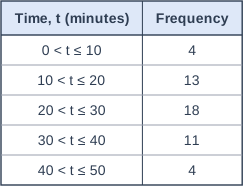
The table shows information about the times, t minutes, that 50 students took to complete a puzzle.

Ella says,

'The range of the times could be 35 minutes.'

Could Ella be correct?
Give a reason for your answer.

Table with columns "Time, t (minutes)", "Frequency". Time, t (minutes): 0 < t ≤ 10; Frequency: 4 | Time, t (minutes): 10 < t ≤ 20; Frequency: 13 | Time, t (minutes): 20 < t ≤ 30; Frequency: 18 | Time, t (minutes): 30 < t ≤ 40; Frequency: 11 | Time, t (minutes): 40 < t ≤ 50; Frequency: 4.

Model answer

Yes.
The shortest time is in the class 0 < t ≤ 10 and the longest time is in the class 40 < t ≤ 50.
The range is more than 30 minutes and less than 50 minutes, so it could be 35 minutes.
For example, a shortest time of 8 minutes and a longest time of 43 minutes give a range of 35 minutes.

Explanation

Grouped data does not show the exact values, so the range can only be estimated. The smallest value lies in the first class and the largest in the last class, which gives the smallest and largest possible ranges. 35 minutes lies between these, so Ella could be correct.

Mark scheme
  1. 1 mark

    B1 for Yes

  2. 1 mark

    B1 for the shortest time is between 0 and 10 minutes and the longest is between 40 and 50 minutes, so the range is between 30 and 50 minutes oe

    Accept a correct example, e.g. 'shortest 8 minutes and longest 43 minutes gives a range of 35'. 'Yes, because we do not know the exact times' alone scores B0 for this mark.

Question 4

3 marks

A teacher works out that the mean mark of 25 students in a test is 62.4.

Two more students then take the same test.
Their marks are 81 and 47.

Work out the mean mark of all 27 students.
Give your answer correct to 1 decimal place.

Model answer

Total of the first 25 marks = \(25 \times 62.4 = 1560\)
Total of all 27 marks = 1560 + 81 + 47 = 1688
Mean = \(1688 \div 27 = 62.518...\)
Mean = 62.5 to 1 decimal place

Explanation

You cannot average the old mean with the two new marks, because the old mean stands for 25 students. Work out the total of the 25 marks first, add the two new marks and divide by the new number of students, 27.

Mark scheme
  1. 1 mark

    M1 for \(25 \times 62.4\)

    Implied by 1560. Exact values from the question; correct answer with no working scores full marks

  2. 1 mark

    M1 for (their 1560 + 81 + 47) \(\div 27\)

    Implied by 1688 ÷ 27.

  3. 1 mark

    A1 for 62.5

    Accept 62.5 to 62.52 (calculator value 62.518...). 63.5 (from \((62.4 + 81 + 47) \div 3\)) scores M0 M0 A0.

Ready to try the rest? Every answer you write is marked against the mark scheme, so you can see exactly where the marks are.

Study Helper Hints first, answers after you try

Stuck on this one? Ask for a hint and I’ll point you in the right direction, without giving the answer away. Once you’ve checked your answer, I’ll show you how the marks are awarded.