
Level:
Correct: 0
Incorrect: 0
Marks: 0/0
Exam Practice
Course:
Topics:
OCR GCSE Maths (Foundation calculator) Smart practice A mixed round aimed at your weak spots
Unit 1
Number Operations and Integers
Unit 2
Fractions, Decimals and Percentages
Unit 3
Indices and Surds
Unit 4
Approximation and Estimation
Unit 5
Ratio, Proportion and Rates of Change
Unit 6
Algebra
Unit 7
Graphs of Equations and Functions
Unit 8
Basic Geometry
Unit 9
Congruence and Similarity
Unit 10
Mensuration
Unit 11
Probability
Unit 12
Statistics
Avg
score:
–
Topics
done:
0/100

Fractions of an amount

Practise 15 exam-style questions on Fractions of an amount for OCR GCSE Maths (Foundation calculator). Write your answer as you would in the exam and get it marked in seconds against the mark scheme, point by point, with the Study Helper on hand if you get stuck.

  • 15 questions
  • 1–4 marks each
  • Instant marking
  • No sign-up needed
15 questions, marked as you go

Sample questions with model answers

Here are 4 of the questions in this topic, each with a model answer, an explanation of why it earns the marks and the mark scheme an examiner would use.

Question 1

1 mark

Work out \(\dfrac{9}{4}\) of 38 kg.

Model answer

\(\dfrac{9}{4} \times 38 = 38 \div 4 \times 9 = 9.5 \times 9 = 85.5\) kg

Explanation

Finding \(\dfrac{9}{4}\) of an amount works in the same way as for any fraction: divide by 4, then multiply by 9. Because \(\dfrac{9}{4}\) is greater than 1, the answer is bigger than 38 kg (it is \(2\dfrac{1}{4}\) times as much). Expecting a fraction of an amount always to be smaller is a common mistake.

Mark scheme
  1. 1 mark

    B1 for 85.5 kg

    Accept \(85\dfrac{1}{2}\) kg or \(\dfrac{171}{2}\) kg. Exact values from the question. 16.88... (\(\dfrac{4}{9}\) of 38) scores 0.
Question 2

2 marks

Write 750 m as a fraction of 2.4 km.
Give your answer in its simplest form.

Model answer

2.4 km = 2400 m
\(\dfrac{750}{2400}\)
Divide the top and bottom by 150: \(\dfrac{750}{2400} = \dfrac{5}{16}\)

Explanation

Both quantities must be in the same units before you write one as a fraction of the other, so change 2.4 km to 2400 m. The quantity named first (750 m) goes on top. Then simplify, for example with the calculator's fraction key; the highest common factor of 750 and 2400 is 150.

Mark scheme
  1. 1 mark

    M1 for \(\dfrac{750}{2400}\) oe

    Both lengths in the same units, e.g. \(\dfrac{0.75}{2.4}\) or \(\dfrac{75}{240}\). \(750 \div 2.4 = 312.5\) (units not matched) scores M0; correct answer with no working scores full marks

  2. 1 mark

    A1 for \(\dfrac{5}{16}\) cao

    Correct answer with no working scores 2 marks. 0.3125 scores M1 A0. \(\dfrac{16}{5}\) (fraction upside down) scores M1 A0 only if \(\dfrac{750}{2400}\) is seen.

Question 3

2 marks

There are 186 students in a year group.
113 of these students walk to school.

Tara says,

"More than \(\dfrac{3}{5}\) of the students in the year group walk to school."

Is Tara correct?
Show how you decide.

Model answer

\(\dfrac{3}{5}\) of 186 = \(186 \div 5 \times 3 = 111.6\)
113 students walk, and 113 is more than 111.6.
Yes, Tara is correct.

Explanation

Either work out \(\dfrac{3}{5}\) of the year group (111.6 students) and compare it with 113, or write 113 as a fraction of 186 and change both fractions to decimals: 0.607... is more than 0.6. The two values are close, so do not round too early: 0.607 rounded to 1 decimal place is 0.6, which would hide the difference.

Mark scheme
  1. 1 mark

    M1 for \(\dfrac{3}{5} \times 186\) or \(\dfrac{113}{186}\)

    Implied by 111.6 or 0.607... or 0.61 or 60.7% seen. Or for \(\dfrac{3}{5}\) and \(\dfrac{113}{186}\) written over a common denominator, e.g. \(\dfrac{558}{930}\) and \(\dfrac{565}{930}\).

  2. 1 mark

    A1 for Yes, with a correct comparison

    e.g. 'Yes, 113 is more than 111.6' or 'Yes, \(\dfrac{113}{186}\) = 0.607... which is more than 0.6'. 'Yes' with no correct supporting value scores 0. Do not accept a comparison using 0.6 rounded from 0.607 (it then looks equal).

Question 4

4 marks

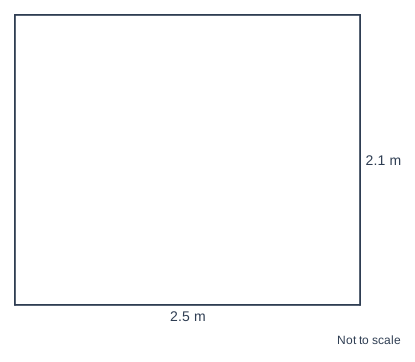
The diagram shows a rectangular wall in Kofi's bathroom.
\(\dfrac{3}{5}\) of the area of the wall is to be covered with tiles.

Tiles are sold in boxes.
The tiles in one box cover 0.9 m².
Each box costs £18.50.

Work out the cost of the boxes of tiles Kofi needs to buy.

Geometry diagram, marked "Not to scale". A rectangle (its vertices are not labelled). The unlabelled side going to the right is labelled 2.5 m. The unlabelled side going upwards is labelled 2.1 m.

Model answer

Area of wall = \(2.5 \times 2.1 = 5.25\) m²
Area to tile = \(\dfrac{3}{5} \times 5.25 = 3.15\) m²
Boxes needed = \(3.15 \div 0.9 = 3.5\), so Kofi must buy 4 boxes.
Cost = \(4 \times 18.50\) = £74.00

Explanation

Find the area of the wall, then \(\dfrac{3}{5}\) of it. Divide by the area one box covers: 3.5 boxes are needed, but boxes are sold whole, so Kofi must round up to 4 boxes. Paying for 3.5 boxes (£64.75) or rounding down to 3 boxes is wrong, because 3 boxes cover only 2.7 m².

Mark scheme
  1. 1 mark

    M1 for \(2.5 \times 2.1\)

    Implied by 5.25 (m²) seen. Exact values from the question; correct answer with no working scores full marks

  2. 1 mark

    M1 for \(\dfrac{3}{5}\) × their 5.25

    Implied by 3.15 (m²) seen.

  3. 1 mark

    M1 for their \(3.15 \div 0.9\)

    Implied by 3.5 seen, or by 4 boxes. Or for repeated addition of 0.9 reaching at least 3.15 (e.g. 4 boxes cover 3.6 m²).

  4. 1 mark

    A1 for £74 or £74.00

    Must come from buying 4 whole boxes. Correct answer with no working scores 4 marks. £64.75 (3.5 boxes) scores M3 A0. £55.50 (3 boxes) scores M3 A0. £111 (6 boxes for the whole wall) or £107.92 (5.83... boxes for the whole wall) scores M1 M0 M1 A0.

Ready to try the rest? Every answer you write is marked against the mark scheme, so you can see exactly where the marks are.

Study Helper Hints first, answers after you try

Stuck on this one? Ask for a hint and I’ll point you in the right direction, without giving the answer away. Once you’ve checked your answer, I’ll show you how the marks are awarded.